

the same efficiency (Fig. 16.38). Biodegradation starts by
n-alkane attack, followed successively by that of branched
alkanes, low molecular weight aromatic compounds, acyclic
alkanes, high molecular weight aromatic compounds, and
cycloalkanes (steranes, hopanes) (van Hamme et al. 2003).
Finally, hydrocarbonoclastic prokaryotes generally have
a specific degradation capacity: they biodegrade either
n-alkanes or aromatic compounds. However, some biodegrade both saturated and aromatic compounds (White et al.
1997; Tapilatu et al. 2010).
Box 16.5 (continued)
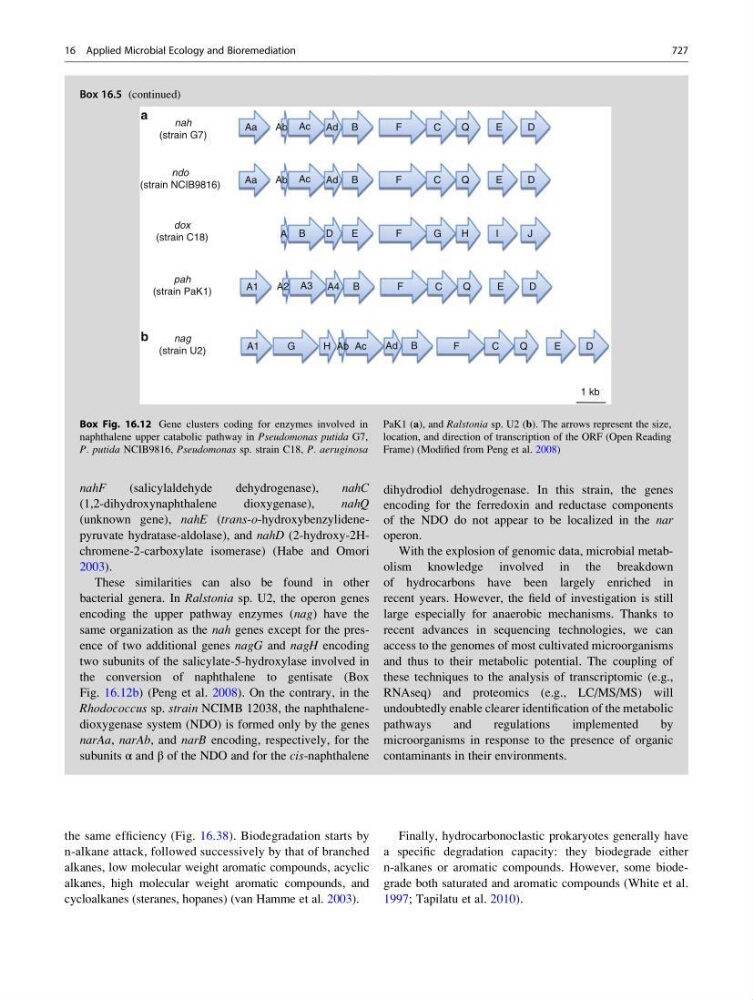
nahF
(salicylaldehyde
dehydrogenase),
nahC
(1,2-dihydroxynaphthalene
dioxygenase),
nahQ
(unknown gene), nahE (trans-o-hydroxybenzylidenepyruvate hydratase-aldolase), and nahD (2-hydroxy-2Hchromene-2-carboxylate isomerase) (Habe and Omori
2003).
These similarities can also be found in other
bacterial genera. In Ralstonia sp. U2, the operon genes
encoding the upper pathway enzymes (nag) have the
same organization as the nah genes except for the presence of two additional genes nagG and nagH encoding
two subunits of the salicylate-5-hydroxylase involved in
the conversion of naphthalene to gentisate (Box
Fig. 16.12b) (Peng et al. 2008). On the contrary, in the
Rhodococcus sp. strain NCIMB 12038, the naphthalenedioxygenase system (NDO) is formed only by the genes
narAa, narAb, and narB encoding, respectively, for the
subunits α and β of the NDO and for the cis-naphthalene
(continued)
Box 16.5 (continued)
dihydrodiol dehydrogenase. In this strain, the genes
encoding for the ferredoxin and reductase components
of the NDO do not appear to be localized in the nar
operon.
With the explosion of genomic data, microbial metabolism knowledge involved in the breakdown
of hydrocarbons have been largely enriched in
recent years. However, the field of investigation is still
large especially for anaerobic mechanisms. Thanks to
recent advances in sequencing technologies, we can
access to the genomes of most cultivated microorganisms
and thus to their metabolic potential. The coupling of
these techniques to the analysis of transcriptomic (e.g.,
RNAseq) and proteomics (e.g., LC/MS/MS) will
undoubtedly enable clearer identification of the metabolic
pathways
and
regulations
implemented
by
microorganisms in response to the presence of organic
contaminants in their environments.
Aa
nah
(strain G7)
1 kb
ndo
(strain NCIB9816)
dox
(strain C18)
pah
(strain PaK1)
nag
(strain U2)
Ac
Ad B
Ab
F
C
Q
E
D
Ac
Ad B
Ab
F
C
Q
E
D
Aa
B
D
E
F
G
H
I
J
A
A3 A4 B
A2
F
C
Q
E
D
A1
G
H Ab
F
C
Q
E
D
A1
Ac
B
Ad
a
b
Box Fig. 16.12 Gene clusters coding for enzymes involved in
naphthalene upper catabolic pathway in Pseudomonas putida G7,
P. putida NCIB9816, Pseudomonas sp. strain C18, P. aeruginosa
PaK1 (a), and Ralstonia sp. U2 (b). The arrows represent the size,
location, and direction of transcription of the ORF (Open Reading
Frame) (Modified from Peng et al. 2008)
16 Applied Microbial Ecology and Bioremediation
727