

Box 16.5 (continued)
there may be some genetic variability (e.g., isoenzyme,
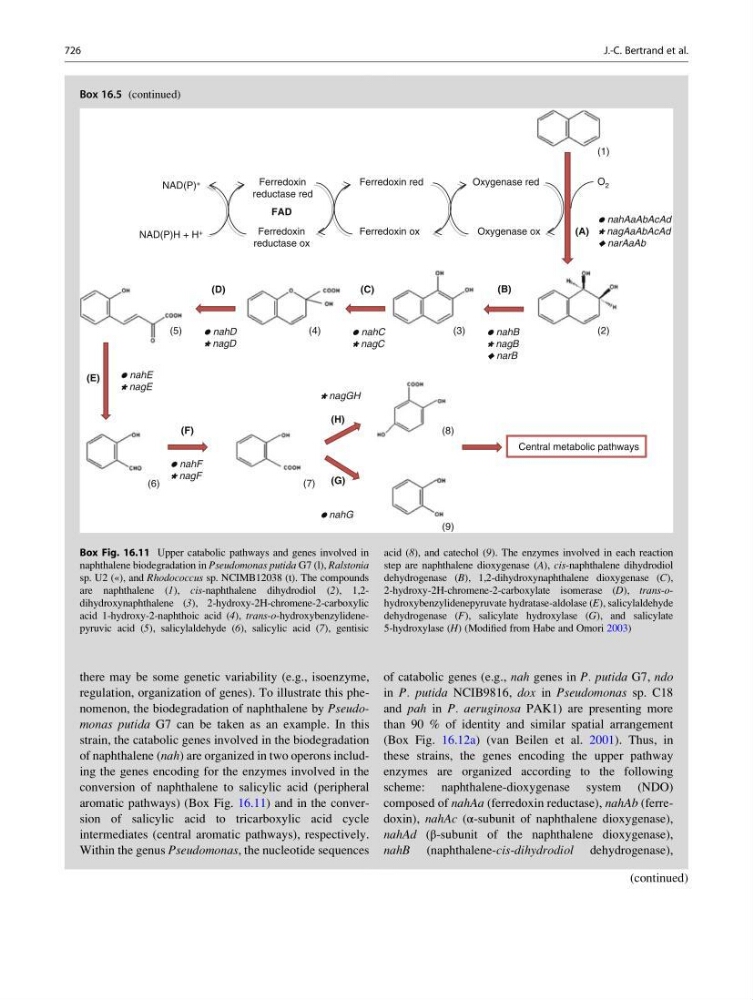
regulation, organization of genes). To illustrate this phenomenon, the biodegradation of naphthalene by Pseudomonas putida G7 can be taken as an example. In this
strain, the catabolic genes involved in the biodegradation
of naphthalene (nah) are organized in two operons including the genes encoding for the enzymes involved in the
conversion of naphthalene to salicylic acid (peripheral
aromatic pathways) (Box Fig. 16.11) and in the conversion of salicylic acid to tricarboxylic acid cycle
intermediates (central aromatic pathways), respectively.
Within the genus Pseudomonas, the nucleotide sequences
(continued)
Box 16.5 (continued)
of catabolic genes (e.g., nah genes in P. putida G7, ndo
in P. putida NCIB9816, dox in Pseudomonas sp. C18
and pah in P. aeruginosa PAK1) are presenting more
than 90 % of identity and similar spatial arrangement
(Box Fig. 16.12a) (van Beilen et al. 2001). Thus, in
these strains, the genes encoding the upper pathway
enzymes are organized according to the following
scheme: naphthalene-dioxygenase system (NDO)
composed of nahAa (ferredoxin reductase), nahAb (ferredoxin), nahAc (α-subunit of naphthalene dioxygenase),
nahAd (β-subunit of the naphthalene dioxygenase),
nahB (naphthalene-cis-dihydrodiol dehydrogenase),
(continued)
(1)
(2)
(3)
(4)
(5)
(6)
(7)
(8)
(9)
nahAaAbAcAd
nagAaAbAcAd
narAaAb
nahB
nagB
narB
nahC
nagC
nahD
nagD
nahE
nagE
nahF
nagF
nahG
(A)
(B)
(C)
(D)
(E)
(F)
(G)
(H)
nagGH
Oxygenase red
Oxygenase ox
Ferredoxin red
Ferredoxin ox
Ferredoxin
reductase red
Ferredoxin
reductase ox
NAD(P) +
NAD(P)H + H +
Central metabolic pathways
FAD
O 2
Box Fig. 16.11 Upper catabolic pathways and genes involved in
naphthalene biodegradation in Pseudomonas putida G7 (l), Ralstonia
sp. U2 («), and Rhodococcus sp. NCIMB12038 (t). The compounds
are naphthalene (1), cis-naphthalene dihydrodiol (2), 1,2dihydroxynaphthalene (3), 2-hydroxy-2H-chromene-2-carboxylic
acid 1-hydroxy-2-naphthoic acid (4), trans-o-hydroxybenzylidenepyruvic acid (5), salicylaldehyde (6), salicylic acid (7), gentisic
acid (8), and catechol (9). The enzymes involved in each reaction
step are naphthalene dioxygenase (A), cis-naphthalene dihydrodiol
dehydrogenase (B), 1,2-dihydroxynaphthalene dioxygenase (C),
2-hydroxy-2H-chromene-2-carboxylate isomerase (D), trans-ohydroxybenzylidenepyruvate hydratase-aldolase (E), salicylaldehyde
dehydrogenase (F), salicylate hydroxylase (G), and salicylate
5-hydroxylase (H) (Modified from Habe and Omori 2003)
726
J.-C. Bertrand et al.