

NADH + H
+
NAD
+
Rubredoxin
reductase
(FAD)
Rubredoxin
reductase
(FADH)
Reduced
Rubredoxin
(Fe
2+
)
Oxidized
rubredoxin
(Fe
3+
)
Oxidized
Reduced
R
CH 2 OH
R
CH 3
R=CH 3 -(CH 2 ) n -
O 2
H 2 O
R-CHO
Hydroxylase
Alcohol
dehydrogenase
R-COOH
NADH +
NAD
+
H 2 O NAD
+
H
+
Aldehyde
dehydrogenase
NADH + H
+
ATP
AMP + PP
Beta-oxidation
coA
Acetyl-coA
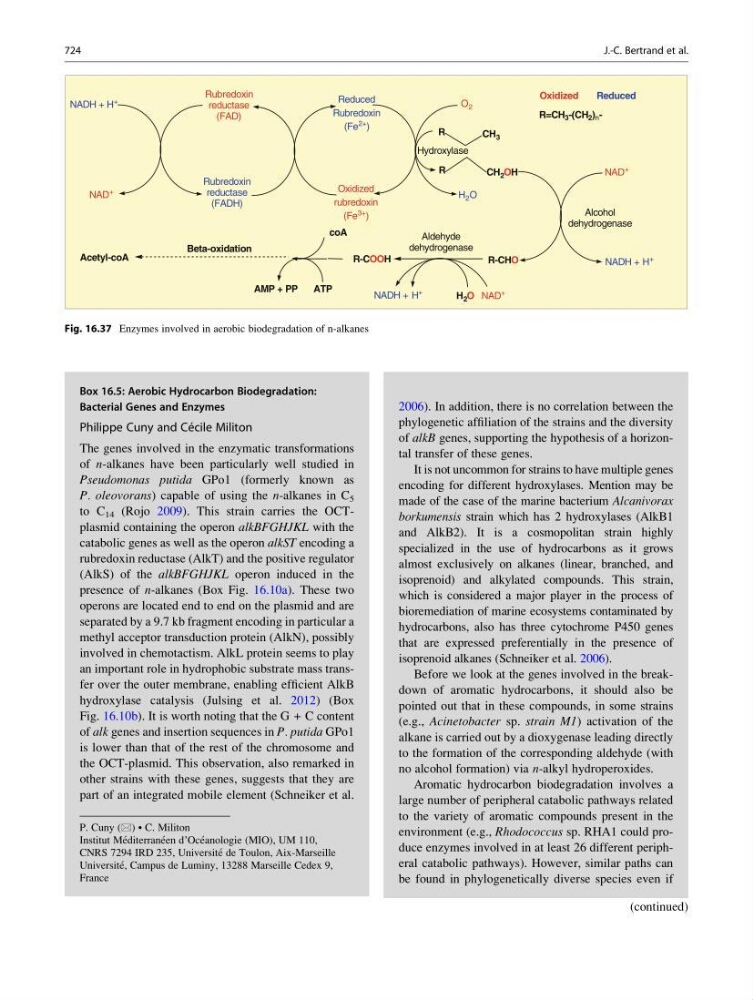
Fig. 16.37 Enzymes involved in aerobic biodegradation of n-alkanes
Box 16.5: Aerobic Hydrocarbon Biodegradation:
Bacterial Genes and Enzymes
Philippe Cuny and Ce ´cile Militon
The genes involved in the enzymatic transformations
of n-alkanes have been particularly well studied in
Pseudomonas putida GPo1 (formerly known as
P. oleovorans) capable of using the n-alkanes in C 5
to C 14 (Rojo 2009). This strain carries the OCTplasmid containing the operon alkBFGHJKL with the
catabolic genes as well as the operon alkST encoding a
rubredoxin reductase (AlkT) and the positive regulator
(AlkS) of the alkBFGHJKL operon induced in the
presence of n-alkanes (Box Fig. 16.10a). These two
operons are located end to end on the plasmid and are
separated by a 9.7 kb fragment encoding in particular a
methyl acceptor transduction protein (AlkN), possibly
involved in chemotactism. AlkL protein seems to play
an important role in hydrophobic substrate mass transfer over the outer membrane, enabling efficient AlkB
hydroxylase catalysis (Julsing et al. 2012) (Box
Fig. 16.10b). It is worth noting that the G + C content
of alk genes and insertion sequences in P. putida GPo1
is lower than that of the rest of the chromosome and
the OCT-plasmid. This observation, also remarked in
other strains with these genes, suggests that they are
part of an integrated mobile element (Schneiker et al.
P. Cuny (*) C. Militon
Institut Me ´diterrane ´en d’Oce ´anologie (MIO), UM 110,
CNRS 7294 IRD 235, Universite ´ de Toulon, Aix-Marseille
Universite ´, Campus de Luminy, 13288 Marseille Cedex 9,
France
(continued)
Box 16.5 (continued)
2006). In addition, there is no correlation between the
phylogenetic affiliation of the strains and the diversity
of alkB genes, supporting the hypothesis of a horizontal transfer of these genes.
It is not uncommon for strains to have multiple genes
encoding for different hydroxylases. Mention may be
made of the case of the marine bacterium Alcanivorax
borkumensis strain which has 2 hydroxylases (AlkB1
and AlkB2). It is a cosmopolitan strain highly
specialized in the use of hydrocarbons as it grows
almost exclusively on alkanes (linear, branched, and
isoprenoid) and alkylated compounds. This strain,
which is considered a major player in the process of
bioremediation of marine ecosystems contaminated by
hydrocarbons, also has three cytochrome P450 genes
that are expressed preferentially in the presence of
isoprenoid alkanes (Schneiker et al. 2006).
Before we look at the genes involved in the breakdown of aromatic hydrocarbons, it should also be
pointed out that in these compounds, in some strains
(e.g., Acinetobacter sp. strain M1) activation of the
alkane is carried out by a dioxygenase leading directly
to the formation of the corresponding aldehyde (with
no alcohol formation) via n-alkyl hydroperoxides.
Aromatic hydrocarbon biodegradation involves a
large number of peripheral catabolic pathways related
to the variety of aromatic compounds present in the
environment (e.g., Rhodococcus sp. RHA1 could produce enzymes involved in at least 26 different peripheral catabolic pathways). However, similar paths can
be found in phylogenetically diverse species even if
(continued)
724
J.-C. Bertrand et al.
+
NAD
+
Rubredoxin
reductase
(FAD)
Rubredoxin
reductase
(FADH)
Reduced
Rubredoxin
(Fe
2+
)
Oxidized
rubredoxin
(Fe
3+
)
Oxidized
Reduced
R
CH 2 OH
R
CH 3
R=CH 3 -(CH 2 ) n -
O 2
H 2 O
R-CHO
Hydroxylase
Alcohol
dehydrogenase
R-COOH
NADH +
NAD
+
H 2 O NAD
+
H
+
Aldehyde
dehydrogenase
NADH + H
+
ATP
AMP + PP
Beta-oxidation
coA
Acetyl-coA
Fig. 16.37 Enzymes involved in aerobic biodegradation of n-alkanes
Box 16.5: Aerobic Hydrocarbon Biodegradation:
Bacterial Genes and Enzymes
Philippe Cuny and Ce ´cile Militon
The genes involved in the enzymatic transformations
of n-alkanes have been particularly well studied in
Pseudomonas putida GPo1 (formerly known as
P. oleovorans) capable of using the n-alkanes in C 5
to C 14 (Rojo 2009). This strain carries the OCTplasmid containing the operon alkBFGHJKL with the
catabolic genes as well as the operon alkST encoding a
rubredoxin reductase (AlkT) and the positive regulator
(AlkS) of the alkBFGHJKL operon induced in the
presence of n-alkanes (Box Fig. 16.10a). These two
operons are located end to end on the plasmid and are
separated by a 9.7 kb fragment encoding in particular a
methyl acceptor transduction protein (AlkN), possibly
involved in chemotactism. AlkL protein seems to play
an important role in hydrophobic substrate mass transfer over the outer membrane, enabling efficient AlkB
hydroxylase catalysis (Julsing et al. 2012) (Box
Fig. 16.10b). It is worth noting that the G + C content
of alk genes and insertion sequences in P. putida GPo1
is lower than that of the rest of the chromosome and
the OCT-plasmid. This observation, also remarked in
other strains with these genes, suggests that they are
part of an integrated mobile element (Schneiker et al.
P. Cuny (*) C. Militon
Institut Me ´diterrane ´en d’Oce ´anologie (MIO), UM 110,
CNRS 7294 IRD 235, Universite ´ de Toulon, Aix-Marseille
Universite ´, Campus de Luminy, 13288 Marseille Cedex 9,
France
(continued)
Box 16.5 (continued)
2006). In addition, there is no correlation between the
phylogenetic affiliation of the strains and the diversity
of alkB genes, supporting the hypothesis of a horizontal transfer of these genes.
It is not uncommon for strains to have multiple genes
encoding for different hydroxylases. Mention may be
made of the case of the marine bacterium Alcanivorax
borkumensis strain which has 2 hydroxylases (AlkB1
and AlkB2). It is a cosmopolitan strain highly
specialized in the use of hydrocarbons as it grows
almost exclusively on alkanes (linear, branched, and
isoprenoid) and alkylated compounds. This strain,
which is considered a major player in the process of
bioremediation of marine ecosystems contaminated by
hydrocarbons, also has three cytochrome P450 genes
that are expressed preferentially in the presence of
isoprenoid alkanes (Schneiker et al. 2006).
Before we look at the genes involved in the breakdown of aromatic hydrocarbons, it should also be
pointed out that in these compounds, in some strains
(e.g., Acinetobacter sp. strain M1) activation of the
alkane is carried out by a dioxygenase leading directly
to the formation of the corresponding aldehyde (with
no alcohol formation) via n-alkyl hydroperoxides.
Aromatic hydrocarbon biodegradation involves a
large number of peripheral catabolic pathways related
to the variety of aromatic compounds present in the
environment (e.g., Rhodococcus sp. RHA1 could produce enzymes involved in at least 26 different peripheral catabolic pathways). However, similar paths can
be found in phylogenetically diverse species even if
(continued)
724
J.-C. Bertrand et al.