

enables electron transfer to the nonheme iron of the NDO
catalytic site. The second step, corresponding to the ring
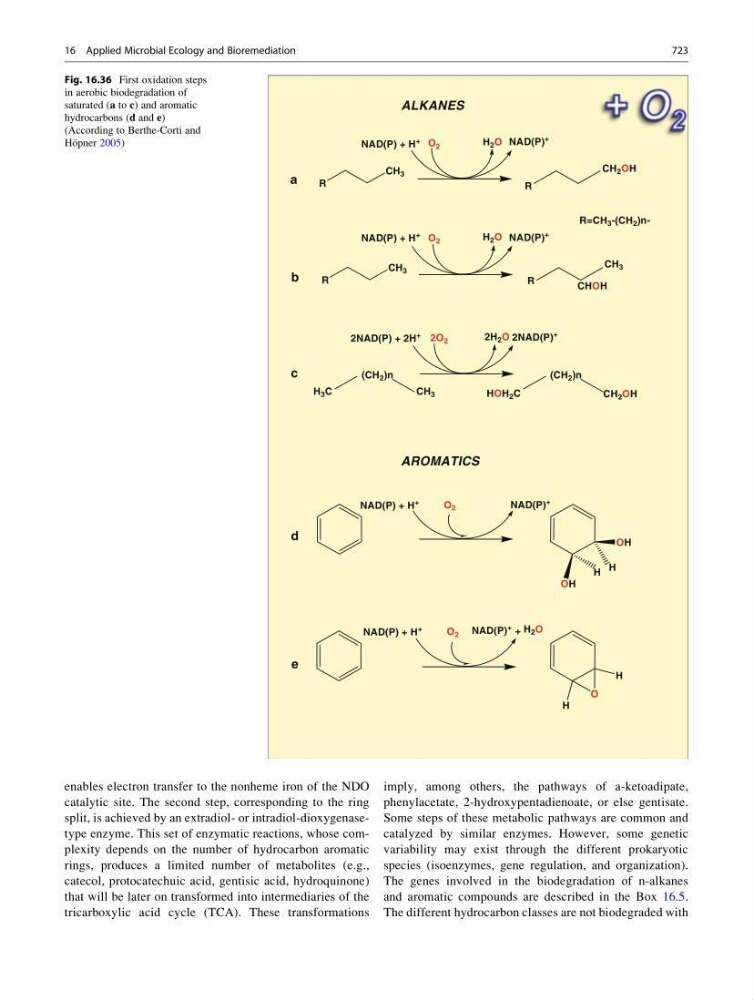
split, is achieved by an extradiol- or intradiol-dioxygenasetype enzyme. This set of enzymatic reactions, whose complexity depends on the number of hydrocarbon aromatic
rings, produces a limited number of metabolites (e.g.,
catecol, protocatechuic acid, gentisic acid, hydroquinone)
that will be later on transformed into intermediaries of the
tricarboxylic acid cycle (TCA). These transformations
imply, among others, the pathways of a-ketoadipate,
phenylacetate, 2-hydroxypentadienoate, or else gentisate.
Some steps of these metabolic pathways are common and
catalyzed by similar enzymes. However, some genetic
variability may exist through the different prokaryotic
species (isoenzymes, gene regulation, and organization).
The genes involved in the biodegradation of n-alkanes
and aromatic compounds are described in the Box 16.5.
The different hydrocarbon classes are not biodegraded with
R
CH 3
R
CH 2 OH
R
CH 3
R
CH 3
CHOH
NAD(P) + H
+ O 2
H 2 O NAD(P)
+
NAD(P) + H
+ O 2
H 2 O NAD(P)
+
R=CH 3 -(CH 2 )na
b
CH 3
2O 2
2H 2 O 2NAD(P)
+
2NAD(P) + 2H
+
(CH 2 )n
H 3 C
(CH 2 )n
CH 2 OH
HOH 2 C
c
O 2
NAD(P)
+
d
NAD(P) + H
+
OH
OH
H H
O 2 NAD(P)
+
NAD(P) + H
+
H 2 O
+
O
H
H
e
ALKANES
AROMATICS
Fig. 16.36 First oxidation steps
in aerobic biodegradation of
saturated (a to c) and aromatic
hydrocarbons (d and e)
(According to Berthe-Corti and
Ho ¨pner 2005)
16 Applied Microbial Ecology and Bioremediation
723