

Box 16.4 (continued)
Biofilm formation at hydrocarbon–water interfaces
has been observed in many strains or consortia degrading
aliphatic or aromatic hydrocarbons. These biofilms
develop on interfaces qualified of nutritive since they
play both the role of substrate and substratum. This feature distinguishes them from conventional biofilms growing on inert supports, such as minerals, metals or plastics.
The bacteria responsible for the formation of this type of
biofilm form preferentially biofilms on metabolizable
compounds poorly soluble in water suggesting that the
determinism of these biofilms is regulated according to
the solubility of the substrate (Johnsen and Karlson 2004;
Grimaud 2010b).
Hydrocarbons in water form a two-phase systems,
comprising an organic phase consisting of solid or liquid
hydrocarbon and the aqueous phase in which a small
fraction of the hydrocarbon dissolves. At the interface
between the two phases, there is a layer of stagnant
water called the boundary layer. The hydrocarbons
dissolved in the water at the interface and then diffuse
through the boundary layer to reach the free aqueous phase.
This creates a concentration gradient of hydrocarbons in the
(continued)
Box 16.4 (continued)
boundary layer. Planktonic bacteria floating in the aqueous phase can only assimilate the hydrocarbon fraction
dissolved in water. The degradation rate and consequently the growth rate of the bacteria depend on the
rate of mass transfer of the hydrocarbon from the organic
phase to the cells in aqueous phase. The mass transfer
process includes the dissolution of the molecules in the
water and their diffusion through the boundary layer.
Planktonic cells can increase the rate of mass transfer
of hydrocarbons by secreting biosurfactants (Box
Fig. 16.9a). In the case of bacteria forming biofilms, it
has often been observed that they do not release
biosurfactants in the aqueous phase. In addition, the
growth rate of cell within the biofilm is much higher
than the growth rate suggested by the rate of mass transfer of the hydrocarbon in the absence of bacteria. In light
of these observations, it is clear that the biofilm lifestyle
favors the mass transfer of hydrocarbons and thus
stimulates the growth of hydrocarbons. Biofilm formation at hydrocarbon–water interfaces is an adaptive process, allowing bacteria to assimilate substrates weakly
soluble in water (Johnsen et al. 2005).
(continued)
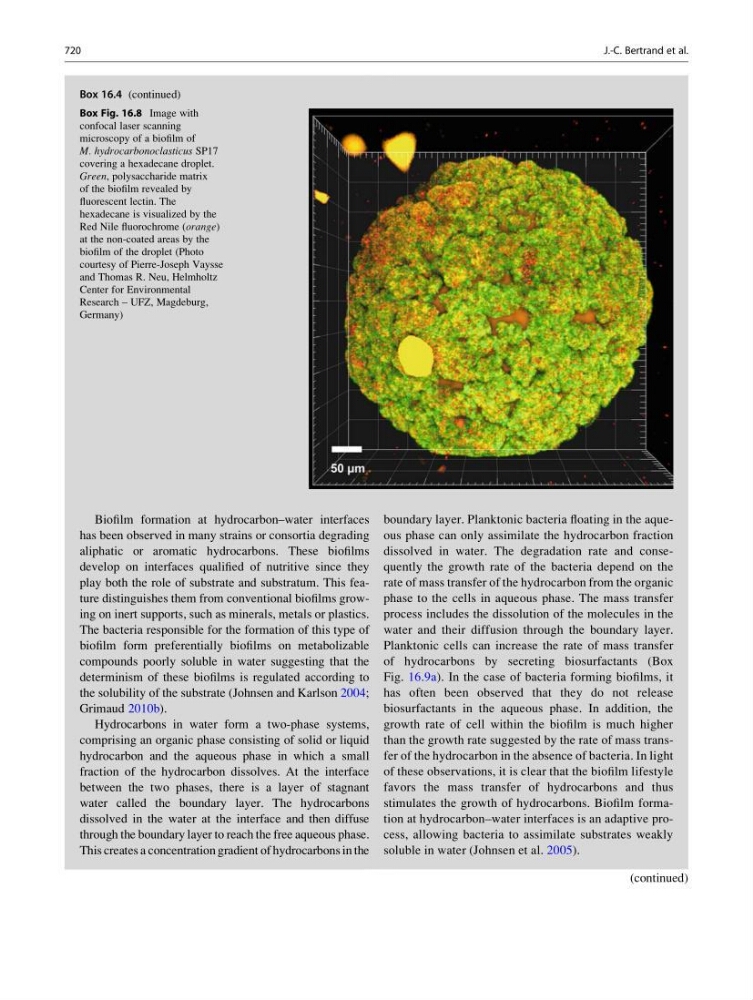
Box Fig. 16.8 Image with
confocal laser scanning
microscopy of a biofilm of
M. hydrocarbonoclasticus SP17
covering a hexadecane droplet.
Green, polysaccharide matrix
of the biofilm revealed by
fluorescent lectin. The
hexadecane is visualized by the
Red Nile fluorochrome (orange)
at the non-coated areas by the
biofilm of the droplet (Photo
courtesy of Pierre-Joseph Vaysse
and Thomas R. Neu, Helmholtz
Center for Environmental
Research – UFZ, Magdeburg,
Germany)
720
J.-C. Bertrand et al.