

Box 16.4 (continued)
Studies conducted on biofilms growing on the
surface of solid hydrocarbons allowed to elucidate a
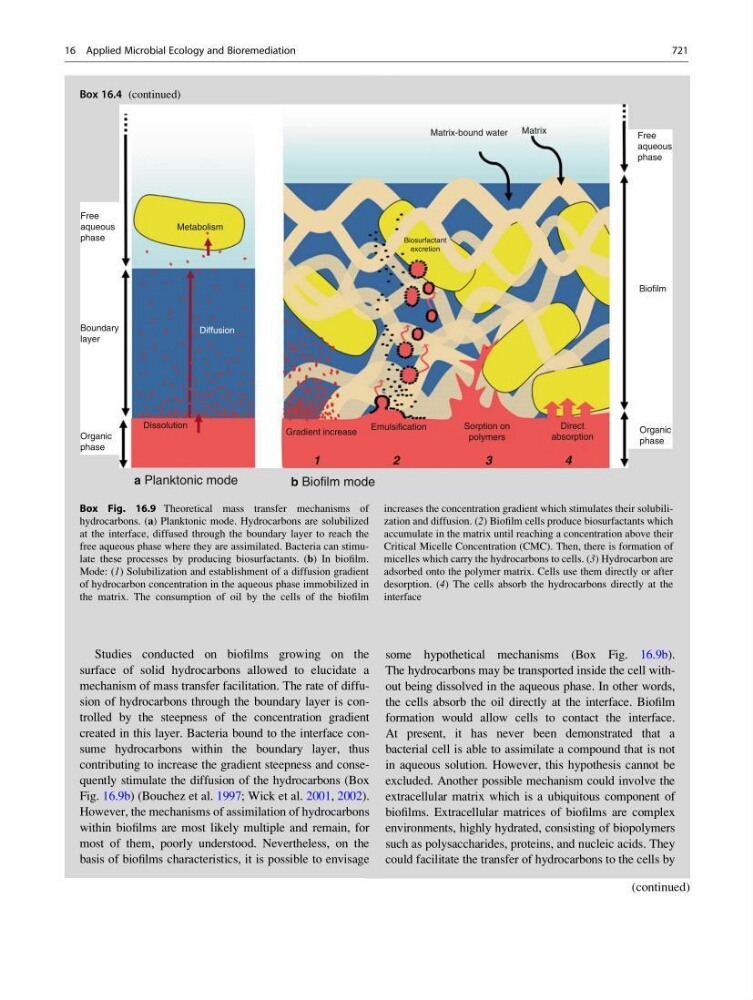
mechanism of mass transfer facilitation. The rate of diffusion of hydrocarbons through the boundary layer is controlled by the steepness of the concentration gradient
created in this layer. Bacteria bound to the interface consume hydrocarbons within the boundary layer, thus
contributing to increase the gradient steepness and consequently stimulate the diffusion of the hydrocarbons (Box
Fig. 16.9b) (Bouchez et al. 1997; Wick et al. 2001, 2002).
However, the mechanisms of assimilation of hydrocarbons
within biofilms are most likely multiple and remain, for
most of them, poorly understood. Nevertheless, on the
basis of biofilms characteristics, it is possible to envisage
(continued)
Box 16.4 (continued)
some hypothetical mechanisms (Box Fig. 16.9b).
The hydrocarbons may be transported inside the cell without being dissolved in the aqueous phase. In other words,
the cells absorb the oil directly at the interface. Biofilm
formation would allow cells to contact the interface.
At present, it has never been demonstrated that a
bacterial cell is able to assimilate a compound that is not
in aqueous solution. However, this hypothesis cannot be
excluded. Another possible mechanism could involve the
extracellular matrix which is a ubiquitous component of
biofilms. Extracellular matrices of biofilms are complex
environments, highly hydrated, consisting of biopolymers
such as polysaccharides, proteins, and nucleic acids. They
could facilitate the transfer of hydrocarbons to the cells by
(continued)
Diffusion
Dissolution
Metabolism
Boundary
layer
Free
aqueous
phase
Organic
phase
Biofilm
1
2
3
4
Matrix
a Planktonic mode
b Biofilm mode
Matrix-bound water
Biosurfactant
excretion
Sorption on
polymers
Emulsification
Gradient increase
Direct
absorption
Organic
phase
Free
aqueous
phase
Box Fig. 16.9 Theoretical mass transfer mechanisms of
hydrocarbons. (a) Planktonic mode. Hydrocarbons are solubilized
at the interface, diffused through the boundary layer to reach the
free aqueous phase where they are assimilated. Bacteria can stimulate these processes by producing biosurfactants. (b) In biofilm.
Mode: (1) Solubilization and establishment of a diffusion gradient
of hydrocarbon concentration in the aqueous phase immobilized in
the matrix. The consumption of oil by the cells of the biofilm
increases the concentration gradient which stimulates their solubilization and diffusion. (2) Biofilm cells produce biosurfactants which
accumulate in the matrix until reaching a concentration above their
Critical Micelle Concentration (CMC). Then, there is formation of
micelles which carry the hydrocarbons to cells. (3) Hydrocarbon are
adsorbed onto the polymer matrix. Cells use them directly or after
desorption. (4) The cells absorb the hydrocarbons directly at the
interface
16 Applied Microbial Ecology and Bioremediation
721