

HYDROCARBONS
Microorganisms
HC emulsified
HC solubilized
Emulsifying activities
Emulsifying agents
Solubilizing agents
Solubilizing activities
HC
Microorganisms
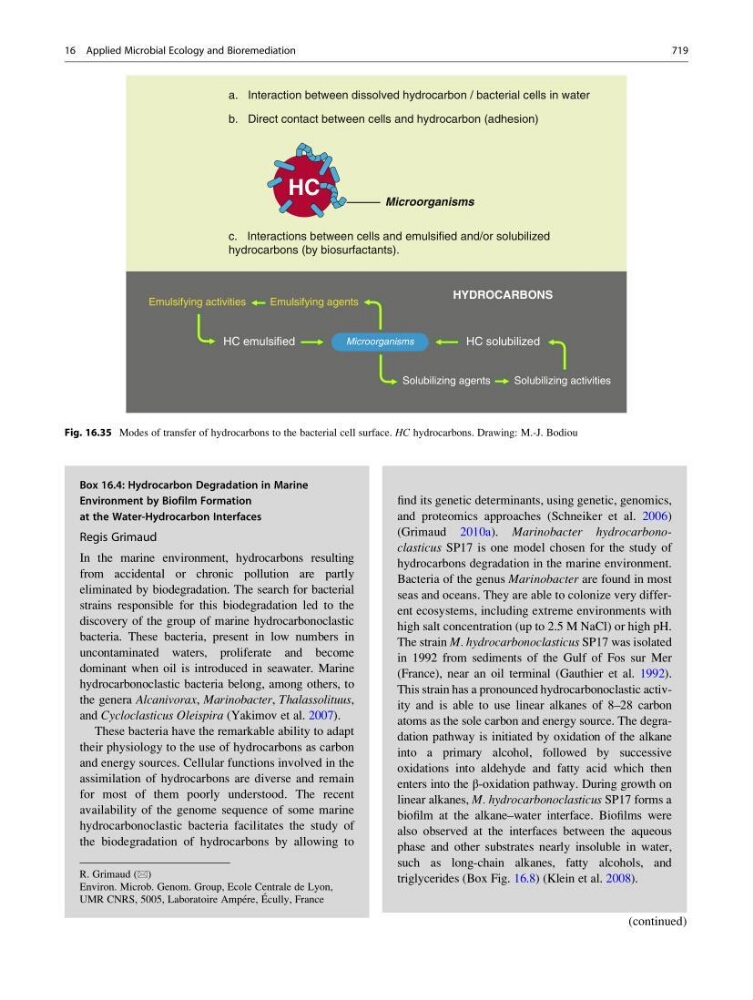
a. Interaction between dissolved hydrocarbon / bacterial cells in water
b. Direct contact between cells and hydrocarbon (adhesion)
c. Interactions between cells and emulsified and/or solubilized
hydrocarbons (by biosurfactants).
Fig. 16.35 Modes of transfer of hydrocarbons to the bacterial cell surface. HC hydrocarbons. Drawing: M.-J. Bodiou
Box 16.4: Hydrocarbon Degradation in Marine
Environment by Biofilm Formation
at the Water-Hydrocarbon Interfaces
Regis Grimaud
In the marine environment, hydrocarbons resulting
from accidental or chronic pollution are partly
eliminated by biodegradation. The search for bacterial
strains responsible for this biodegradation led to the
discovery of the group of marine hydrocarbonoclastic
bacteria. These bacteria, present in low numbers in
uncontaminated waters, proliferate and become
dominant when oil is introduced in seawater. Marine
hydrocarbonoclastic bacteria belong, among others, to
the genera Alcanivorax, Marinobacter, Thalassolituus,
and Cycloclasticus Oleispira (Yakimov et al. 2007).
These bacteria have the remarkable ability to adapt
their physiology to the use of hydrocarbons as carbon
and energy sources. Cellular functions involved in the
assimilation of hydrocarbons are diverse and remain
for most of them poorly understood. The recent
availability of the genome sequence of some marine
hydrocarbonoclastic bacteria facilitates the study of
the biodegradation of hydrocarbons by allowing to
R. Grimaud (*)
Environ. Microb. Genom. Group, Ecole Centrale de Lyon,
UMR CNRS, 5005, Laboratoire Ampe ´re, E ´ cully, France
(continued)
Box 16.4 (continued)
find its genetic determinants, using genetic, genomics,
and proteomics approaches (Schneiker et al. 2006)
(Grimaud 2010a). Marinobacter hydrocarbonoclasticus SP17 is one model chosen for the study of
hydrocarbons degradation in the marine environment.
Bacteria of the genus Marinobacter are found in most
seas and oceans. They are able to colonize very different ecosystems, including extreme environments with
high salt concentration (up to 2.5 M NaCl) or high pH.
The strain M. hydrocarbonoclasticus SP17 was isolated
in 1992 from sediments of the Gulf of Fos sur Mer
(France), near an oil terminal (Gauthier et al. 1992).
This strain has a pronounced hydrocarbonoclastic activity and is able to use linear alkanes of 8–28 carbon
atoms as the sole carbon and energy source. The degradation pathway is initiated by oxidation of the alkane
into a primary alcohol, followed by successive
oxidations into aldehyde and fatty acid which then
enters into the β-oxidation pathway. During growth on
linear alkanes, M. hydrocarbonoclasticus SP17 forms a
biofilm at the alkane–water interface. Biofilms were
also observed at the interfaces between the aqueous
phase and other substrates nearly insoluble in water,
such as long-chain alkanes, fatty alcohols, and
triglycerides (Box Fig. 16.8) (Klein et al. 2008).
(continued)
16 Applied Microbial Ecology and Bioremediation
719
Microorganisms
HC emulsified
HC solubilized
Emulsifying activities
Emulsifying agents
Solubilizing agents
Solubilizing activities
HC
Microorganisms
a. Interaction between dissolved hydrocarbon / bacterial cells in water
b. Direct contact between cells and hydrocarbon (adhesion)
c. Interactions between cells and emulsified and/or solubilized
hydrocarbons (by biosurfactants).
Fig. 16.35 Modes of transfer of hydrocarbons to the bacterial cell surface. HC hydrocarbons. Drawing: M.-J. Bodiou
Box 16.4: Hydrocarbon Degradation in Marine
Environment by Biofilm Formation
at the Water-Hydrocarbon Interfaces
Regis Grimaud
In the marine environment, hydrocarbons resulting
from accidental or chronic pollution are partly
eliminated by biodegradation. The search for bacterial
strains responsible for this biodegradation led to the
discovery of the group of marine hydrocarbonoclastic
bacteria. These bacteria, present in low numbers in
uncontaminated waters, proliferate and become
dominant when oil is introduced in seawater. Marine
hydrocarbonoclastic bacteria belong, among others, to
the genera Alcanivorax, Marinobacter, Thalassolituus,
and Cycloclasticus Oleispira (Yakimov et al. 2007).
These bacteria have the remarkable ability to adapt
their physiology to the use of hydrocarbons as carbon
and energy sources. Cellular functions involved in the
assimilation of hydrocarbons are diverse and remain
for most of them poorly understood. The recent
availability of the genome sequence of some marine
hydrocarbonoclastic bacteria facilitates the study of
the biodegradation of hydrocarbons by allowing to
R. Grimaud (*)
Environ. Microb. Genom. Group, Ecole Centrale de Lyon,
UMR CNRS, 5005, Laboratoire Ampe ´re, E ´ cully, France
(continued)
Box 16.4 (continued)
find its genetic determinants, using genetic, genomics,
and proteomics approaches (Schneiker et al. 2006)
(Grimaud 2010a). Marinobacter hydrocarbonoclasticus SP17 is one model chosen for the study of
hydrocarbons degradation in the marine environment.
Bacteria of the genus Marinobacter are found in most
seas and oceans. They are able to colonize very different ecosystems, including extreme environments with
high salt concentration (up to 2.5 M NaCl) or high pH.
The strain M. hydrocarbonoclasticus SP17 was isolated
in 1992 from sediments of the Gulf of Fos sur Mer
(France), near an oil terminal (Gauthier et al. 1992).
This strain has a pronounced hydrocarbonoclastic activity and is able to use linear alkanes of 8–28 carbon
atoms as the sole carbon and energy source. The degradation pathway is initiated by oxidation of the alkane
into a primary alcohol, followed by successive
oxidations into aldehyde and fatty acid which then
enters into the β-oxidation pathway. During growth on
linear alkanes, M. hydrocarbonoclasticus SP17 forms a
biofilm at the alkane–water interface. Biofilms were
also observed at the interfaces between the aqueous
phase and other substrates nearly insoluble in water,
such as long-chain alkanes, fatty alcohols, and
triglycerides (Box Fig. 16.8) (Klein et al. 2008).
(continued)
16 Applied Microbial Ecology and Bioremediation
719