

amounts in some living organisms (bacteria, algae,
plants), it was not clearly demonstrated whether these
compounds were really biosynthesized or their presence
resulted from bioaccumulation.
(ii) Diagenetic hydrocarbons. Some hydrocarbons are produced through early diagenetic processes of the organic
matter (time scale from a few days to tens of years). As an
example, in sediments, phytol that is a degradation product of the chlorophyll a phytyl moiety leads to pristane and
phytane under oxic and anoxic conditions, respectively.
(iii) Hydrocarbons from natural marine seepages. Petroleum
hydrocarbons are released through Earth crust faults,
whether continental or oceanic. One of the most important seepage is that of Santa Barbara (California) daily
releasing about 80 tons of methane and 35 tons of
non-methanic hydrocarbons (Hornafius et al. 1999).
Most methane is oxidized by the water column microorganisms; according to Mau and collaborators (2007),
only 1–10 % are finally released into the atmosphere.
(iv) Pyrolytic hydrocarbons. They are released into the atmosphere in large amount during forest fires (Kim et al.
2003). The main hydrocarbon families above mentioned
are present. For instance, the chemical composition of
pine wood smoke is as follows: terpenoids and
derivatives (39 %), PAH and alkyl-PAH (17 %), alkenes
(15 %), alkanes and steroids (8 % each), alkanoic acid
(6 %), monosaccharides (4 %), and phenols (3 %)
(Simoneit et al. 2000). During fires, essentially light
hydrocarbons are released in the atmosphere where they
can be carried away over long distances. Thus, HAPs
produced by forest fires occurring in Indonesia were
detected more than 1,000 km away (Okuda et al. 2002).
Hydrocarbon from Anthropogenic Origin
The use of petroleum products by mankind causes a very
large environment contamination and two kinds of sources
contribute to this contamination. The first kind of sources is
represented by chronic inputs with particularly rejections in
the city or industrial networks, inputs linked to exploiting
and producing petroleum and to transportations. A more
detailed description of inputs into the ocean will be provided
further. The second kind of sources concerns accidental
inputs that may happen at each production and exploitation
stage and represent an important contamination risk. The
most spectacular are oil-well-head accidents, mishaps linked
to storage, pipeline breakdown, and shipwrecks of oil
tankers and gas carriers. Anthropogenic inputs are from
pyrolytic and petroleum origin:
(i) Pyrolytic origin. This source is supplied by burning
fossilized (hydrocarbon, coal) or recent (wood) organic
matter used for house or city heating; industrial processes
(steel factories) have a strong impact on the amount
and structure of released compounds, specially HAPs.
These residues are released into the environment through
the atmosphere (directly or by soil washing) and by transportations. The combustion temperature and the organic
matter nature determine the kind of released hydrocarbon.
(ii) Petroleum origin. This origin corresponds to all
pollutions induced by the mankind use of hydrocarbons
except their burning.
16.8.1.3 Biodegradation by Microorganisms
Hydrocarbons are biodegraded by many microorganisms
called hydrocarbonoclastics (Timmis 2010). These microorganisms carry the necessary enzymes for the first transformation steps of these compounds, which corresponds to
the metabolism peripheral or high pathways. Hydrocarbons
are then transformed into key intermediate metabolites: alcohol for alkanes, catechol or benzyl-succinate with aromatic
hydrocarbons, etc. These metabolites will be further involved
in metabolic pathways present in many microorganisms and
finally reach the central or low metabolic pathways such as βoxidation and the tricarboxylic acid cycle (Krebs cycle). The
initial reactions of hydrocarbon transformation involve a large
diversity of hydrocarbonoclastic bacteria-specific enzymes.
These enzymes are coded by different genes whose localization (plasmidic, chromosomic, associated to mobile elements
like “cassettes*”), organization, and regulation also appear
diversified. It is worth noting that some non-catabolic genes
that are involved in a decisive way in hydrocarbon biodegradation can be associated and expressed together with catabolic genes (Samanta et al. 2002).
Hydrocarbon Transfer to Cell Surface
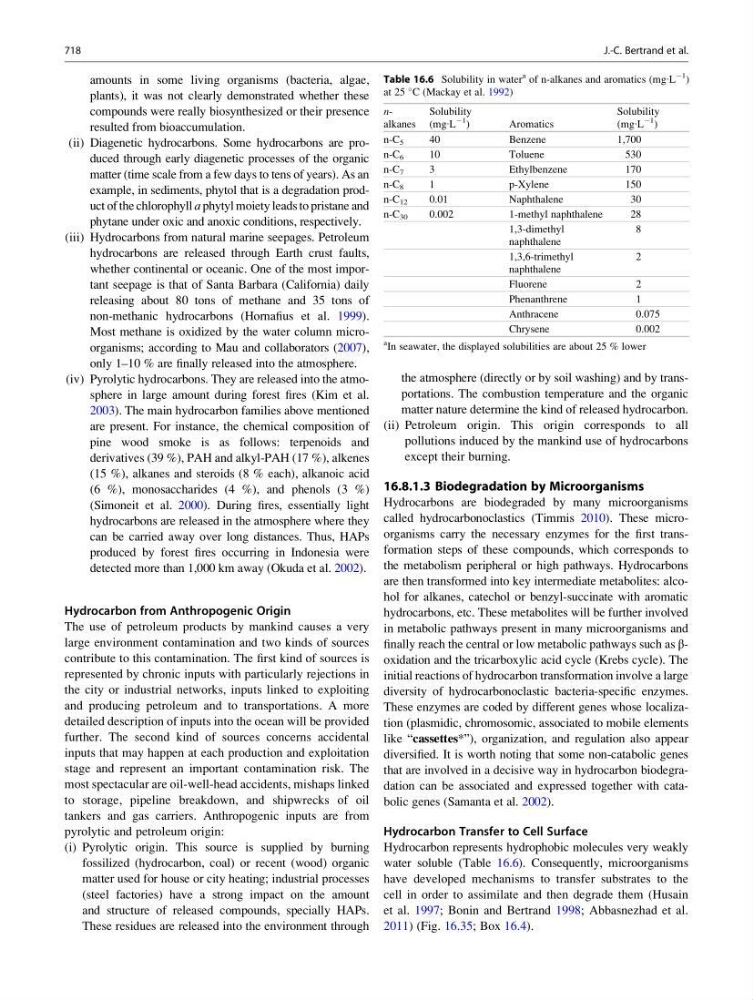
Hydrocarbon represents hydrophobic molecules very weakly
water soluble (Table 16.6). Consequently, microorganisms
have developed mechanisms to transfer substrates to the
cell in order to assimilate and then degrade them (Husain
et al. 1997; Bonin and Bertrand 1998; Abbasnezhad et al.
2011) (Fig. 16.35; Box 16.4).
Table 16.6 Solubility in water
a of n-alkanes and aromatics (mg∙L
À1
)
at 25
C (Mackay et al. 1992)
nalkanes
Solubility
(mg∙L
À1
)
Aromatics
Solubility
(mg∙L
À1
)
n-C 5
40
Benzene
1,700
n-C 6
10
Toluene
530
n-C 7
3
Ethylbenzene
170
n-C 8
1
p-Xylene
150
n-C 12
0.01
Naphthalene
30
n-C 30
0.002
1-methyl naphthalene
28
1,3-dimethyl
naphthalene
8
1,3,6-trimethyl
naphthalene
2
Fluorene
2
Phenanthrene
1
Anthracene
0.075
Chrysene
0.002
a
In seawater, the displayed solubilities are about 25 % lower
718
J.-C. Bertrand et al.