

But, if PCBs are lipid soluble, they are in contrast very
little water soluble. For a given PCB, its solubility is
inversely proportional to its chlorination level. It is
indeed in the range 6.36–29.15 μM for monochlorobiphenyls and 2.4 10
À6
μM for decachlorobiphenyl.
This partially explains the biodegradation resistance of
highly chlorinated congeners (bioavailability) (Hurst
et al. 2002). The solubility importance is confirmed by
the biodegradation stimulation in the presence of
biosurfactants that increase the PCB bioavailability
(Ohtsubo et al. 2004).
(iii) Congener structure, in particular, the number and
position of chlorine atoms.
(iv) PCB concentration: generally, when the pollutant concentration is too small, the enzymes involved in their
biodegradation are not induced and the growth of
relevant microorganisms is not favored. In contrast,
a too large concentration will inhibit growth.
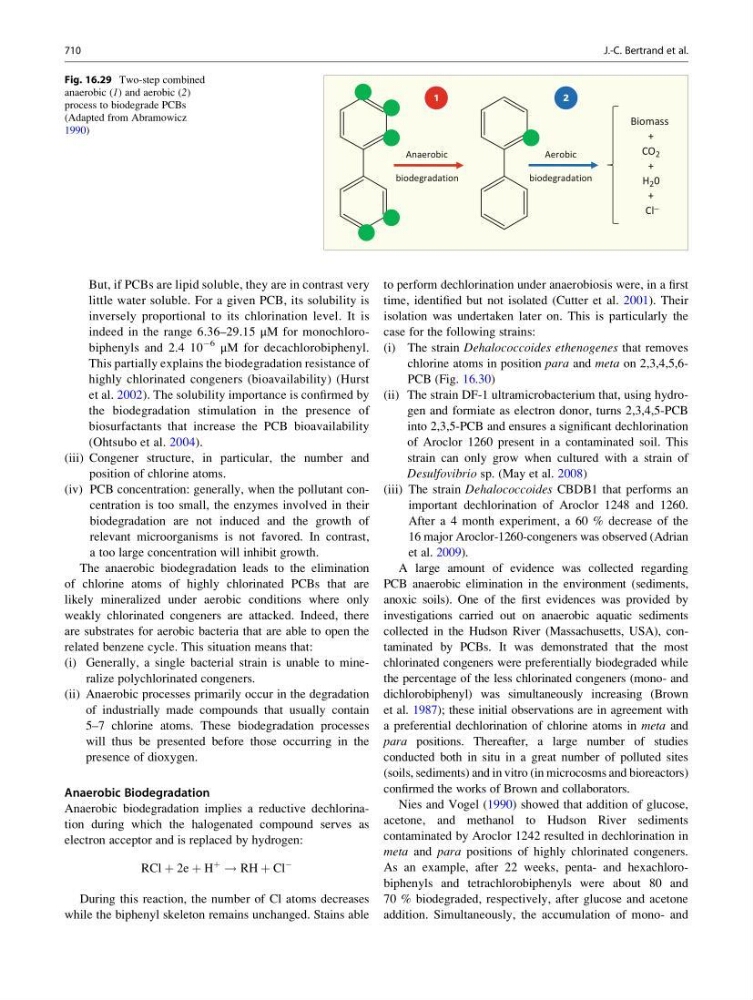
The anaerobic biodegradation leads to the elimination
of chlorine atoms of highly chlorinated PCBs that are
likely mineralized under aerobic conditions where only
weakly chlorinated congeners are attacked. Indeed, there
are substrates for aerobic bacteria that are able to open the
related benzene cycle. This situation means that:
(i) Generally, a single bacterial strain is unable to mineralize polychlorinated congeners.
(ii) Anaerobic processes primarily occur in the degradation
of industrially made compounds that usually contain
5–7 chlorine atoms. These biodegradation processes
will thus be presented before those occurring in the
presence of dioxygen.
Anaerobic Biodegradation
Anaerobic biodegradation implies a reductive dechlorination during which the halogenated compound serves as
electron acceptor and is replaced by hydrogen:
RCl þ 2e þ H
þ
! RH þ Cl
À
During this reaction, the number of Cl atoms decreases
while the biphenyl skeleton remains unchanged. Stains able
to perform dechlorination under anaerobiosis were, in a first
time, identified but not isolated (Cutter et al. 2001). Their
isolation was undertaken later on. This is particularly the
case for the following strains:
(i) The strain Dehalococcoides ethenogenes that removes
chlorine atoms in position para and meta on 2,3,4,5,6PCB (Fig. 16.30)
(ii) The strain DF-1 ultramicrobacterium that, using hydrogen and formiate as electron donor, turns 2,3,4,5-PCB
into 2,3,5-PCB and ensures a significant dechlorination
of Aroclor 1260 present in a contaminated soil. This
strain can only grow when cultured with a strain of
Desulfovibrio sp. (May et al. 2008)
(iii) The strain Dehalococcoides CBDB1 that performs an
important dechlorination of Aroclor 1248 and 1260.
After a 4 month experiment, a 60 % decrease of the
16 major Aroclor-1260-congeners was observed (Adrian
et al. 2009).
A large amount of evidence was collected regarding
PCB anaerobic elimination in the environment (sediments,
anoxic soils). One of the first evidences was provided by
investigations carried out on anaerobic aquatic sediments
collected in the Hudson River (Massachusetts, USA), contaminated by PCBs. It was demonstrated that the most
chlorinated congeners were preferentially biodegraded while
the percentage of the less chlorinated congeners (mono- and
dichlorobiphenyl) was simultaneously increasing (Brown
et al. 1987); these initial observations are in agreement with
a preferential dechlorination of chlorine atoms in meta and
para positions. Thereafter, a large number of studies
conducted both in situ in a great number of polluted sites
(soils, sediments) and in vitro (in microcosms and bioreactors)
confirmed the works of Brown and collaborators.
Nies and Vogel (1990) showed that addition of glucose,
acetone, and methanol to Hudson River sediments
contaminated by Aroclor 1242 resulted in dechlorination in
meta and para positions of highly chlorinated congeners.
As an example, after 22 weeks, penta- and hexachlorobiphenyls and tetrachlorobiphenyls were about 80 and
70 % biodegraded, respectively, after glucose and acetone
addition. Simultaneously, the accumulation of mono- and
Biomass
+
CO 2
+
H 2 0
+
Cl −
Anaerobic
biodegradation
Aerobic
biodegradation
1
2
Fig. 16.29 Two-step combined
anaerobic (1) and aerobic (2)
process to biodegrade PCBs
(Adapted from Abramowicz
1990)
710
J.-C. Bertrand et al.