

(log Ko/w), from 4.5 for monochlorobiphenyls up to
over 8 for polychlorinated congeners. The ensuing
bioaccumulation leads to an occasionally very important
bioamplification. For instance, the progression of PCB
concentration in a trophic chain of the North America
Great Lakes is significant: water (0.005 ppb) ! phytoplankton (0.0025 ppm) ! zooplankton (0.123 ppm) !
rainbow smelt (1.04 ppm) ! made up trout (4.83 ppm)
! silver seagull eggs (124 ppm), let a bioconcentration
factor (BCF) close to 25106 (Ramade 2002).
16.7.4.3 Microbial Biodegradation
Microbial biodegradation proceeds according to two
distinct and complementary ways (Fig. 16.29): the reductive anaerobic way and the oxidative aerobic way
(Abramowicz 1990; Mhiri and Tandeau de Marsac 1997;
Borja et al. 2005; Pieper 2005; Field and Sierra-Alvarez
2008). Biodegradation essentially depends on the
following:
(i) Environmental factors such as temperature, pH,
environment oxygenation, salinity, and presence of
toxic compounds. Indeed, contaminated biotopes often
contain other xenobiotics such as metals that may have
a toxic effect on microorganisms able to degrade PCBs.
Some PCB catabolic products may also have an inhibitory effect if they are not eliminated. It is the case of
chlorobenzoic acids, chloroacetophenones, and compounds produced by chlorocatechol cleavage (Mhiri
and Tandeau de Marsac 1997).
(ii) Congener solubility: the most water-soluble
compounds are more easily attained by microorganisms than those with a low water solubility.
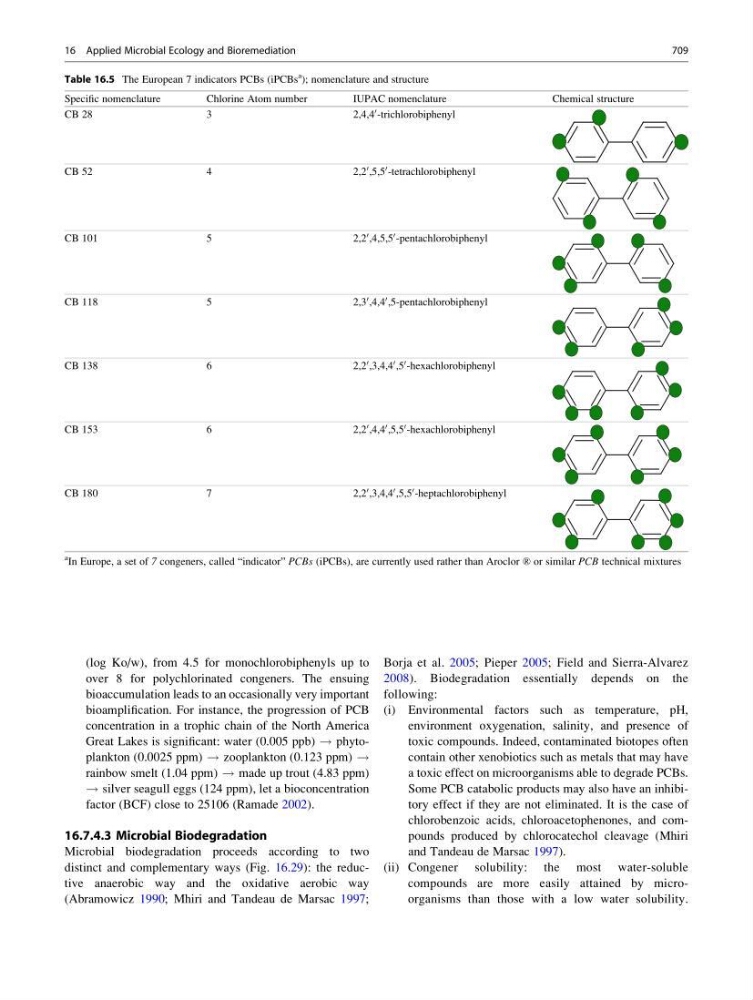
Table 16.5 The European 7 indicators PCBs (iPCBs
a
); nomenclature and structure
Specific nomenclature
Chlorine Atom number
IUPAC nomenclature
Chemical structure
CB 28
3
2,4,4
0 -trichlorobiphenyl
CB 52
4
2,2
0 ,5,5
0 -tetrachlorobiphenyl
CB 101
5
2,2
0 ,4,5,5
0 -pentachlorobiphenyl
CB 118
5
2,3
0 ,4,4
0 ,5-pentachlorobiphenyl
CB 138
6
2,2
0 ,3,4,4
0 ,5
0 -hexachlorobiphenyl
CB 153
6
2,2
0 ,4,4
0 ,5,5
0 -hexachlorobiphenyl
CB 180
7
2,2
0 ,3,4,4
0 ,5,5
0 -heptachlorobiphenyl
a
In Europe, a set of 7 congeners, called “indicator” PCBs (iPCBs), are currently used rather than Aroclor ® or similar PCB technical mixtures
16 Applied Microbial Ecology and Bioremediation
709