

depletion of the selection pressure is in favor of the hypothesis of the loss or at least of the dilution of the genetic
potential within the pesticide-degrading community
(Changey et al. 2011), suggesting that pesticide-degrading
ability remains a versatile function. Finally, among the
techniques associated to the bioaugmentation, there is
one relying on the use of killed E. coli recombinant strains
that have been genetically modified to overexpress the
atzA gene (Strong et al. 2000). It is rather, in this case, an
enzyme treatment, the microbial strain having no other
role to ensure than the encapsulation of enzymes.
16.7.4 Polychlorobiphenyls (PCBs)
16.7.4.1 Synthesis, Chemical Structure, and Use
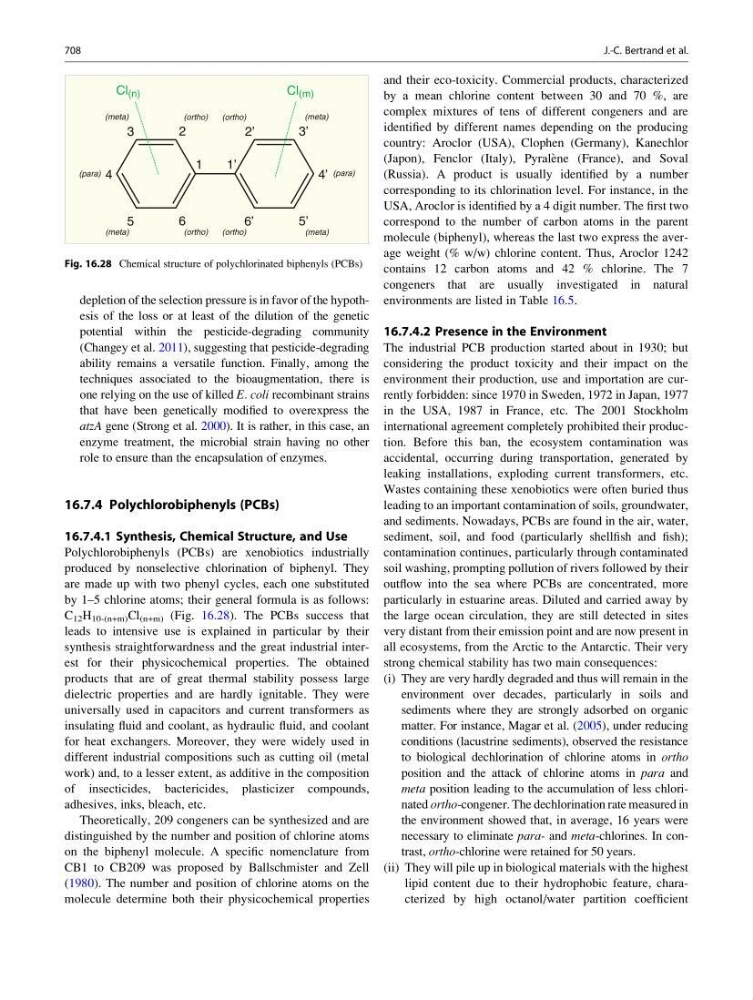
Polychlorobiphenyls (PCBs) are xenobiotics industrially
produced by nonselective chlorination of biphenyl. They
are made up with two phenyl cycles, each one substituted
by 1–5 chlorine atoms; their general formula is as follows:
C 12 H 10-(n+m) Cl (n+m) (Fig. 16.28). The PCBs success that
leads to intensive use is explained in particular by their
synthesis straightforwardness and the great industrial interest for their physicochemical properties. The obtained
products that are of great thermal stability possess large
dielectric properties and are hardly ignitable. They were
universally used in capacitors and current transformers as
insulating fluid and coolant, as hydraulic fluid, and coolant
for heat exchangers. Moreover, they were widely used in
different industrial compositions such as cutting oil (metal
work) and, to a lesser extent, as additive in the composition
of insecticides, bactericides, plasticizer compounds,
adhesives, inks, bleach, etc.
Theoretically, 209 congeners can be synthesized and are
distinguished by the number and position of chlorine atoms
on the biphenyl molecule. A specific nomenclature from
CB1 to CB209 was proposed by Ballschmister and Zell
(1980). The number and position of chlorine atoms on the
molecule determine both their physicochemical properties
and their eco-toxicity. Commercial products, characterized
by a mean chlorine content between 30 and 70 %, are
complex mixtures of tens of different congeners and are
identified by different names depending on the producing
country: Aroclor (USA), Clophen (Germany), Kanechlor
(Japon), Fenclor (Italy), Pyrale `ne (France), and Soval
(Russia). A product is usually identified by a number
corresponding to its chlorination level. For instance, in the
USA, Aroclor is identified by a 4 digit number. The first two
correspond to the number of carbon atoms in the parent
molecule (biphenyl), whereas the last two express the average weight (% w/w) chlorine content. Thus, Aroclor 1242
contains 12 carbon atoms and 42 % chlorine. The 7
congeners that are usually investigated in natural
environments are listed in Table 16.5.
16.7.4.2 Presence in the Environment
The industrial PCB production started about in 1930; but
considering the product toxicity and their impact on the
environment their production, use and importation are currently forbidden: since 1970 in Sweden, 1972 in Japan, 1977
in the USA, 1987 in France, etc. The 2001 Stockholm
international agreement completely prohibited their production. Before this ban, the ecosystem contamination was
accidental, occurring during transportation, generated by
leaking installations, exploding current transformers, etc.
Wastes containing these xenobiotics were often buried thus
leading to an important contamination of soils, groundwater,
and sediments. Nowadays, PCBs are found in the air, water,
sediment, soil, and food (particularly shellfish and fish);
contamination continues, particularly through contaminated
soil washing, prompting pollution of rivers followed by their
outflow into the sea where PCBs are concentrated, more
particularly in estuarine areas. Diluted and carried away by
the large ocean circulation, they are still detected in sites
very distant from their emission point and are now present in
all ecosystems, from the Arctic to the Antarctic. Their very
strong chemical stability has two main consequences:
(i) They are very hardly degraded and thus will remain in the
environment over decades, particularly in soils and
sediments where they are strongly adsorbed on organic
matter. For instance, Magar et al. (2005), under reducing
conditions (lacustrine sediments), observed the resistance
to biological dechlorination of chlorine atoms in ortho
position and the attack of chlorine atoms in para and
meta position leading to the accumulation of less chlorinated ortho-congener. The dechlorination rate measured in
the environment showed that, in average, 16 years were
necessary to eliminate para- and meta-chlorines. In contrast, ortho-chlorine were retained for 50 years.
(ii) They will pile up in biological materials with the highest
lipid content due to their hydrophobic feature, characterized by high octanol/water partition coefficient
Cl (n)
Cl (m)
1
1’
5
6
6’
5’
3
2
2’
3’
4
4’
(ortho)
(meta)
(para)
(ortho)
(ortho)
(ortho)
(meta)
(meta)
(meta)
(para)
Fig. 16.28 Chemical structure of polychlorinated biphenyls (PCBs)
708
J.-C. Bertrand et al.