

Box 16.3 (continued)
be assembled from the shuffling of the soil
metagenome DNA.
Step 1
The “MEME” (“Multiple Expectation maximization for
Motif Elicitation”) bioinformatics program was used in
order to detect sequence similarities after protein or nucleic
motives were established in the complete sequence for
detecting structural similarity among proteins. Applied to
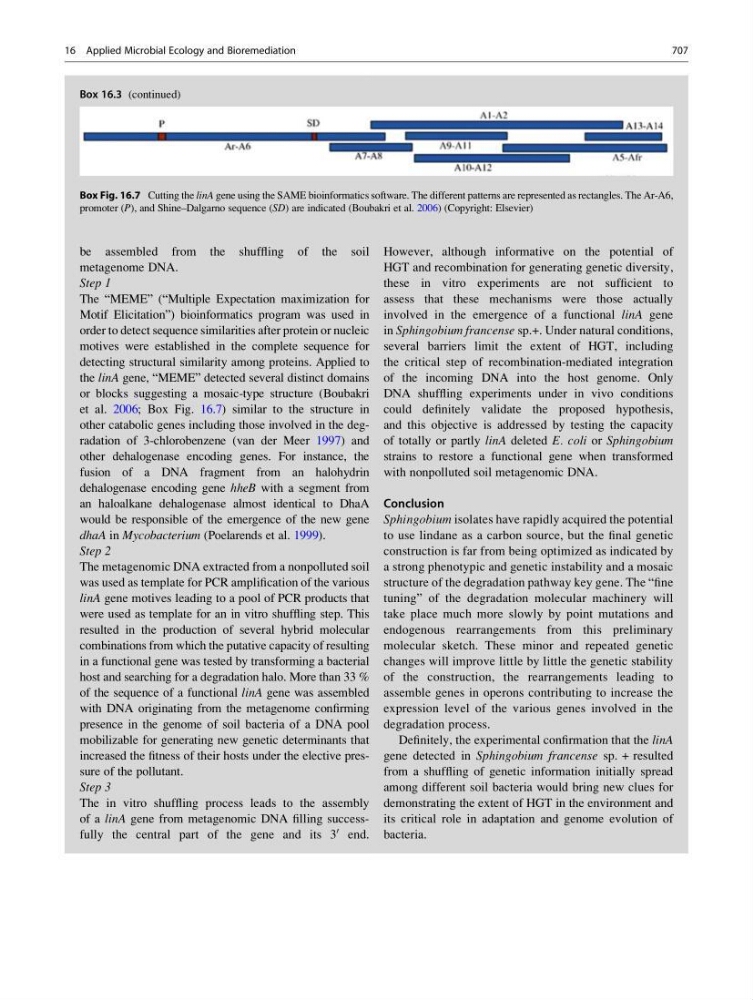
the linA gene, “MEME” detected several distinct domains
or blocks suggesting a mosaic-type structure (Boubakri
et al. 2006; Box Fig. 16.7) similar to the structure in
other catabolic genes including those involved in the degradation of 3-chlorobenzene (van der Meer 1997) and
other dehalogenase encoding genes. For instance, the
fusion of a DNA fragment from an halohydrin
dehalogenase encoding gene hheB with a segment from
an haloalkane dehalogenase almost identical to DhaA
would be responsible of the emergence of the new gene
dhaA in Mycobacterium (Poelarends et al. 1999).
Step 2
The metagenomic DNA extracted from a nonpolluted soil
was used as template for PCR amplification of the various
linA gene motives leading to a pool of PCR products that
were used as template for an in vitro shuffling step. This
resulted in the production of several hybrid molecular
combinations from which the putative capacity of resulting
in a functional gene was tested by transforming a bacterial
host and searching for a degradation halo. More than 33 %
of the sequence of a functional linA gene was assembled
with DNA originating from the metagenome confirming
presence in the genome of soil bacteria of a DNA pool
mobilizable for generating new genetic determinants that
increased the fitness of their hosts under the elective pressure of the pollutant.
Step 3
The in vitro shuffling process leads to the assembly
of a linA gene from metagenomic DNA filling successfully the central part of the gene and its 3
0 end.
(continued)
Box 16.3 (continued)
However, although informative on the potential of
HGT and recombination for generating genetic diversity,
these in vitro experiments are not sufficient to
assess that these mechanisms were those actually
involved in the emergence of a functional linA gene
in Sphingobium francense sp.+. Under natural conditions,
several barriers limit the extent of HGT, including
the critical step of recombination-mediated integration
of the incoming DNA into the host genome. Only
DNA shuffling experiments under in vivo conditions
could definitely validate the proposed hypothesis,
and this objective is addressed by testing the capacity
of totally or partly linA deleted E. coli or Sphingobium
strains to restore a functional gene when transformed
with nonpolluted soil metagenomic DNA.
Conclusion
Sphingobium isolates have rapidly acquired the potential
to use lindane as a carbon source, but the final genetic
construction is far from being optimized as indicated by
a strong phenotypic and genetic instability and a mosaic
structure of the degradation pathway key gene. The “fine
tuning” of the degradation molecular machinery will
take place much more slowly by point mutations and
endogenous rearrangements from this preliminary
molecular sketch. These minor and repeated genetic
changes will improve little by little the genetic stability
of the construction, the rearrangements leading to
assemble genes in operons contributing to increase the
expression level of the various genes involved in the
degradation process.
Definitely, the experimental confirmation that the linA
gene detected in Sphingobium francense sp. + resulted
from a shuffling of genetic information initially spread
among different soil bacteria would bring new clues for
demonstrating the extent of HGT in the environment and
its critical role in adaptation and genome evolution of
bacteria.
Box Fig. 16.7 Cutting the linA gene using the SAME bioinformatics software. The different patterns are represented as rectangles. The Ar-A6,
promoter (P), and Shine–Dalgarno sequence (SD) are indicated (Boubakri et al. 2006) (Copyright: Elsevier)
16 Applied Microbial Ecology and Bioremediation
707