

dichlorobiphenyls was observed. However, in cultures
without enrichment, biodegradation could not be observed.
Finally, anaerobiosis in all cultures was demonstrated by
an intense methanogenic activity.
A similar approach was conducted on PCB contaminated
sediments from 3 different ecosystems: a river (Hudson
River), a lake (Silver Lake), and an estuary (New Bedford
Harbor) (Alder et al. 1993). The 3 sediment types were
supplemented with Aroclor 1242 and a carbon source in
the form of a short-chain free fatty acid (SCFA) mixture,
consisting of acetate, propionate, butyrate, and hexanoic
acid. In flasks rigorously maintained in anaerobiosis, PCB
evolution was monitored under methanogenesis and sulfatoreduction conditions (by adding carbonate and sulfate in
excess, respectively). In the 3 tested sediments, the authors
could provide evidence of dechlorination processes. The
fastest were observed with the Hudson River sediments
supplemented with volatile free fatty acids or short-chain
fatty acids (SCFA), with preferential elimination of chlorine
atoms in meta and para positions (65 % were eliminated
after 2 month incubation), leading to the accumulation of
mono-, di-, and tri-ortho-substituted PCB congeners. In contrast, in the absence of SCFA supplementation, the same
dechlorination level was only achieved after 11 months.
From the whole set of studies dedicated to PCB anaerobic
biodegradation that was most often observed under
methanogenesis conditions, it turns out that the same trends
were observed whatever the considered sites and PCBs:
para- and meta-disubstituted congeners are more frequently
degraded than ortho-ones. Dechlorination in ortho position
is weak. Dechlorinations usually produce mono- and
dichlorinated congeners. Some works demonstrated the existence of slow anaerobic pathways that may lead to the
production of trace biphenyl (Natarajan et al. 1996)
(Fig. 16.31). Moreover, microorganisms present in a given
site have specific capacities to degrade some PCBs (Quensen
et al. 1990).
Aerobic Biodegradation
Weakly chlorinated congeners produced by dechlorination
of highly chlorinated congeners are substrates for Gramnegative aerobic bacteria (genus Pseudomonas, Alcaligenes,
Achromobacter, Comamonas, Sphingomonas, Ralstonia,
Acinetobacter, Burkholderia) and Gram-positive bacteria
(genus Rhodococcus, Corynebacterium, Bacillus) (Pieper
2005; Field and Sierra-Alvarez 2008).
PCBs are also metabolized by different strains of whiteroot fungi. The trend reflects the general observation that
aerobic PCB biodegradability decreases with increased
chlorine content (Field and Sierra-Alvarez 2008). Biodegradation of Aroclors 1242, 1254, and 1260 (42, 54, and 60 %
chlorine, respectively) by Phanerochaete chrysosporium
decreases their concentration by 60.9, 30.5, and 17.6 %,
respectively (Yadav et al. 1995).
Many experiments demonstrated aerobic biodegradation
of PCBs. They were conducted with microorganisms
cultured in liquid medium, sediment, or soil kept under
aerobic conditions in microcosms in the presence of cells
immobilized on materials at the surface of which they
formed biofilms. For instance, PCB biodegradation was
achieved by bacterial biofilms in packed-bed batch
bioreactors (Fava et al. 1996), with a bacterial co-culture
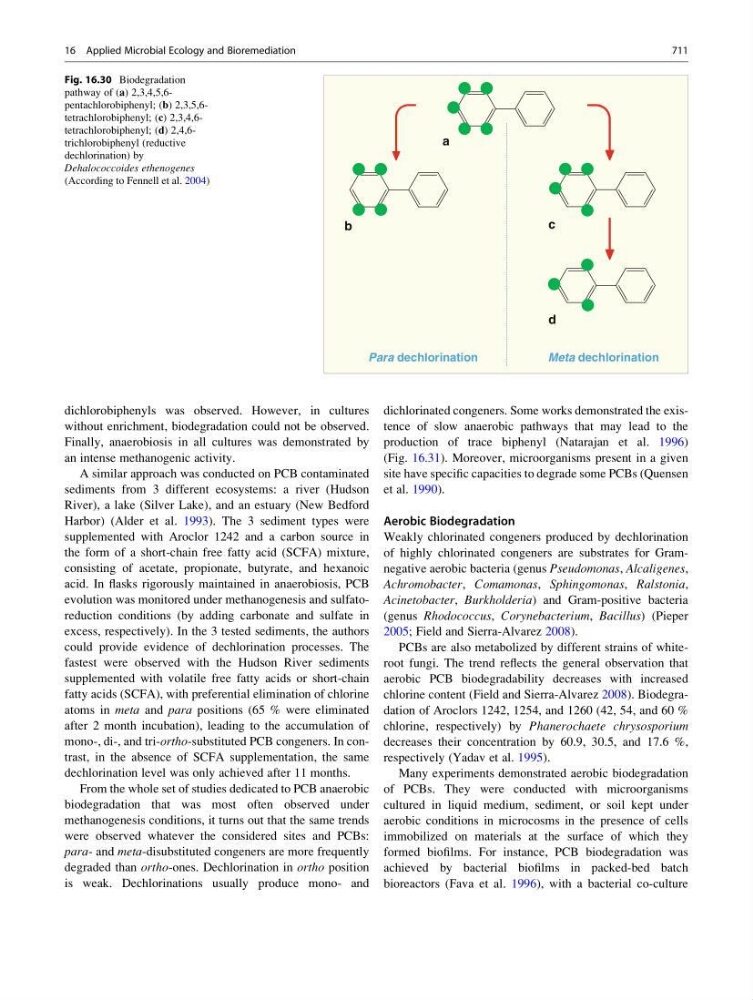
a
b
c
d
Para dechlorination
Meta dechlorination
Fig. 16.30 Biodegradation
pathway of (a) 2,3,4,5,6pentachlorobiphenyl; (b) 2,3,5,6tetrachlorobiphenyl; (c) 2,3,4,6tetrachlorobiphenyl; (d) 2,4,6trichlorobiphenyl (reductive
dechlorination) by
Dehalococcoides ethenogenes
(According to Fennell et al. 2004)
16 Applied Microbial Ecology and Bioremediation
711