

periphery of the porphyrin. In vivo, Chls and BChls form
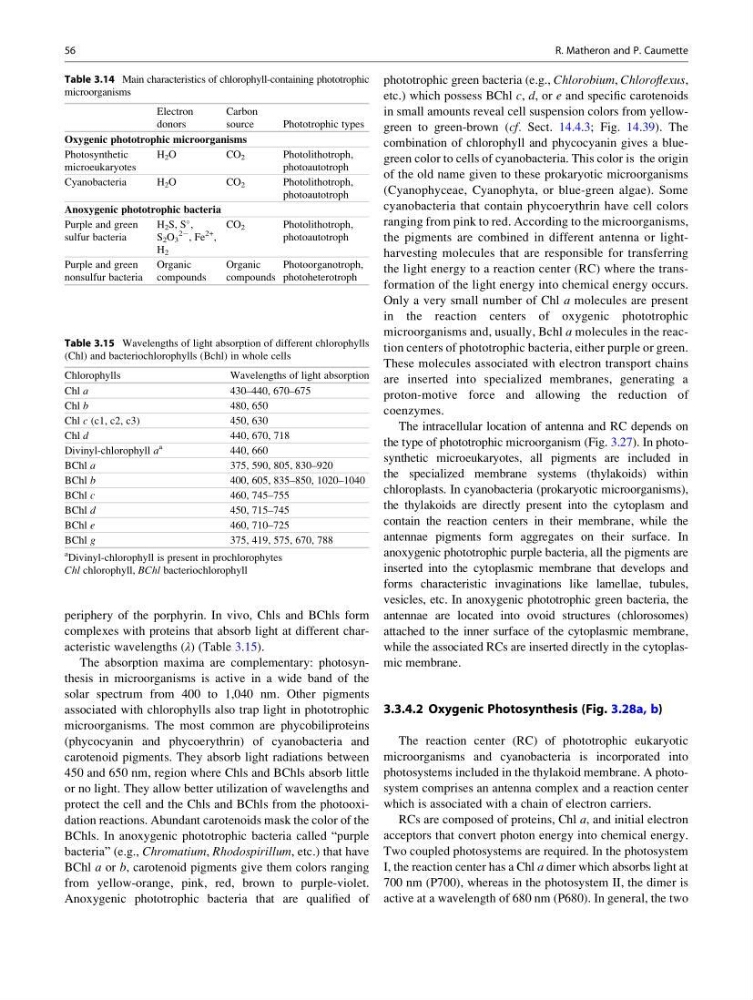
complexes with proteins that absorb light at different characteristic wavelengths (λ) (Table 3.15).
The absorption maxima are complementary: photosynthesis in microorganisms is active in a wide band of the
solar spectrum from 400 to 1,040 nm. Other pigments
associated with chlorophylls also trap light in phototrophic
microorganisms. The most common are phycobiliproteins
(phycocyanin and phycoerythrin) of cyanobacteria and
carotenoid pigments. They absorb light radiations between
450 and 650 nm, region where Chls and BChls absorb little
or no light. They allow better utilization of wavelengths and
protect the cell and the Chls and BChls from the photooxidation reactions. Abundant carotenoids mask the color of the
BChls. In anoxygenic phototrophic bacteria called “purple
bacteria” (e.g., Chromatium, Rhodospirillum, etc.) that have
BChl a or b, carotenoid pigments give them colors ranging
from yellow-orange, pink, red, brown to purple-violet.
Anoxygenic phototrophic bacteria that are qualified of
phototrophic green bacteria (e.g., Chlorobium, Chloroflexus,
etc.) which possess BChl c, d, or e and specific carotenoids
in small amounts reveal cell suspension colors from yellowgreen to green-brown (cf. Sect. 14.4.3; Fig. 14.39). The
combination of chlorophyll and phycocyanin gives a bluegreen color to cells of cyanobacteria. This color is the origin
of the old name given to these prokaryotic microorganisms
(Cyanophyceae, Cyanophyta, or blue-green algae). Some
cyanobacteria that contain phycoerythrin have cell colors
ranging from pink to red. According to the microorganisms,
the pigments are combined in different antenna or lightharvesting molecules that are responsible for transferring
the light energy to a reaction center (RC) where the transformation of the light energy into chemical energy occurs.
Only a very small number of Chl a molecules are present
in the reaction centers of oxygenic phototrophic
microorganisms and, usually, Bchl a molecules in the reaction centers of phototrophic bacteria, either purple or green.
These molecules associated with electron transport chains
are inserted into specialized membranes, generating a
proton-motive force and allowing the reduction of
coenzymes.
The intracellular location of antenna and RC depends on
the type of phototrophic microorganism (Fig. 3.27). In photosynthetic microeukaryotes, all pigments are included in
the specialized membrane systems (thylakoids) within
chloroplasts. In cyanobacteria (prokaryotic microorganisms),
the thylakoids are directly present into the cytoplasm and
contain the reaction centers in their membrane, while the
antennae pigments form aggregates on their surface. In
anoxygenic phototrophic purple bacteria, all the pigments are
inserted into the cytoplasmic membrane that develops and
forms characteristic invaginations like lamellae, tubules,
vesicles, etc. In anoxygenic phototrophic green bacteria, the
antennae are located into ovoid structures (chlorosomes)
attached to the inner surface of the cytoplasmic membrane,
while the associated RCs are inserted directly in the cytoplasmic membrane.
3.3.4.2 Oxygenic Photosynthesis (Fig. 3.28a, b)
The reaction center (RC) of phototrophic eukaryotic
microorganisms and cyanobacteria is incorporated into
photosystems included in the thylakoid membrane. A photosystem comprises an antenna complex and a reaction center
which is associated with a chain of electron carriers.
RCs are composed of proteins, Chl a, and initial electron
acceptors that convert photon energy into chemical energy.
Two coupled photosystems are required. In the photosystem
I, the reaction center has a Chl a dimer which absorbs light at
700 nm (P700), whereas in the photosystem II, the dimer is
active at a wavelength of 680 nm (P680). In general, the two
Table 3.15 Wavelengths of light absorption of different chlorophylls
(Chl) and bacteriochlorophylls (Bchl) in whole cells
Chlorophylls
Wavelengths of light absorption
Chl a
430–440, 670–675
Chl b
480, 650
Chl c (c1, c2, c3)
450, 630
Chl d
440, 670, 718
Divinyl-chlorophyll a
a
440, 660
BChl a
375, 590, 805, 830–920
BChl b
400, 605, 835–850, 1020–1040
BChl c
460, 745–755
BChl d
450, 715–745
BChl e
460, 710–725
BChl g
375, 419, 575, 670, 788
a
Divinyl-chlorophyll is present in prochlorophytes
Chl chlorophyll, BChl bacteriochlorophyll
Table 3.14 Main characteristics of chlorophyll-containing phototrophic
microorganisms
Electron
donors
Carbon
source
Phototrophic types
Oxygenic phototrophic microorganisms
Photosynthetic
microeukaryotes
H 2 O
C O 2
Photolithotroph,
photoautotroph
Cyanobacteria
H 2 O
C O 2
Photolithotroph,
photoautotroph
Anoxygenic phototrophic bacteria
Purple and green
sulfur bacteria
H 2 S, S
,
S 2 O 3
2À
, Fe
2+ ,
H 2
CO 2
Photolithotroph,
photoautotroph
Purple and green
nonsulfur bacteria
Organic
compounds
Organic
compounds
Photoorganotroph,
photoheterotroph
56
R. Matheron and P. Caumette
complexes with proteins that absorb light at different characteristic wavelengths (λ) (Table 3.15).
The absorption maxima are complementary: photosynthesis in microorganisms is active in a wide band of the
solar spectrum from 400 to 1,040 nm. Other pigments
associated with chlorophylls also trap light in phototrophic
microorganisms. The most common are phycobiliproteins
(phycocyanin and phycoerythrin) of cyanobacteria and
carotenoid pigments. They absorb light radiations between
450 and 650 nm, region where Chls and BChls absorb little
or no light. They allow better utilization of wavelengths and
protect the cell and the Chls and BChls from the photooxidation reactions. Abundant carotenoids mask the color of the
BChls. In anoxygenic phototrophic bacteria called “purple
bacteria” (e.g., Chromatium, Rhodospirillum, etc.) that have
BChl a or b, carotenoid pigments give them colors ranging
from yellow-orange, pink, red, brown to purple-violet.
Anoxygenic phototrophic bacteria that are qualified of
phototrophic green bacteria (e.g., Chlorobium, Chloroflexus,
etc.) which possess BChl c, d, or e and specific carotenoids
in small amounts reveal cell suspension colors from yellowgreen to green-brown (cf. Sect. 14.4.3; Fig. 14.39). The
combination of chlorophyll and phycocyanin gives a bluegreen color to cells of cyanobacteria. This color is the origin
of the old name given to these prokaryotic microorganisms
(Cyanophyceae, Cyanophyta, or blue-green algae). Some
cyanobacteria that contain phycoerythrin have cell colors
ranging from pink to red. According to the microorganisms,
the pigments are combined in different antenna or lightharvesting molecules that are responsible for transferring
the light energy to a reaction center (RC) where the transformation of the light energy into chemical energy occurs.
Only a very small number of Chl a molecules are present
in the reaction centers of oxygenic phototrophic
microorganisms and, usually, Bchl a molecules in the reaction centers of phototrophic bacteria, either purple or green.
These molecules associated with electron transport chains
are inserted into specialized membranes, generating a
proton-motive force and allowing the reduction of
coenzymes.
The intracellular location of antenna and RC depends on
the type of phototrophic microorganism (Fig. 3.27). In photosynthetic microeukaryotes, all pigments are included in
the specialized membrane systems (thylakoids) within
chloroplasts. In cyanobacteria (prokaryotic microorganisms),
the thylakoids are directly present into the cytoplasm and
contain the reaction centers in their membrane, while the
antennae pigments form aggregates on their surface. In
anoxygenic phototrophic purple bacteria, all the pigments are
inserted into the cytoplasmic membrane that develops and
forms characteristic invaginations like lamellae, tubules,
vesicles, etc. In anoxygenic phototrophic green bacteria, the
antennae are located into ovoid structures (chlorosomes)
attached to the inner surface of the cytoplasmic membrane,
while the associated RCs are inserted directly in the cytoplasmic membrane.
3.3.4.2 Oxygenic Photosynthesis (Fig. 3.28a, b)
The reaction center (RC) of phototrophic eukaryotic
microorganisms and cyanobacteria is incorporated into
photosystems included in the thylakoid membrane. A photosystem comprises an antenna complex and a reaction center
which is associated with a chain of electron carriers.
RCs are composed of proteins, Chl a, and initial electron
acceptors that convert photon energy into chemical energy.
Two coupled photosystems are required. In the photosystem
I, the reaction center has a Chl a dimer which absorbs light at
700 nm (P700), whereas in the photosystem II, the dimer is
active at a wavelength of 680 nm (P680). In general, the two
Table 3.15 Wavelengths of light absorption of different chlorophylls
(Chl) and bacteriochlorophylls (Bchl) in whole cells
Chlorophylls
Wavelengths of light absorption
Chl a
430–440, 670–675
Chl b
480, 650
Chl c (c1, c2, c3)
450, 630
Chl d
440, 670, 718
Divinyl-chlorophyll a
a
440, 660
BChl a
375, 590, 805, 830–920
BChl b
400, 605, 835–850, 1020–1040
BChl c
460, 745–755
BChl d
450, 715–745
BChl e
460, 710–725
BChl g
375, 419, 575, 670, 788
a
Divinyl-chlorophyll is present in prochlorophytes
Chl chlorophyll, BChl bacteriochlorophyll
Table 3.14 Main characteristics of chlorophyll-containing phototrophic
microorganisms
Electron
donors
Carbon
source
Phototrophic types
Oxygenic phototrophic microorganisms
Photosynthetic
microeukaryotes
H 2 O
C O 2
Photolithotroph,
photoautotroph
Cyanobacteria
H 2 O
C O 2
Photolithotroph,
photoautotroph
Anoxygenic phototrophic bacteria
Purple and green
sulfur bacteria
H 2 S, S
,
S 2 O 3
2À
, Fe
2+ ,
H 2
CO 2
Photolithotroph,
photoautotroph
Purple and green
nonsulfur bacteria
Organic
compounds
Organic
compounds
Photoorganotroph,
photoheterotroph
56
R. Matheron and P. Caumette