

microorganisms that consume dihydrogen are sulfatereducing bacteria, acetogenic bacteria, or methanogenic
archaea. This interspecies hydrogen transfer reaction is
called syntrophic reaction because both microorganisms
involved acquire a benefit from their interrelationship
(Stams and Plugge 2009).
A well-known case of syntrophy is the fermentation of
ethanol to acetate and methane by a coculture of a syntrophic
bacterium and a methanogenic archaea. The syntrophic bacterium ferments ethanol to acetate and dihydrogen:
2 ethanol þ 2 H 2 O ! 2 acetate þ 4 H 2 þ 2 H
þ
ΔG
0 ¼ þ20 kJ
The endergonic reaction cannot allow the development of
this bacterium unless the dihydrogen partial pressure is
lowered to 10
À4 atm. Only in this case, the fermentation by
the syntrophic bacteria becomes exergonic and releases
energy (À44 kJ) for its growth (Zehnder and Stumm 1988).
The methanogenic archaea consume dihydrogen and thus the
syntrophic bacteria produces energy and can grow. The resultant of the two equations is in favor of energy production:
Syntrophic bacterium:
2 ethanol þ 2 H 2 O ! 2 acetate þ 4 H 2 þ 2 H
þ
ΔG
0 ¼ þ20 kJ
Methanogenic archaea:
4H 2 þ CO 2 ! CH 4 þ 2 H 2 O ΔG
0 ¼ À131 kJ
Results:
2 ethanol þ CO 2 ! 2 acetate þ CH 4 þ 2H
þ
ΔG
0 ¼ À111 kJ
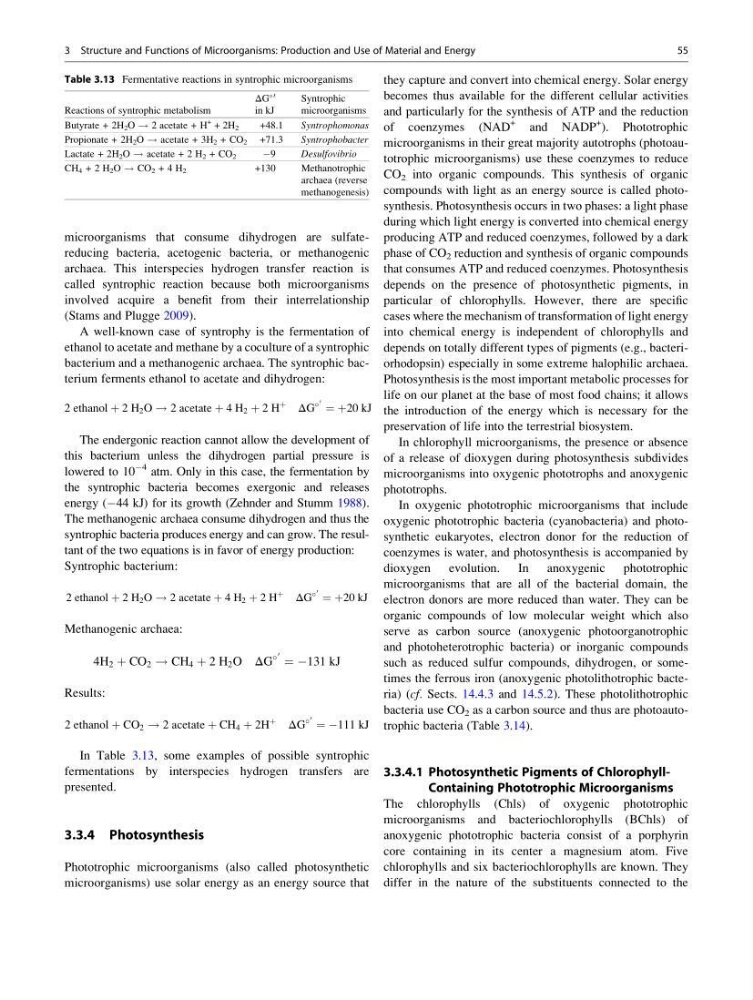
In Table 3.13, some examples of possible syntrophic
fermentations by interspecies hydrogen transfers are
presented.
3.3.4 Photosynthesis
Phototrophic microorganisms (also called photosynthetic
microorganisms) use solar energy as an energy source that
they capture and convert into chemical energy. Solar energy
becomes thus available for the different cellular activities
and particularly for the synthesis of ATP and the reduction
of coenzymes (NAD
+
and NADP
+
). Phototrophic
microorganisms in their great majority autotrophs (photoautotrophic microorganisms) use these coenzymes to reduce
CO 2 into organic compounds. This synthesis of organic
compounds with light as an energy source is called photosynthesis. Photosynthesis occurs in two phases: a light phase
during which light energy is converted into chemical energy
producing ATP and reduced coenzymes, followed by a dark
phase of CO 2 reduction and synthesis of organic compounds
that consumes ATP and reduced coenzymes. Photosynthesis
depends on the presence of photosynthetic pigments, in
particular of chlorophylls. However, there are specific
cases where the mechanism of transformation of light energy
into chemical energy is independent of chlorophylls and
depends on totally different types of pigments (e.g., bacteriorhodopsin) especially in some extreme halophilic archaea.
Photosynthesis is the most important metabolic processes for
life on our planet at the base of most food chains; it allows
the introduction of the energy which is necessary for the
preservation of life into the terrestrial biosystem.
In chlorophyll microorganisms, the presence or absence
of a release of dioxygen during photosynthesis subdivides
microorganisms into oxygenic phototrophs and anoxygenic
phototrophs.
In oxygenic phototrophic microorganisms that include
oxygenic phototrophic bacteria (cyanobacteria) and photosynthetic eukaryotes, electron donor for the reduction of
coenzymes is water, and photosynthesis is accompanied by
dioxygen evolution. In anoxygenic phototrophic
microorganisms that are all of the bacterial domain, the
electron donors are more reduced than water. They can be
organic compounds of low molecular weight which also
serve as carbon source (anoxygenic photoorganotrophic
and photoheterotrophic bacteria) or inorganic compounds
such as reduced sulfur compounds, dihydrogen, or sometimes the ferrous iron (anoxygenic photolithotrophic bacteria) (cf. Sects. 14.4.3 and 14.5.2). These photolithotrophic
bacteria use CO 2 as a carbon source and thus are photoautotrophic bacteria (Table 3.14).
3.3.4.1 Photosynthetic Pigments of ChlorophyllContaining Phototrophic Microorganisms
The chlorophylls (Chls) of oxygenic phototrophic
microorganisms and bacteriochlorophylls (BChls) of
anoxygenic phototrophic bacteria consist of a porphyrin
core containing in its center a magnesium atom. Five
chlorophylls and six bacteriochlorophylls are known. They
differ in the nature of the substituents connected to the
Table 3.13 Fermentative reactions in syntrophic microorganisms
Reactions of syntrophic metabolism
ΔG
0
in kJ
Syntrophic
microorganisms
Butyrate + 2H 2 O ! 2 acetate + H
+ + 2H 2
+48.1
Syntrophomonas
Propionate + 2H 2 O ! acetate + 3H 2 + CO 2 +71.3
Syntrophobacter
Lactate + 2H 2 O ! acetate + 2 H 2 + CO 2
À9
Desulfovibrio
CH 4 + 2 H 2 O ! CO 2 + 4 H 2
+130
Methanotrophic
archaea (reverse
methanogenesis)
3 Structure and Functions of Microorganisms: Production and Use of Material and Energy
55
archaea. This interspecies hydrogen transfer reaction is
called syntrophic reaction because both microorganisms
involved acquire a benefit from their interrelationship
(Stams and Plugge 2009).
A well-known case of syntrophy is the fermentation of
ethanol to acetate and methane by a coculture of a syntrophic
bacterium and a methanogenic archaea. The syntrophic bacterium ferments ethanol to acetate and dihydrogen:
2 ethanol þ 2 H 2 O ! 2 acetate þ 4 H 2 þ 2 H
þ
ΔG
0 ¼ þ20 kJ
The endergonic reaction cannot allow the development of
this bacterium unless the dihydrogen partial pressure is
lowered to 10
À4 atm. Only in this case, the fermentation by
the syntrophic bacteria becomes exergonic and releases
energy (À44 kJ) for its growth (Zehnder and Stumm 1988).
The methanogenic archaea consume dihydrogen and thus the
syntrophic bacteria produces energy and can grow. The resultant of the two equations is in favor of energy production:
Syntrophic bacterium:
2 ethanol þ 2 H 2 O ! 2 acetate þ 4 H 2 þ 2 H
þ
ΔG
0 ¼ þ20 kJ
Methanogenic archaea:
4H 2 þ CO 2 ! CH 4 þ 2 H 2 O ΔG
0 ¼ À131 kJ
Results:
2 ethanol þ CO 2 ! 2 acetate þ CH 4 þ 2H
þ
ΔG
0 ¼ À111 kJ
In Table 3.13, some examples of possible syntrophic
fermentations by interspecies hydrogen transfers are
presented.
3.3.4 Photosynthesis
Phototrophic microorganisms (also called photosynthetic
microorganisms) use solar energy as an energy source that
they capture and convert into chemical energy. Solar energy
becomes thus available for the different cellular activities
and particularly for the synthesis of ATP and the reduction
of coenzymes (NAD
+
and NADP
+
). Phototrophic
microorganisms in their great majority autotrophs (photoautotrophic microorganisms) use these coenzymes to reduce
CO 2 into organic compounds. This synthesis of organic
compounds with light as an energy source is called photosynthesis. Photosynthesis occurs in two phases: a light phase
during which light energy is converted into chemical energy
producing ATP and reduced coenzymes, followed by a dark
phase of CO 2 reduction and synthesis of organic compounds
that consumes ATP and reduced coenzymes. Photosynthesis
depends on the presence of photosynthetic pigments, in
particular of chlorophylls. However, there are specific
cases where the mechanism of transformation of light energy
into chemical energy is independent of chlorophylls and
depends on totally different types of pigments (e.g., bacteriorhodopsin) especially in some extreme halophilic archaea.
Photosynthesis is the most important metabolic processes for
life on our planet at the base of most food chains; it allows
the introduction of the energy which is necessary for the
preservation of life into the terrestrial biosystem.
In chlorophyll microorganisms, the presence or absence
of a release of dioxygen during photosynthesis subdivides
microorganisms into oxygenic phototrophs and anoxygenic
phototrophs.
In oxygenic phototrophic microorganisms that include
oxygenic phototrophic bacteria (cyanobacteria) and photosynthetic eukaryotes, electron donor for the reduction of
coenzymes is water, and photosynthesis is accompanied by
dioxygen evolution. In anoxygenic phototrophic
microorganisms that are all of the bacterial domain, the
electron donors are more reduced than water. They can be
organic compounds of low molecular weight which also
serve as carbon source (anoxygenic photoorganotrophic
and photoheterotrophic bacteria) or inorganic compounds
such as reduced sulfur compounds, dihydrogen, or sometimes the ferrous iron (anoxygenic photolithotrophic bacteria) (cf. Sects. 14.4.3 and 14.5.2). These photolithotrophic
bacteria use CO 2 as a carbon source and thus are photoautotrophic bacteria (Table 3.14).
3.3.4.1 Photosynthetic Pigments of ChlorophyllContaining Phototrophic Microorganisms
The chlorophylls (Chls) of oxygenic phototrophic
microorganisms and bacteriochlorophylls (BChls) of
anoxygenic phototrophic bacteria consist of a porphyrin
core containing in its center a magnesium atom. Five
chlorophylls and six bacteriochlorophylls are known. They
differ in the nature of the substituents connected to the
Table 3.13 Fermentative reactions in syntrophic microorganisms
Reactions of syntrophic metabolism
ΔG
0
in kJ
Syntrophic
microorganisms
Butyrate + 2H 2 O ! 2 acetate + H
+ + 2H 2
+48.1
Syntrophomonas
Propionate + 2H 2 O ! acetate + 3H 2 + CO 2 +71.3
Syntrophobacter
Lactate + 2H 2 O ! acetate + 2 H 2 + CO 2
À9
Desulfovibrio
CH 4 + 2 H 2 O ! CO 2 + 4 H 2
+130
Methanotrophic
archaea (reverse
methanogenesis)
3 Structure and Functions of Microorganisms: Production and Use of Material and Energy
55