

3.3.3.4 Syntrophy Interspecies Hydrogen Transfer
During fermentation, the reaction of syntrophy* or interspecies hydrogen transfer is a mechanism involving two
microorganisms in anoxic conditions: a first microorganism
that ferments a low fermentable substrate (propionate, butyrate, ethanol) producing acetate and dihydrogen (syntrophic
microorganism: Syntrophobacter, Syntrophomonas), only in
the presence of a second microorganism that consumes the
dihydrogen as it is produced. The direct reaction of
fermentation of these poorly fermentable substrates by the
syntrophic microorganism is impossible because it is thermodynamically unfavorable. The reaction requires energy
and therefore cannot be coupled to a mechanism that
generates energy. This reaction is only possible if the
dihydrogen produced during fermentation is maintained at
a very low level (partial pressure of about 10
À4 atm or less)
by the activity of a second microorganism that consumes
dihydrogen as soon as it is produced; the main
NADH
NADH
Lactate
Acetoin
2 CO 2
CO 2
2, 3 - Butanediol
2 NADH
2 NADH
2 NADH
NADH
Succinate
Formate
Acetyl - CoA
Propionate
Ethanol
Acetate
Aceton
Butyryl - CoA
Isopropanol
Butyrate
Butanol
Pyruvate
CO 2
CO 2
CO 2
CO 2 + H 2
H 2
Acetyl - CoA
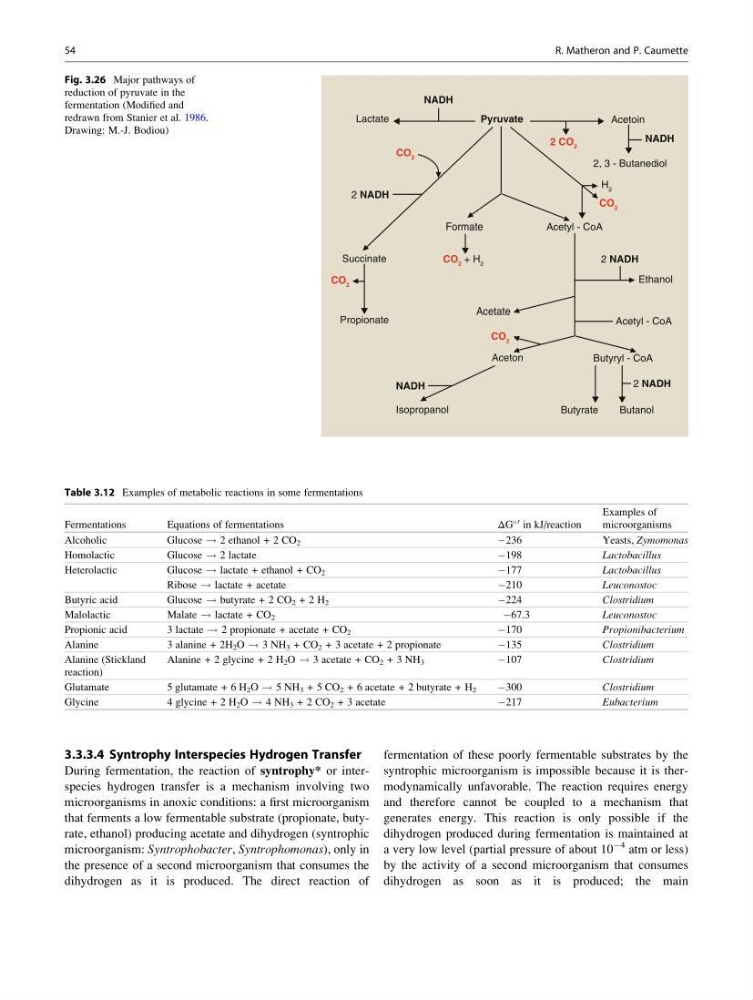
Fig. 3.26 Major pathways of
reduction of pyruvate in the
fermentation (Modified and
redrawn from Stanier et al. 1986.
Drawing: M.-J. Bodiou)
Table 3.12 Examples of metabolic reactions in some fermentations
Fermentations
Equations of fermentations
ΔG
0 in kJ/reaction
Examples of
microorganisms
Alcoholic
Glucose ! 2 ethanol + 2 CO 2
À236
Yeasts, Zymomonas
Homolactic
Glucose ! 2 lactate
À198
Lactobacillus
Heterolactic
Glucose ! lactate + ethanol + CO 2
À177
Lactobacillus
Ribose ! lactate + acetate
À210
Leuconostoc
Butyric acid
Glucose ! butyrate + 2 CO 2 + 2 H 2
À224
Clostridium
Malolactic
Malate ! lactate + CO 2
À67.3
Leuconostoc
Propionic acid
3 lactate ! 2 propionate + acetate + CO 2
À170
Propionibacterium
Alanine
3 alanine + 2H 2 O ! 3 NH 3 + CO 2 + 3 acetate + 2 propionate
À135
Clostridium
Alanine (Stickland
reaction)
Alanine + 2 glycine + 2 H 2 O ! 3 acetate + CO 2 + 3 NH 3
À107
Clostridium
Glutamate
5 glutamate + 6 H 2 O ! 5 NH 3 + 5 CO 2 + 6 acetate + 2 butyrate + H 2
À300
Clostridium
Glycine
4 glycine + 2 H 2 O ! 4 NH 3 + 2 CO 2 + 3 acetate
À217
Eubacterium
54
R. Matheron and P. Caumette
During fermentation, the reaction of syntrophy* or interspecies hydrogen transfer is a mechanism involving two
microorganisms in anoxic conditions: a first microorganism
that ferments a low fermentable substrate (propionate, butyrate, ethanol) producing acetate and dihydrogen (syntrophic
microorganism: Syntrophobacter, Syntrophomonas), only in
the presence of a second microorganism that consumes the
dihydrogen as it is produced. The direct reaction of
fermentation of these poorly fermentable substrates by the
syntrophic microorganism is impossible because it is thermodynamically unfavorable. The reaction requires energy
and therefore cannot be coupled to a mechanism that
generates energy. This reaction is only possible if the
dihydrogen produced during fermentation is maintained at
a very low level (partial pressure of about 10
À4 atm or less)
by the activity of a second microorganism that consumes
dihydrogen as soon as it is produced; the main
NADH
NADH
Lactate
Acetoin
2 CO 2
CO 2
2, 3 - Butanediol
2 NADH
2 NADH
2 NADH
NADH
Succinate
Formate
Acetyl - CoA
Propionate
Ethanol
Acetate
Aceton
Butyryl - CoA
Isopropanol
Butyrate
Butanol
Pyruvate
CO 2
CO 2
CO 2
CO 2 + H 2
H 2
Acetyl - CoA
Fig. 3.26 Major pathways of
reduction of pyruvate in the
fermentation (Modified and
redrawn from Stanier et al. 1986.
Drawing: M.-J. Bodiou)
Table 3.12 Examples of metabolic reactions in some fermentations
Fermentations
Equations of fermentations
ΔG
0 in kJ/reaction
Examples of
microorganisms
Alcoholic
Glucose ! 2 ethanol + 2 CO 2
À236
Yeasts, Zymomonas
Homolactic
Glucose ! 2 lactate
À198
Lactobacillus
Heterolactic
Glucose ! lactate + ethanol + CO 2
À177
Lactobacillus
Ribose ! lactate + acetate
À210
Leuconostoc
Butyric acid
Glucose ! butyrate + 2 CO 2 + 2 H 2
À224
Clostridium
Malolactic
Malate ! lactate + CO 2
À67.3
Leuconostoc
Propionic acid
3 lactate ! 2 propionate + acetate + CO 2
À170
Propionibacterium
Alanine
3 alanine + 2H 2 O ! 3 NH 3 + CO 2 + 3 acetate + 2 propionate
À135
Clostridium
Alanine (Stickland
reaction)
Alanine + 2 glycine + 2 H 2 O ! 3 acetate + CO 2 + 3 NH 3
À107
Clostridium
Glutamate
5 glutamate + 6 H 2 O ! 5 NH 3 + 5 CO 2 + 6 acetate + 2 butyrate + H 2
À300
Clostridium
Glycine
4 glycine + 2 H 2 O ! 4 NH 3 + 2 CO 2 + 3 acetate
À217
Eubacterium
54
R. Matheron and P. Caumette