

3. In homolactic bacteria, excretion of lactate takes place by
symport with H
+ forming a proton gradient.
These different processes which concern only special
cases in fermentations allow an additional production of
energy.
3.3.3.3 Diversity of Fermentations and Their
Metabolic Pathways
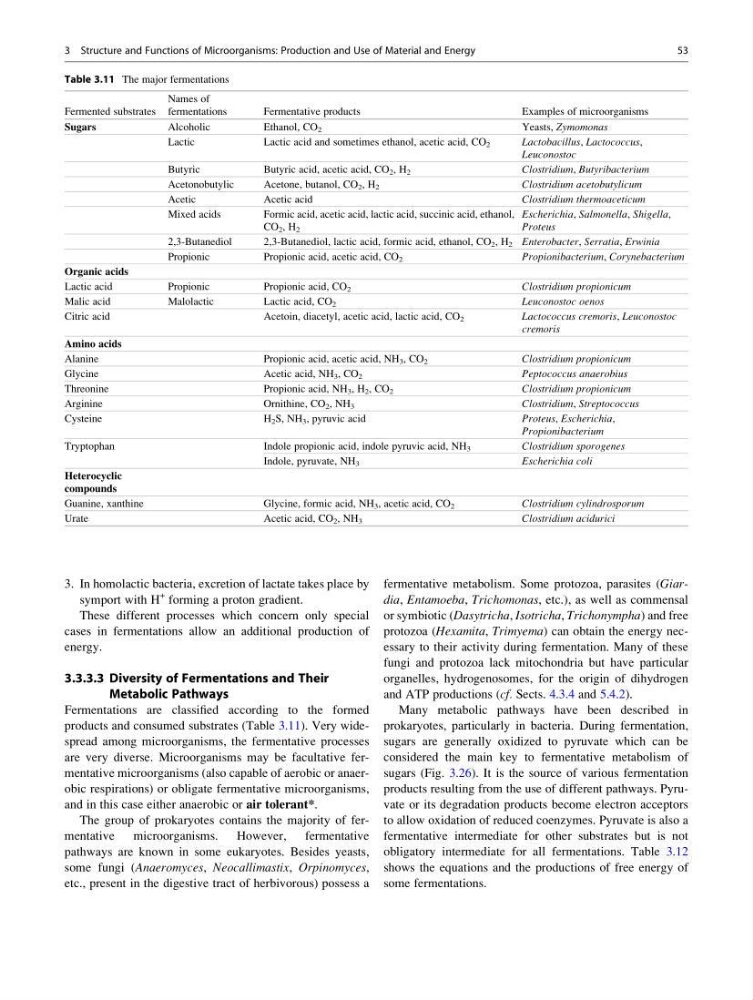
Fermentations are classified according to the formed
products and consumed substrates (Table 3.11). Very widespread among microorganisms, the fermentative processes
are very diverse. Microorganisms may be facultative fermentative microorganisms (also capable of aerobic or anaerobic respirations) or obligate fermentative microorganisms,
and in this case either anaerobic or air tolerant*.
The group of prokaryotes contains the majority of fermentative microorganisms. However, fermentative
pathways are known in some eukaryotes. Besides yeasts,
some fungi (Anaeromyces, Neocallimastix, Orpinomyces,
etc., present in the digestive tract of herbivorous) possess a
fermentative metabolism. Some protozoa, parasites (Giardia, Entamoeba, Trichomonas, etc.), as well as commensal
or symbiotic (Dasytricha, Isotricha, Trichonympha) and free
protozoa (Hexamita, Trimyema) can obtain the energy necessary to their activity during fermentation. Many of these
fungi and protozoa lack mitochondria but have particular
organelles, hydrogenosomes, for the origin of dihydrogen
and ATP productions (cf. Sects. 4.3.4 and 5.4.2).
Many metabolic pathways have been described in
prokaryotes, particularly in bacteria. During fermentation,
sugars are generally oxidized to pyruvate which can be
considered the main key to fermentative metabolism of
sugars (Fig. 3.26). It is the source of various fermentation
products resulting from the use of different pathways. Pyruvate or its degradation products become electron acceptors
to allow oxidation of reduced coenzymes. Pyruvate is also a
fermentative intermediate for other substrates but is not
obligatory intermediate for all fermentations. Table 3.12
shows the equations and the productions of free energy of
some fermentations.
Table 3.11 The major fermentations
Fermented substrates
Names of
fermentations
Fermentative products
Examples of microorganisms
Sugars
Alcoholic
Ethanol, CO 2
Yeasts, Zymomonas
Lactic
Lactic acid and sometimes ethanol, acetic acid, CO 2
Lactobacillus, Lactococcus,
Leuconostoc
Butyric
Butyric acid, acetic acid, CO 2 , H 2
Clostridium, Butyribacterium
Acetonobutylic
Acetone, butanol, CO 2 , H 2
Clostridium acetobutylicum
Acetic
Acetic acid
Clostridium thermoaceticum
Mixed acids
Formic acid, acetic acid, lactic acid, succinic acid, ethanol,
CO 2 , H 2
Escherichia, Salmonella, Shigella,
Proteus
2,3-Butanediol
2,3-Butanediol, lactic acid, formic acid, ethanol, CO 2 , H 2 Enterobacter, Serratia, Erwinia
Propionic
Propionic acid, acetic acid, CO 2
Propionibacterium, Corynebacterium
Organic acids
Lactic acid
Propionic
Propionic acid, CO 2
Clostridium propionicum
Malic acid
Malolactic
Lactic acid, CO 2
Leuconostoc oenos
Citric acid
Acetoin, diacetyl, acetic acid, lactic acid, CO 2
Lactococcus cremoris, Leuconostoc
cremoris
Amino acids
Alanine
Propionic acid, acetic acid, NH 3 , CO 2
Clostridium propionicum
Glycine
Acetic acid, NH 3 , CO 2
Peptococcus anaerobius
Threonine
Propionic acid, NH 3 , H 2 , CO 2
Clostridium propionicum
Arginine
Ornithine, CO 2 , NH 3
Clostridium, Streptococcus
Cysteine
H 2 S, NH 3 , pyruvic acid
Proteus, Escherichia,
Propionibacterium
Tryptophan
Indole propionic acid, indole pyruvic acid, NH 3
Clostridium sporogenes
Indole, pyruvate, NH 3
Escherichia coli
Heterocyclic
compounds
Guanine, xanthine
Glycine, formic acid, NH 3 , acetic acid, CO 2
Clostridium cylindrosporum
Urate
Acetic acid, CO 2 , NH 3
Clostridium acidurici
3 Structure and Functions of Microorganisms: Production and Use of Material and Energy
53
symport with H
+ forming a proton gradient.
These different processes which concern only special
cases in fermentations allow an additional production of
energy.
3.3.3.3 Diversity of Fermentations and Their
Metabolic Pathways
Fermentations are classified according to the formed
products and consumed substrates (Table 3.11). Very widespread among microorganisms, the fermentative processes
are very diverse. Microorganisms may be facultative fermentative microorganisms (also capable of aerobic or anaerobic respirations) or obligate fermentative microorganisms,
and in this case either anaerobic or air tolerant*.
The group of prokaryotes contains the majority of fermentative microorganisms. However, fermentative
pathways are known in some eukaryotes. Besides yeasts,
some fungi (Anaeromyces, Neocallimastix, Orpinomyces,
etc., present in the digestive tract of herbivorous) possess a
fermentative metabolism. Some protozoa, parasites (Giardia, Entamoeba, Trichomonas, etc.), as well as commensal
or symbiotic (Dasytricha, Isotricha, Trichonympha) and free
protozoa (Hexamita, Trimyema) can obtain the energy necessary to their activity during fermentation. Many of these
fungi and protozoa lack mitochondria but have particular
organelles, hydrogenosomes, for the origin of dihydrogen
and ATP productions (cf. Sects. 4.3.4 and 5.4.2).
Many metabolic pathways have been described in
prokaryotes, particularly in bacteria. During fermentation,
sugars are generally oxidized to pyruvate which can be
considered the main key to fermentative metabolism of
sugars (Fig. 3.26). It is the source of various fermentation
products resulting from the use of different pathways. Pyruvate or its degradation products become electron acceptors
to allow oxidation of reduced coenzymes. Pyruvate is also a
fermentative intermediate for other substrates but is not
obligatory intermediate for all fermentations. Table 3.12
shows the equations and the productions of free energy of
some fermentations.
Table 3.11 The major fermentations
Fermented substrates
Names of
fermentations
Fermentative products
Examples of microorganisms
Sugars
Alcoholic
Ethanol, CO 2
Yeasts, Zymomonas
Lactic
Lactic acid and sometimes ethanol, acetic acid, CO 2
Lactobacillus, Lactococcus,
Leuconostoc
Butyric
Butyric acid, acetic acid, CO 2 , H 2
Clostridium, Butyribacterium
Acetonobutylic
Acetone, butanol, CO 2 , H 2
Clostridium acetobutylicum
Acetic
Acetic acid
Clostridium thermoaceticum
Mixed acids
Formic acid, acetic acid, lactic acid, succinic acid, ethanol,
CO 2 , H 2
Escherichia, Salmonella, Shigella,
Proteus
2,3-Butanediol
2,3-Butanediol, lactic acid, formic acid, ethanol, CO 2 , H 2 Enterobacter, Serratia, Erwinia
Propionic
Propionic acid, acetic acid, CO 2
Propionibacterium, Corynebacterium
Organic acids
Lactic acid
Propionic
Propionic acid, CO 2
Clostridium propionicum
Malic acid
Malolactic
Lactic acid, CO 2
Leuconostoc oenos
Citric acid
Acetoin, diacetyl, acetic acid, lactic acid, CO 2
Lactococcus cremoris, Leuconostoc
cremoris
Amino acids
Alanine
Propionic acid, acetic acid, NH 3 , CO 2
Clostridium propionicum
Glycine
Acetic acid, NH 3 , CO 2
Peptococcus anaerobius
Threonine
Propionic acid, NH 3 , H 2 , CO 2
Clostridium propionicum
Arginine
Ornithine, CO 2 , NH 3
Clostridium, Streptococcus
Cysteine
H 2 S, NH 3 , pyruvic acid
Proteus, Escherichia,
Propionibacterium
Tryptophan
Indole propionic acid, indole pyruvic acid, NH 3
Clostridium sporogenes
Indole, pyruvate, NH 3
Escherichia coli
Heterocyclic
compounds
Guanine, xanthine
Glycine, formic acid, NH 3 , acetic acid, CO 2
Clostridium cylindrosporum
Urate
Acetic acid, CO 2 , NH 3
Clostridium acidurici
3 Structure and Functions of Microorganisms: Production and Use of Material and Energy
53