

photosystems operate simultaneously; electrons are transferred from photosystem II to photosystem I.
By absorbing a photon, the P680 dimer of photosystem II
passes from a ground state to an excited state which is
strongly reduced, allowing the transfer of electron along
the first chain of electron carriers to the RC of photosystem
I (P 700). For this, P680 dimer gives its electron very quickly
to a pheophytin (Chl molecule devoid of magnesium) at low
redox potential which transfers it to the chain of electron
carriers. A new light excitement transfers another electron
and so on. The electrons are used for reducing the dimer
P700 when excited by light. This transfer is accompanied by
a translocation of protons in the center of the thylakoid to the
origin of a proton-motive force that generates ATP by photophosphorylation via ATP synthases of the thylakoid. Chl
of photosystem II, which has lost electrons during its excitation by light, recovers electrons from a water molecule. The
Chl
oxdized /Chl couple having a redox potential higher than
O 2 /H 2 O redox couple (+0.9 and +0.82 volts, respectively)
gives this reaction thermodynamically possible. The oxidation of the water molecule by loss of electrons is
accompanied by release of dioxygen. The protons released
contribute to the formation of the proton gradient at the level
of the thylakoid membrane:
H 2 O ! 2 e
À
þ 2 H
þ
þ ½ O 2
In photosystem I, the electron of the dimer of Chl a
(P700) excited by a photon is transferred to a first carrier
A0 (Chl a modified) and then a second A1. Then the
electrons pass through a chain of carriers containing iron
sulfur protein and ferredoxin. Finally, the electrons are
transferred to NADP reductase that reduces the coenzyme.
The reduction of the coenzyme with water as electron donor
is thermodynamically unfavorable:
NADP
þ þ H 2 O ! NADPH, H
þ þ ½ O 2 ΔG
0 ¼ þ220 kJ=NADP
þ
Both activation steps are needed to bring the electrons at
the top of photosystem I which represents the energy change
required for efficient transfer of electrons from water to
NADP
+
. This flux of electrons in one direction is noncyclic
transport or noncyclic photophosphorylation which is also
called schema “Z.”
When the reducing power (NADPH, H
+
) is sufficiently
large, cyclic electron transfer or cyclic photophosphorylation
takes place involving only photosystem I. The electrons transit directly from Fd to complex b/f to reduce the P700 Chl.
This transfer creates a proton gradient for ATP formation.
3.3.4.3 Anoxygenic Photosynthesis (Fig. 3.29a–c)
Anoxygenic phototrophic bacteria have only one photosystem. Photosystem of phototrophic purple bacteria is
Chloroplast
membrane
Cytoplasmic
membrane
Cytoplasmic
membrane
Cytoplasmic
membrane
Cytoplasmic
membrane
Thylakoid
Thylakoid
( PA + RC )
( RC )
Phycobilisome
( PA )
Chloroplast
Phototrophic eukaryote
Cyanobacteria
Green phototrophic
bacteria
Purple phototrophic
bacteria
Cell wall
Cell wall
Cell wall
R.C.
Chlorosome
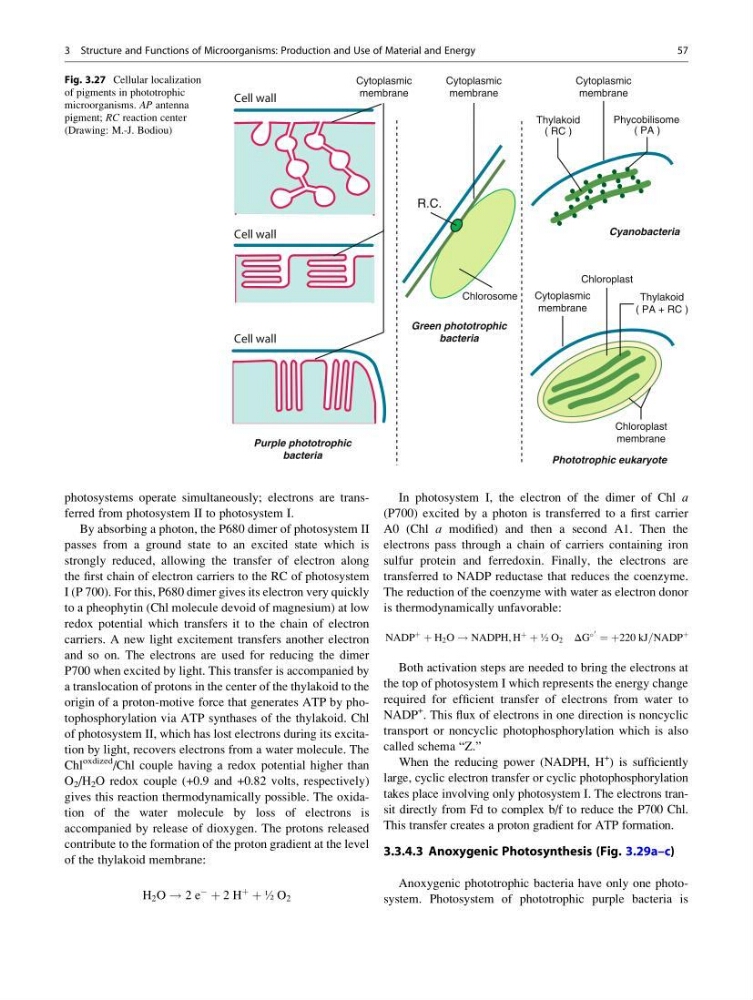
Fig. 3.27 Cellular localization
of pigments in phototrophic
microorganisms. AP antenna
pigment; RC reaction center
(Drawing: M.-J. Bodiou)
3 Structure and Functions of Microorganisms: Production and Use of Material and Energy
57
By absorbing a photon, the P680 dimer of photosystem II
passes from a ground state to an excited state which is
strongly reduced, allowing the transfer of electron along
the first chain of electron carriers to the RC of photosystem
I (P 700). For this, P680 dimer gives its electron very quickly
to a pheophytin (Chl molecule devoid of magnesium) at low
redox potential which transfers it to the chain of electron
carriers. A new light excitement transfers another electron
and so on. The electrons are used for reducing the dimer
P700 when excited by light. This transfer is accompanied by
a translocation of protons in the center of the thylakoid to the
origin of a proton-motive force that generates ATP by photophosphorylation via ATP synthases of the thylakoid. Chl
of photosystem II, which has lost electrons during its excitation by light, recovers electrons from a water molecule. The
Chl
oxdized /Chl couple having a redox potential higher than
O 2 /H 2 O redox couple (+0.9 and +0.82 volts, respectively)
gives this reaction thermodynamically possible. The oxidation of the water molecule by loss of electrons is
accompanied by release of dioxygen. The protons released
contribute to the formation of the proton gradient at the level
of the thylakoid membrane:
H 2 O ! 2 e
À
þ 2 H
þ
þ ½ O 2
In photosystem I, the electron of the dimer of Chl a
(P700) excited by a photon is transferred to a first carrier
A0 (Chl a modified) and then a second A1. Then the
electrons pass through a chain of carriers containing iron
sulfur protein and ferredoxin. Finally, the electrons are
transferred to NADP reductase that reduces the coenzyme.
The reduction of the coenzyme with water as electron donor
is thermodynamically unfavorable:
NADP
þ þ H 2 O ! NADPH, H
þ þ ½ O 2 ΔG
0 ¼ þ220 kJ=NADP
þ
Both activation steps are needed to bring the electrons at
the top of photosystem I which represents the energy change
required for efficient transfer of electrons from water to
NADP
+
. This flux of electrons in one direction is noncyclic
transport or noncyclic photophosphorylation which is also
called schema “Z.”
When the reducing power (NADPH, H
+
) is sufficiently
large, cyclic electron transfer or cyclic photophosphorylation
takes place involving only photosystem I. The electrons transit directly from Fd to complex b/f to reduce the P700 Chl.
This transfer creates a proton gradient for ATP formation.
3.3.4.3 Anoxygenic Photosynthesis (Fig. 3.29a–c)
Anoxygenic phototrophic bacteria have only one photosystem. Photosystem of phototrophic purple bacteria is
Chloroplast
membrane
Cytoplasmic
membrane
Cytoplasmic
membrane
Cytoplasmic
membrane
Cytoplasmic
membrane
Thylakoid
Thylakoid
( PA + RC )
( RC )
Phycobilisome
( PA )
Chloroplast
Phototrophic eukaryote
Cyanobacteria
Green phototrophic
bacteria
Purple phototrophic
bacteria
Cell wall
Cell wall
Cell wall
R.C.
Chlorosome
Fig. 3.27 Cellular localization
of pigments in phototrophic
microorganisms. AP antenna
pigment; RC reaction center
(Drawing: M.-J. Bodiou)
3 Structure and Functions of Microorganisms: Production and Use of Material and Energy
57