

Phosphotriesterases are involved in the transformation of
organophosphorus insecticides: parathion is converted
either into paraoxon by hydrolysis of the P–S bond or
into paranitrophenol and diethylthiophosphoric acid by
hydrolysis of the O–P bond. There are several examples
of hydrolases that target the C–N bond. A microbial
nitrilase converts bromoxynil into 3,5-dibromo-4hydroxybenzoate. Amido and chlorohydrolases play a
a : 1,2 DHDN dehydrogenase (EC 1.3.1.29)
HO
OH
OH
OH
1,2-DHDN
1,2-DHN
NAD
+
NADH + H
+
b : isoproturon demethylamine dehydrogenase (E.C.1.5.99.-)
NH
N
CH 3
H 3 C
H 3 C
H 3 C
H 3 C
CH 3
CH 3
O
NH
NH
O
H 2 O HCHO + 2 H
+ + 2 e
-
isoproturon
MDMI
c - 1 : 3,5-DCC 1,2 dioxygenase (E.C. 1.13.11.-)
Cl
OH
OH
Cl
CH
Cl
Cl
COOO 2
2 H
+
3,5-DCC
2,4-DCM
c – 2 : 4-CC 2,3-dioxygenase (EC 1.13.11.2)
OH
OH
Cl
OH
Cl
COO
COO
4-chlorocatéchol
O 2
H
+
CHMS
d – 1 : 2,4-DCP hydroxylase (E.C. 1.14.13.20)
OH
Cl
Cl
Cl
OH
OH
Cl
NADPH H
+ + H
+ + O 2 NADP
+ + H 2 O
2,4-DCP
3,5-DCC
d – 2 : atrazine monooxygenase (E.C. 1.14.15.-)
N
N
N
Cl
NH 2
NH
N
N
N
Cl
NH
NH
atrazine
DEA
CH 3 CHO
1/2 O 2
e : reductive dehalogenase (E.C. 1.97.1.-) (halorespiration)
H 2
H
+ + Cl
-
ATP
COO
Cl
COO
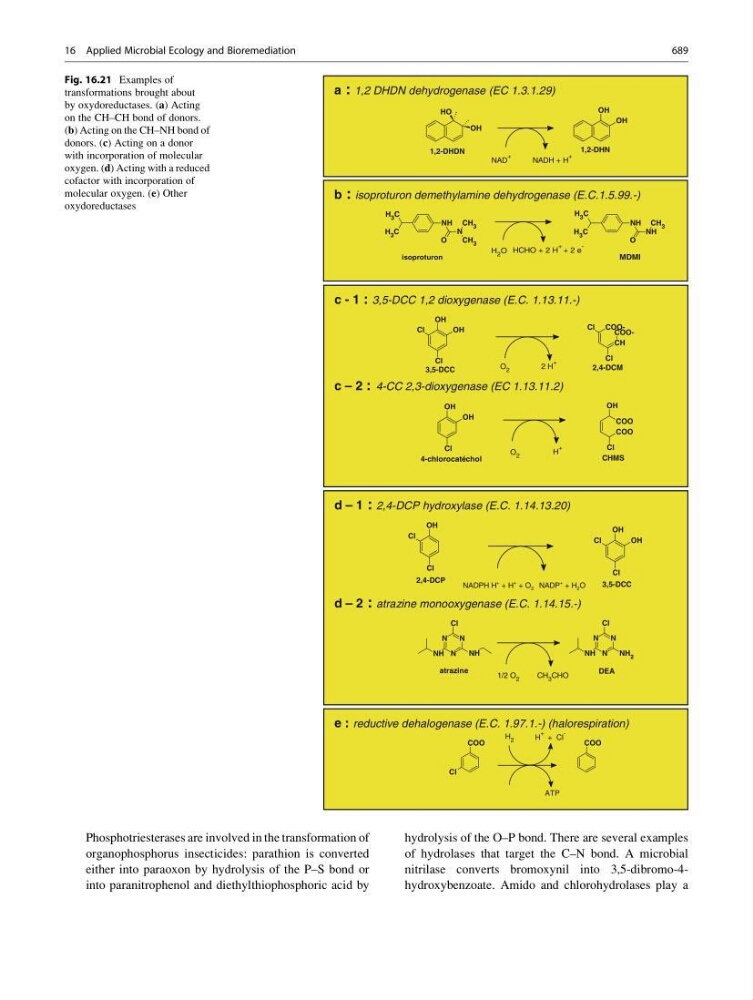
Fig. 16.21 Examples of
transformations brought about
by oxydoreductases. (a) Acting
on the CH–CH bond of donors.
(b) Acting on the CH–NH bond of
donors. (c) Acting on a donor
with incorporation of molecular
oxygen. (d) Acting with a reduced
cofactor with incorporation of
molecular oxygen. (e) Other
oxydoreductases
16 Applied Microbial Ecology and Bioremediation
689