

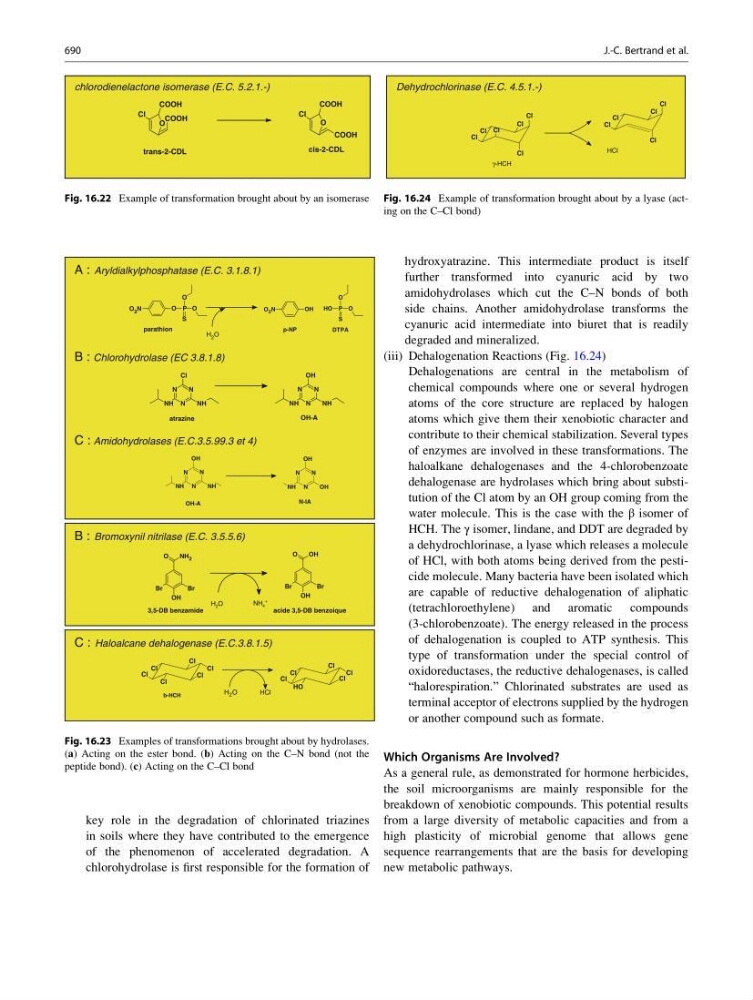
key role in the degradation of chlorinated triazines
in soils where they have contributed to the emergence
of the phenomenon of accelerated degradation. A
chlorohydrolase is first responsible for the formation of
hydroxyatrazine. This intermediate product is itself
further transformed into cyanuric acid by two
amidohydrolases which cut the C–N bonds of both
side chains. Another amidohydrolase transforms the
cyanuric acid intermediate into biuret that is readily
degraded and mineralized.
(iii) Dehalogenation Reactions (Fig. 16.24)
Dehalogenations are central in the metabolism of
chemical compounds where one or several hydrogen
atoms of the core structure are replaced by halogen
atoms which give them their xenobiotic character and
contribute to their chemical stabilization. Several types
of enzymes are involved in these transformations. The
haloalkane dehalogenases and the 4-chlorobenzoate
dehalogenase are hydrolases which bring about substitution of the Cl atom by an OH group coming from the
water molecule. This is the case with the β isomer of
HCH. The γ isomer, lindane, and DDT are degraded by
a dehydrochlorinase, a lyase which releases a molecule
of HCl, with both atoms being derived from the pesticide molecule. Many bacteria have been isolated which
are capable of reductive dehalogenation of aliphatic
(tetrachloroethylene) and aromatic compounds
(3-chlorobenzoate). The energy released in the process
of dehalogenation is coupled to ATP synthesis. This
type of transformation under the special control of
oxidoreductases, the reductive dehalogenases, is called
“halorespiration.” Chlorinated substrates are used as
terminal acceptor of electrons supplied by the hydrogen
or another compound such as formate.
Which Organisms Are Involved?
As a general rule, as demonstrated for hormone herbicides,
the soil microorganisms are mainly responsible for the
breakdown of xenobiotic compounds. This potential results
from a large diversity of metabolic capacities and from a
high plasticity of microbial genome that allows gene
sequence rearrangements that are the basis for developing
new metabolic pathways.
chlorodienelactone isomerase (E.C. 5.2.1.-)
trans-2-CDL
cis-2-CDL
Cl
O
COOH
COOH
Cl
O
COOH
COOH
Fig. 16.22 Example of transformation brought about by an isomerase
A : Aryldialkylphosphatase (E.C. 3.1.8.1)
O 2 N
O P
O
S
O
O 2 N
OH
HO P
O
S
O
H 2 O
parathion
p-NP
DTPA
B : Chlorohydrolase (EC 3.8.1.8)
atrazine
OH-A
N
N
N
Cl
NH
NH
N
N
N
OH
NH
NH
C : Amidohydrolases (E.C.3.5.99.3 et 4)
N
N
N
OH
NH
NH
N
N
N
OH
OH
NH
OH-A
N-IA
B : Bromoxynil nitrilase (E.C. 3.5.5.6)
Br
Br
OH
NH 2
O
Br
OH
Br
O
H
O
H 2 O
NH 4
+
3,5-DB benzamide
acide 3,5-DB benzoique
C : Haloalcane dehalogenase (E.C.3.8.1.5)
H 2 O
HCl
b-HCH
Cl
HO
Cl
Cl
Cl
Cl
Cl
Cl
Cl
Cl
Cl
Cl
Fig. 16.23 Examples of transformations brought about by hydrolases.
(a) Acting on the ester bond. (b) Acting on the C–N bond (not the
peptide bond). (c) Acting on the C–Cl bond
Dehydrochlorinase (E.C. 4.5.1.-)
Cl
Cl
Cl
Cl
Cl
Cl
Cl
Cl
Cl
Cl
Cl
HCl
γ-HCH
Fig. 16.24 Example of transformation brought about by a lyase (acting on the C–Cl bond)
690
J.-C. Bertrand et al.