

same class brings about N-demethylation of isoproturon
with an unspecified acceptor. N-dealkylation of atrazine
in soils is mediated via a monooxygenase, a cytochrome
P450*, in the presence of molecular oxygen. This
enzyme brings about the incorporation of one atom of
oxygen on the substrate, the other atom reacts with the
electrons a cofactor (often NAD(P)H) to form a water
molecule. Some monooxygenases and dioxygenases are
involved in the degradation of aromatic rings, which are
often the basic structure of xenobiotic chemicals.
They are central in the enzyme machinery of soil
microorganisms as they are key players in the degradation of natural polymers that make up the soil organic
matter. A specific subclass, the hydroxylases, contributes
to the formation of dihydrodiols and/or catechols preparing the opening of aromatic rings by another group of
dioxygenases. They catalyze the incorporation of one or
both atoms of molecular oxygen in the presence of NAD
(P)H as a donor. Complete mineralization of aromatic
compounds may also depend on intramolecular rearrangements. The transformation of geometric isomers is
mediated by isomerases (Fig. 16.22). Nitroreductases
are also oxidoreductases which catalyze the reduction
of NO 2 groups present in some cycles such as parathion
and trifluralin in the presence of NAD (P) H. These
amino derivatives are probably involved in the formation
of bound residues. Microorganisms also produce a wide
range of other oxidative enzymes, peroxidase, laccase,
and tyrosinase that catalyze very specific transformations
producing minor structural changes. These transformations are collectively called “detoxification
reactions*” as they generally contribute to a decrease
in the biological activity. Soil fungi are mainly responsible for these transformations. Some of the products of
these transformations, e.g., quinone derivatives, have the
ability to react spontaneously to form polymers which
are included in the pool of non-extractable bound
residues. With 3,4-dichloroaniline however (a metabolite
of phenyl carbamates and phenylurea), one can observe
the formation of tetrachloroazobenzenes with carcinogenic activity. Other oxidative transformations by conjugation such as methylation and acetylation have been
reported. They are still very poorly documented.
(ii) Hydrolysis Reactions (Fig. 16.23)
Hydrolases are another class of enzymes that frequently
bring about degradation of pesticides. Ester, amide, or
carbon-halogen bonds are broken by hydrolases. They
generally operate in the absence of redox cofactors.
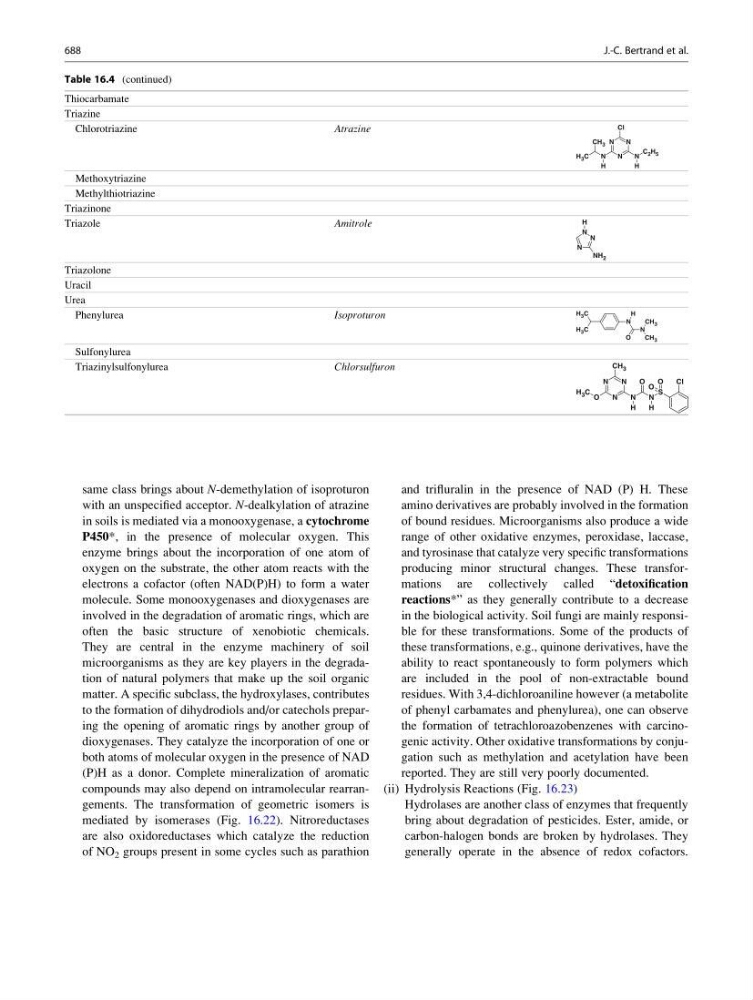
Table 16.4 (continued)
Thiocarbamate
Triazine
Chlorotriazine
Atrazine
N
N
N
N
N
Cl
H
C 2 H 5
H
CH 3
H 3 C
Methoxytriazine
Methylthiotriazine
Triazinone
Triazole
Amitrole
N
N
N
NH 2
H
Triazolone
Uracil
Urea
Phenylurea
Isoproturon
N
N
CH 3
H 3 C
H 3 C
CH 3
H
O
Sulfonylurea
Triazinylsulfonylurea
Chlorsulfuron
N
N
N
CH 3
O
N
H
N
O
H
S
O
O
H 3 C
Cl
688
J.-C. Bertrand et al.