

discharge standards. The two sets of membrane reactors
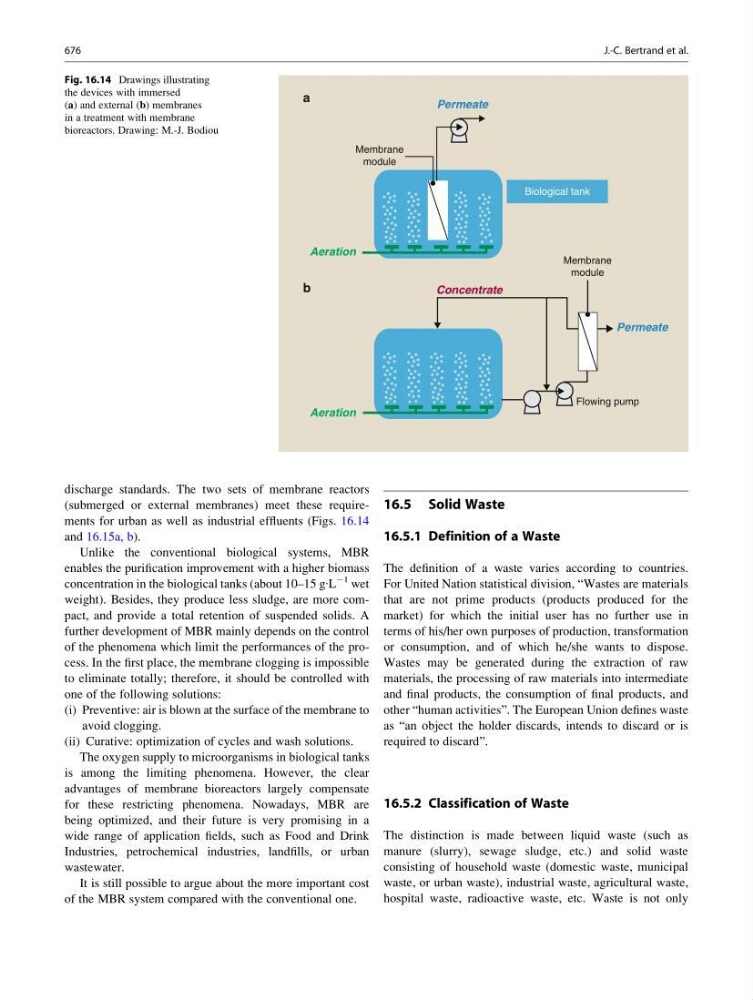
(submerged or external membranes) meet these requirements for urban as well as industrial effluents (Figs. 16.14
and 16.15a, b).
Unlike the conventional biological systems, MBR
enables the purification improvement with a higher biomass
concentration in the biological tanks (about 10–15 g∙L
À1 wet
weight). Besides, they produce less sludge, are more compact, and provide a total retention of suspended solids. A
further development of MBR mainly depends on the control
of the phenomena which limit the performances of the process. In the first place, the membrane clogging is impossible
to eliminate totally; therefore, it should be controlled with
one of the following solutions:
(i) Preventive: air is blown at the surface of the membrane to
avoid clogging.
(ii) Curative: optimization of cycles and wash solutions.
The oxygen supply to microorganisms in biological tanks
is among the limiting phenomena. However, the clear
advantages of membrane bioreactors largely compensate
for these restricting phenomena. Nowadays, MBR are
being optimized, and their future is very promising in a
wide range of application fields, such as Food and Drink
Industries, petrochemical industries, landfills, or urban
wastewater.
It is still possible to argue about the more important cost
of the MBR system compared with the conventional one.
16.5 Solid Waste
16.5.1 Definition of a Waste
The definition of a waste varies according to countries.
For United Nation statistical division, “Wastes are materials
that are not prime products (products produced for the
market) for which the initial user has no further use in
terms of his/her own purposes of production, transformation
or consumption, and of which he/she wants to dispose.
Wastes may be generated during the extraction of raw
materials, the processing of raw materials into intermediate
and final products, the consumption of final products, and
other “human activities”. The European Union defines waste
as “an object the holder discards, intends to discard or is
required to discard”.
16.5.2 Classification of Waste
The distinction is made between liquid waste (such as
manure (slurry), sewage sludge, etc.) and solid waste
consisting of household waste (domestic waste, municipal
waste, or urban waste), industrial waste, agricultural waste,
hospital waste, radioactive waste, etc. Waste is not only
Permeate
Permeate
Concentrate
Membrane
module
Membrane
module
Aeration
Aeration
Biological tank
Flowing pump
a
b
Fig. 16.14 Drawings illustrating
the devices with immersed
(a) and external (b) membranes
in a treatment with membrane
bioreactors. Drawing: M.-J. Bodiou
676
J.-C. Bertrand et al.