

which releases very little energy (cf. Sects. 3.3.2 and 3.3.3).
This treatment mode is generally used to purify agricultural
or industrial wastewater and to stabilize primary sludge
(sludge methanization).
16.4.3.4 Tertiary Treatments: Nitrogen
and Phosphorus Removal
by Other Processes; Complementary
Refining Treatments
If after secondary treatments nitrogen and phosphorus
concentrations do not meet standards specified by legislation, tertiary physicochemical treatments are implemented.
Nitrogen removal under the form of nitrogen can be obtained
after alkalinization and chlorination, whereas phosphates can be removed by precipitation with salts of iron,
aluminum, or calcium. Other more specific tertiary
treatments (non-exhaustive list) contribute to refine the
quality of the discharged water:
(i) Activated carbon filtration to remove organic matters,
which are resistant to biological treatments
(ii) Reduction of the load of pathogen agents by
coagulation–flocculation
(iii) Ultrafiltration, nanofiltration, and reverse osmosis
16.4.3.5 An Innovative Process: Membrane
BioReactors (MBR)
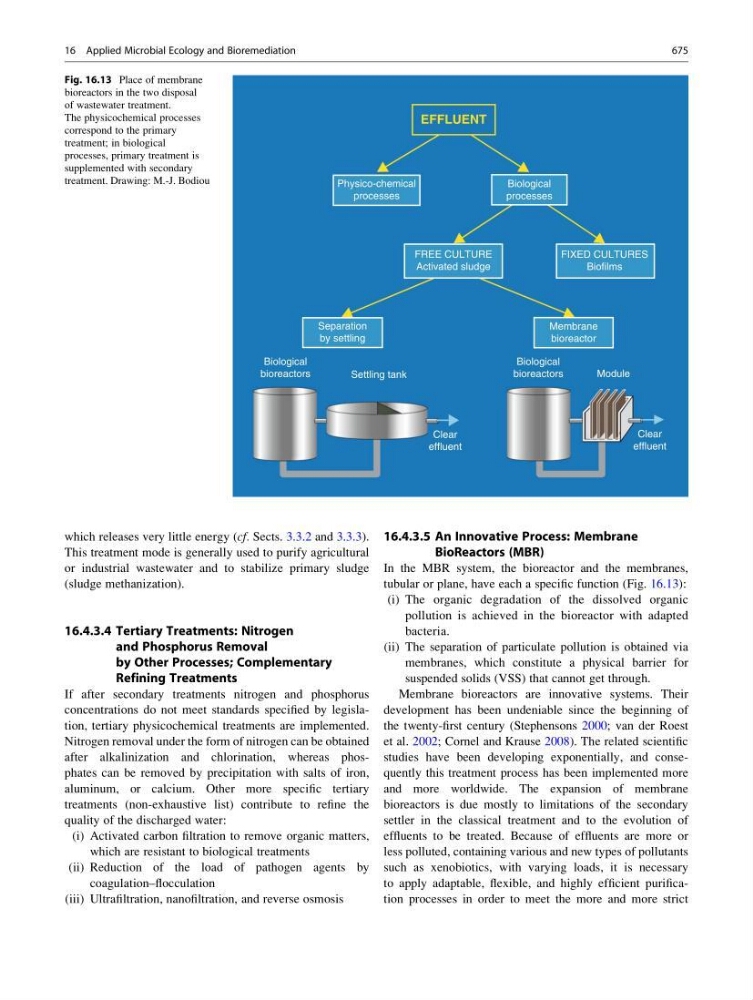
In the MBR system, the bioreactor and the membranes,
tubular or plane, have each a specific function (Fig. 16.13):
(i) The organic degradation of the dissolved organic
pollution is achieved in the bioreactor with adapted
bacteria.
(ii) The separation of particulate pollution is obtained via
membranes, which constitute a physical barrier for
suspended solids (VSS) that cannot get through.
Membrane bioreactors are innovative systems. Their
development has been undeniable since the beginning of
the twenty-first century (Stephensons 2000; van der Roest
et al. 2002; Cornel and Krause 2008). The related scientific
studies have been developing exponentially, and consequently this treatment process has been implemented more
and more worldwide. The expansion of membrane
bioreactors is due mostly to limitations of the secondary
settler in the classical treatment and to the evolution of
effluents to be treated. Because of effluents are more or
less polluted, containing various and new types of pollutants
such as xenobiotics, with varying loads, it is necessary
to apply adaptable, flexible, and highly efficient purification processes in order to meet the more and more strict
Clear
effluent
Clear
effluent
Biological
bioreactors
Biological
bioreactors
Module
Settling tank
EFFLUENT
Physico-chemical
processes
Biological
processes
FREE CULTURE
Activated sludge
FIXED CULTURES
Biofilms
Membrane
bioreactor
Separation
by settling
Fig. 16.13 Place of membrane
bioreactors in the two disposal
of wastewater treatment.
The physicochemical processes
correspond to the primary
treatment; in biological
processes, primary treatment is
supplemented with secondary
treatment. Drawing: M.-J. Bodiou
16 Applied Microbial Ecology and Bioremediation
675