

Secondary Settling in Aerobic Activated
Sludge Treatments
Another stage to separate microorganisms and the treated
liquid is necessary to prevent any discharge of suspended solids
in the natural environment. Flocs are therefore separated
from the treated water by a secondary settling (Fig. 16.12).
A part of the settled sludge is recycled in order to enable
the reseeding of the biological aerated tank (aeration tank)
and thus to maintain a biomass concentration enough to
purify the effluent (Fig. 16.8). The other part, namely, the
excessive sludge, is periodically extracted to be treated in
composting centers, for example.
In practice, activated sludge process remains limited by a
lack of flexibility towards the variations of the composition
of the pollutant loads and the biomass concentration; it is
expressed by significant secondary settling problems if the
settling is more than 4 g∙L
À1 . Besides, because of the
increase in the production capacity of the industrial sites
and of stricter discharge standards, biological wastewater
treatment plants are generally undersized and cannot meet
the specification required by the legislator. These drawbacks
have been a tremendous challenge for the scientific community and the wastewater professionals. This challenge has
been solved by the coupling of biological processes (treatment in bioreactor) and physical processes (processes with
porous membranes) with biomass recycling which led to the
membrane bioreactor (MBR).
Anaerobic Biological Treatments
The purification of effluents can also be completely carried
out in anaerobic conditions (in the biological sense) in
anaerobic reactors. During the degradation, the organic
matter is transformed into gas (carbon dioxide, methane).
Compared with aerobic purification, anaerobic purification
is slower and generates a less important biomass production,
since the involved microorganisms have a metabolism
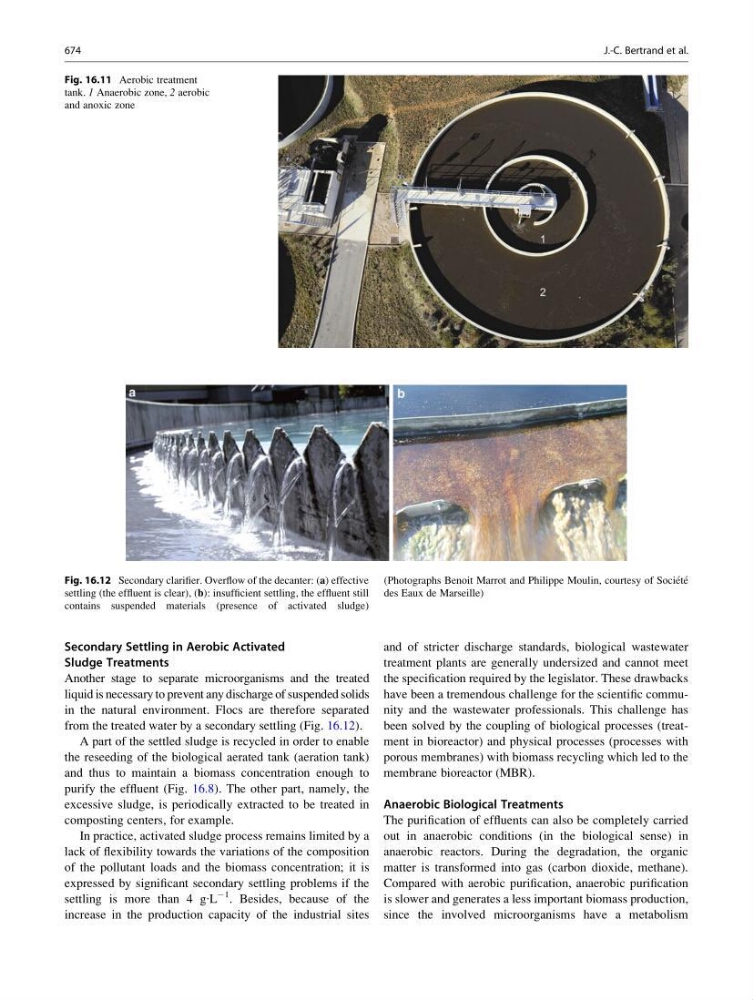
Fig. 16.11 Aerobic treatment
tank. 1 Anaerobic zone, 2 aerobic
and anoxic zone
Fig. 16.12 Secondary clarifier. Overflow of the decanter: (a) effective
settling (the effluent is clear), (b): insufficient settling, the effluent still
contains suspended materials (presence of activated sludge)
(Photographs Benoit Marrot and Philippe Moulin, courtesy of Socie ´te ´
des Eaux de Marseille)
674
J.-C. Bertrand et al.