

and in the intermediate one to denitrification (Degre ´mont
2008). Alternation in the aerobic tank of aerated and nonaerated periods (sequential aeration) enables the combination of aerobic treatment and denitrification in the same
tank. Wastewater professionals use the expression
"biological treatement by referring to the whole processes
that they define as aerobic, anoxic, and anaerobic wastewater
are submitted to.
Anoxic
tank
Aeration
tank
Treatment processes
for sludge
Pretreatment
and
primary
treatment
a
Waste
water
Secondary
settling
tank
Clear
effluent
Primary sludge
Recycling
Secondary recycled sludge
Secondary sludge
b
Pretreatment
and
primary
treatment
Anaerobic
tank
Anoxic
tank
Aeration
tank
Clear
effluent
Primary sludge
Secondary recycled sludge
Secondary sludge
Secondary
settling
tank
Waste
water
Recycling
Treatment processes
for sludge
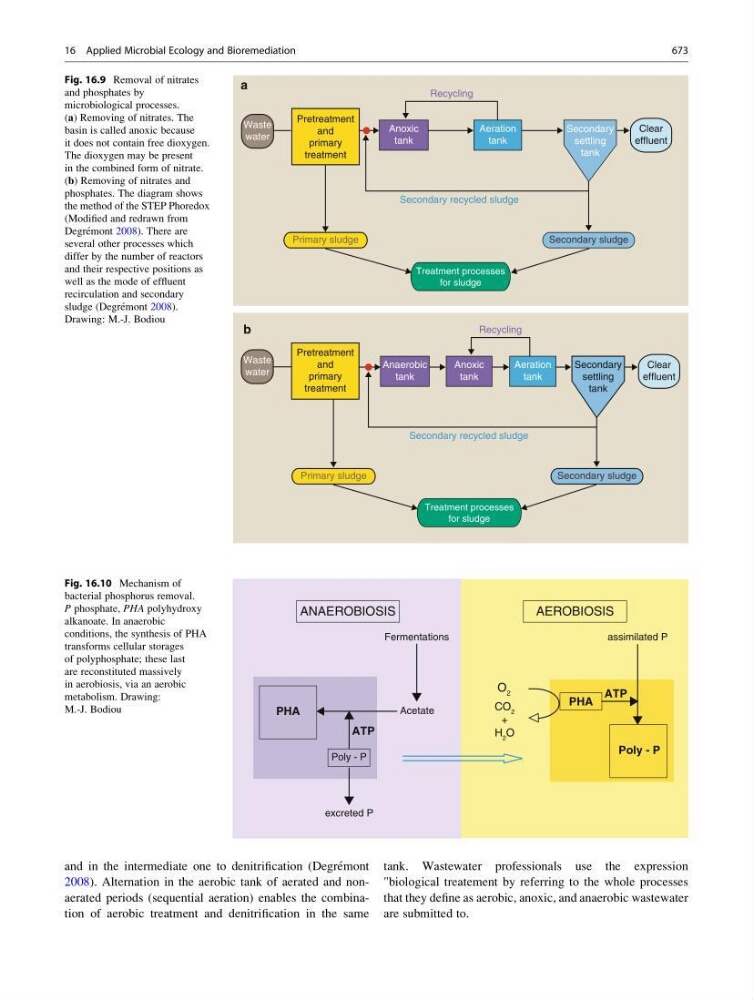
Fig. 16.9 Removal of nitrates
and phosphates by
microbiological processes.
(a) Removing of nitrates. The
basin is called anoxic because
it does not contain free dioxygen.
The dioxygen may be present
in the combined form of nitrate.
(b) Removing of nitrates and
phosphates. The diagram shows
the method of the STEP Phoredox
(Modified and redrawn from
Degre ´mont 2008). There are
several other processes which
differ by the number of reactors
and their respective positions as
well as the mode of effluent
recirculation and secondary
sludge (Degre ´mont 2008).
Drawing: M.-J. Bodiou
Fermentations
Acetate
PHA
PHA
ATP
ATP
Poly - P
Poly - P
assimilated P
O 2
CO 2
+
H 2 O
excreted P
ANAEROBIOSIS
AEROBIOSIS
Fig. 16.10 Mechanism of
bacterial phosphorus removal.
P phosphate, PHA polyhydroxy
alkanoate. In anaerobic
conditions, the synthesis of PHA
transforms cellular storages
of polyphosphate; these last
are reconstituted massively
in aerobiosis, via an aerobic
metabolism. Drawing:
M.-J. Bodiou
16 Applied Microbial Ecology and Bioremediation
673