

16.4.3.3 Secondary Treatments
Secondary treatments have biological treatments with or without oxygen and a settling step in the activated sludge process.
Aerobic Biological Treatments
Treatment of urban and industrial effluents mainly requires
a biological process either under aerobic or anoxic, even
anaerobic conditions (terminology used in process engineering will be specified later). Processes vary according
to the type of culture either free or fixed. In the first
case, microorganisms are maintained in suspension in the
liquid treated (activated sludge). In the second case, bacterial
cultures are fixed on a solid support (pozzolan, gravel,
Raschig rings) where they develop to form a biofilm, which
will eliminate pollution. In processes of fixed cultures,
microorganisms constitute bacteria beds* or develop on
disks or other granular beds. These processes are not detailed
here because they are less and less attractive due to their
excessive dimensioning to obtain a suitable purification rate.
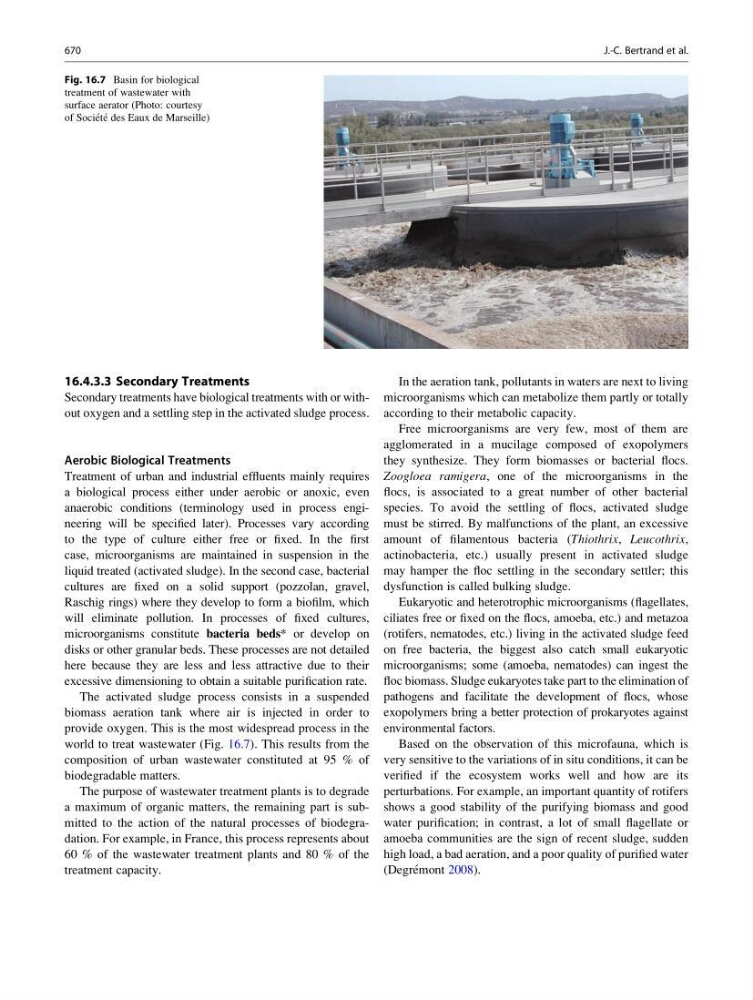
The activated sludge process consists in a suspended
biomass aeration tank where air is injected in order to
provide oxygen. This is the most widespread process in the
world to treat wastewater (Fig. 16.7). This results from the
composition of urban wastewater constituted at 95 % of
biodegradable matters.
The purpose of wastewater treatment plants is to degrade
a maximum of organic matters, the remaining part is submitted to the action of the natural processes of biodegradation. For example, in France, this process represents about
60 % of the wastewater treatment plants and 80 % of the
treatment capacity.
In the aeration tank, pollutants in waters are next to living
microorganisms which can metabolize them partly or totally
according to their metabolic capacity.
Free microorganisms are very few, most of them are
agglomerated in a mucilage composed of exopolymers
they synthesize. They form biomasses or bacterial flocs.
Zoogloea ramigera, one of the microorganisms in the
flocs, is associated to a great number of other bacterial
species. To avoid the settling of flocs, activated sludge
must be stirred. By malfunctions of the plant, an excessive
amount of filamentous bacteria (Thiothrix, Leucothrix,
actinobacteria, etc.) usually present in activated sludge
may hamper the floc settling in the secondary settler; this
dysfunction is called bulking sludge.
Eukaryotic and heterotrophic microorganisms (flagellates,
ciliates free or fixed on the flocs, amoeba, etc.) and metazoa
(rotifers, nematodes, etc.) living in the activated sludge feed
on free bacteria, the biggest also catch small eukaryotic
microorganisms; some (amoeba, nematodes) can ingest the
floc biomass. Sludge eukaryotes take part to the elimination of
pathogens and facilitate the development of flocs, whose
exopolymers bring a better protection of prokaryotes against
environmental factors.
Based on the observation of this microfauna, which is
very sensitive to the variations of in situ conditions, it can be
verified if the ecosystem works well and how are its
perturbations. For example, an important quantity of rotifers
shows a good stability of the purifying biomass and good
water purification; in contrast, a lot of small flagellate or
amoeba communities are the sign of recent sludge, sudden
high load, a bad aeration, and a poor quality of purified water
(Degre ´mont 2008).
Fig. 16.7 Basin for biological
treatment of wastewater with
surface aerator (Photo: courtesy
of Socie ´te ´ des Eaux de Marseille)
670
J.-C. Bertrand et al.