

them settling by gravity would be too long compared with
the flow coming into the plant (Table 16.2). This quantity of
VSS represents about 10 % of the incoming VSS. To
increase the settling velocity, VSS will be artificially thickened (coagulation–flocculation) because these fine particles
can be assimilated to resin grains exchanging generally
negatively charged ions.
16.4.3.2 Primary Treatments or Physicochemical
Treatments
Coagulation–Flocculation
The particles involved by these treatments are colloids.
Their origin varies: soil erosion, dissolution of mineral
substances, decomposition of organic matters, etc. These
particles have a very small diameter (less than 1 μm) and
are particularly responsible for the color and the turbidity
of the surface water. The decantation velocities of these
particles are very slow: coagulation–flocculation is therefore
necessary. The main purpose of coagulation is the destabilization of the suspended particles, to make easy their agglomeration. Flocculation facilitates contact between destabilized
particles. They begin to agglomerate to form a floc that
will be eliminated by settling. However, as colloids are
negatively charged, they repel one another and make any
agglomeration impossible. If repulsions are eliminated,
particles will agglomerate, grow, and settle quickly. The
addition of high oxidation state cations such as Fe
3+ and
Al
3+ avoids the repulsion of electric charges. So, in the
WWTP, charges will be brought by a small quantity of
charged coagulants (FeCl 3 , Al 2 (SO 4 ) 3 ). During this process,
phosphates precipitate in the form of insoluble salts.
Settling
Settling is the step after coagulation–flocculation. It is carried out in various types of settlers: horizontal, vertical, or
lamellar settlers (Degre ´mont 2008).
Since inlet of the plant, the water has generally been
submitted to these pretreatments in confined premises and
at low pressure to prevent the diffusion of unpleasant odors
in the atmosphere. These odors will generally be treated with
a chlorinated solution and soda. Flocculation, coagulation,
and settling are also part of the elimination process of
microorganisms, particularly of enteric origin, among
which some of them are pathogenic.
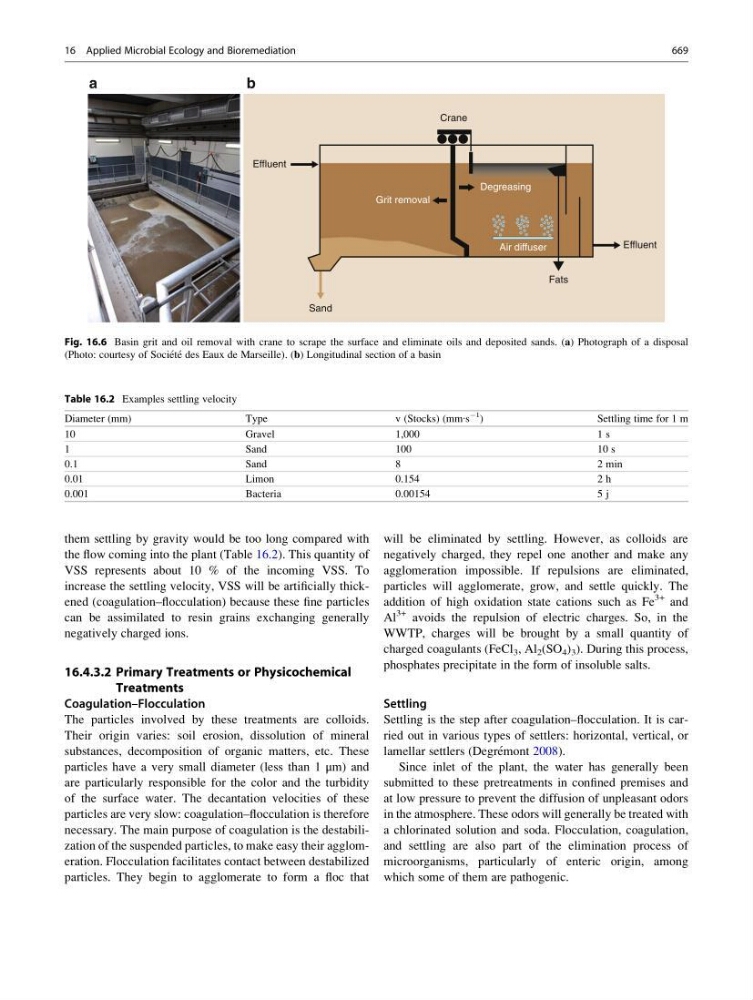
Crane
Effluent
Effluent
Fats
Sand
Degreasing
Grit removal
Air diffuser
b
a
Fig. 16.6 Basin grit and oil removal with crane to scrape the surface and eliminate oils and deposited sands. (a) Photograph of a disposal
(Photo: courtesy of Socie ´te ´ des Eaux de Marseille). (b) Longitudinal section of a basin
Table 16.2 Examples settling velocity
Diameter (mm)
Type
v (Stocks) (mm∙s
À1
)
Settling time for 1 m
10
Gravel
1,000
1 s
1
Sand
100
10 s
0.1
Sand
8
2 min
0.01
Limon
0.154
2 h
0.001
Bacteria
0.00154
5 j
16 Applied Microbial Ecology and Bioremediation
669