

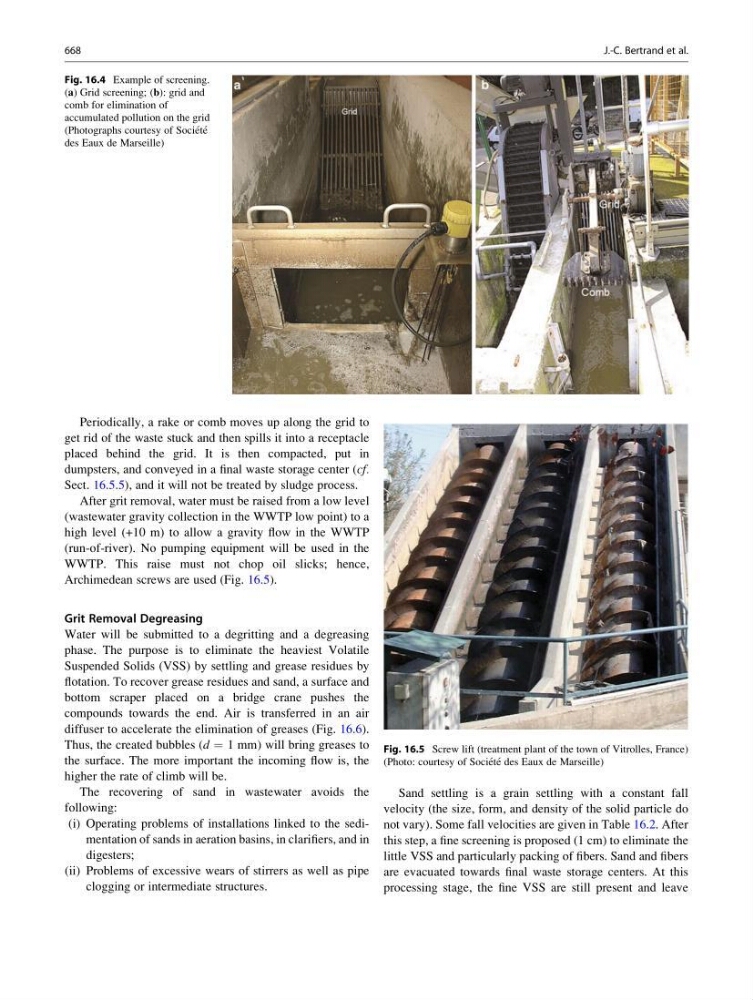
Periodically, a rake or comb moves up along the grid to
get rid of the waste stuck and then spills it into a receptacle
placed behind the grid. It is then compacted, put in
dumpsters, and conveyed in a final waste storage center (cf.
Sect. 16.5.5), and it will not be treated by sludge process.
After grit removal, water must be raised from a low level
(wastewater gravity collection in the WWTP low point) to a
high level (+10 m) to allow a gravity flow in the WWTP
(run-of-river). No pumping equipment will be used in the
WWTP. This raise must not chop oil slicks; hence,
Archimedean screws are used (Fig. 16.5).
Grit Removal Degreasing
Water will be submitted to a degritting and a degreasing
phase. The purpose is to eliminate the heaviest Volatile
Suspended Solids (VSS) by settling and grease residues by
flotation. To recover grease residues and sand, a surface and
bottom scraper placed on a bridge crane pushes the
compounds towards the end. Air is transferred in an air
diffuser to accelerate the elimination of greases (Fig. 16.6).
Thus, the created bubbles (d ¼ 1 mm) will bring greases to
the surface. The more important the incoming flow is, the
higher the rate of climb will be.
The recovering of sand in wastewater avoids the
following:
(i) Operating problems of installations linked to the sedimentation of sands in aeration basins, in clarifiers, and in
digesters;
(ii) Problems of excessive wears of stirrers as well as pipe
clogging or intermediate structures.
Sand settling is a grain settling with a constant fall
velocity (the size, form, and density of the solid particle do
not vary). Some fall velocities are given in Table 16.2. After
this step, a fine screening is proposed (1 cm) to eliminate the
little VSS and particularly packing of fibers. Sand and fibers
are evacuated towards final waste storage centers. At this
processing stage, the fine VSS are still present and leave
Fig. 16.4 Example of screening.
(a) Grid screening; (b): grid and
comb for elimination of
accumulated pollution on the grid
(Photographs courtesy of Socie ´te ´
des Eaux de Marseille)
Fig. 16.5 Screw lift (treatment plant of the town of Vitrolles, France)
(Photo: courtesy of Socie ´te ´ des Eaux de Marseille)
668
J.-C. Bertrand et al.