

weight in oxidizable matters, mainly organic. Oxidizable
matters in waters are characterised by two quantitative indices:
• Chemical Oxygen Demand (COD), which corresponds to
the amount of oxygen necessary to the chemical oxidation of the totality of the reduced organic and mineral
compounds
• Biochemical Oxygen Demand (BOD 5 ), which corresponds to the amount of oxygen consumed by organisms
in 5 days to oxidize the reduced organic and mineral
compounds
Other parameters are taken into account: nitrogenous
matters expressed in total nitrogen (TN) corresponding to
the sum of organic and ammonium nitrogen (N-NH 4
+
) and
phosphorus matters expressed in total phosphorus (TP)
and/or in phosphorus (P-PO 4
3À ) (Table 16.1). It is noteworthy that 95 % of urban wastewater consist of biodegradable matter. The remaining part discharged in environment
is then submitted to the action of natural biodegradation
processes.
16.4.3 Wastewater Treatment
Because of the discharge diversity, treatments (and
pretreatments) are carried out through physicochemical and
biological processes. A microbial ecologist who deals with
wastewater cannot ignore the physicochemical treatments
to which the wastewater is submitted before the
microbiological treatment. The different treatment processes
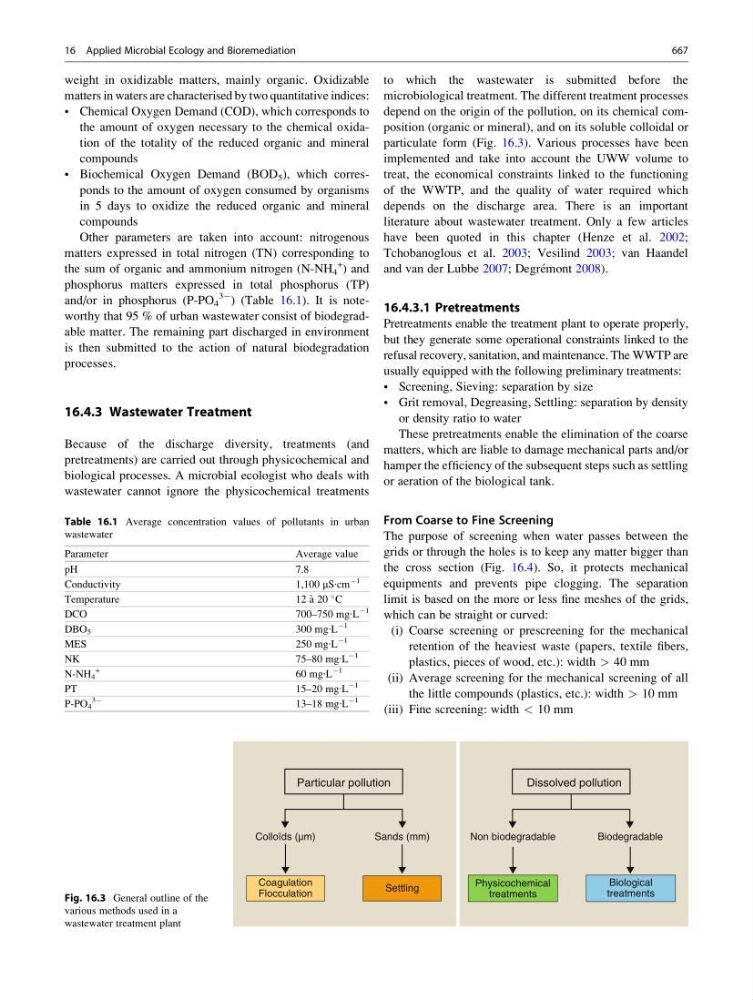
depend on the origin of the pollution, on its chemical composition (organic or mineral), and on its soluble colloidal or
particulate form (Fig. 16.3). Various processes have been
implemented and take into account the UWW volume to
treat, the economical constraints linked to the functioning
of the WWTP, and the quality of water required which
depends on the discharge area. There is an important
literature about wastewater treatment. Only a few articles
have been quoted in this chapter (Henze et al. 2002;
Tchobanoglous et al. 2003; Vesilind 2003; van Haandel
and van der Lubbe 2007; Degre ´mont 2008).
16.4.3.1 Pretreatments
Pretreatments enable the treatment plant to operate properly,
but they generate some operational constraints linked to the
refusal recovery, sanitation, and maintenance. The WWTP are
usually equipped with the following preliminary treatments:
• Screening, Sieving: separation by size
• Grit removal, Degreasing, Settling: separation by density
or density ratio to water
These pretreatments enable the elimination of the coarse
matters, which are liable to damage mechanical parts and/or
hamper the efficiency of the subsequent steps such as settling
or aeration of the biological tank.
From Coarse to Fine Screening
The purpose of screening when water passes between the
grids or through the holes is to keep any matter bigger than
the cross section (Fig. 16.4). So, it protects mechanical
equipments and prevents pipe clogging. The separation
limit is based on the more or less fine meshes of the grids,
which can be straight or curved:
(i) Coarse screening or prescreening for the mechanical
retention of the heaviest waste (papers, textile fibers,
plastics, pieces of wood, etc.): width > 40 mm
(ii) Average screening for the mechanical screening of all
the little compounds (plastics, etc.): width > 10 mm
(iii) Fine screening: width < 10 mm
Table 16.1 Average concentration values of pollutants in urban
wastewater
Parameter
Average value
pH
7.8
Conductivity
1,100 μS∙cm
À1
Temperature
12 a ` 20
C
DCO
700–750 mg∙L
À1
DBO 5
300 mg∙L
À1
MES
250 mg∙L
À1
NK
75–80 mg∙L
À1
N-NH 4
+
60 mg∙L
À1
PT
15–20 mg∙L
À1
P-PO 4
3À
13–18 mg∙L
À1
Particular pollution
Dissolved pollution
Colloïds (μm)
Sands (mm)
Non biodegradable
Biodegradable
Coagulation
Flocculation
Settling
Physicochemical
treatments
Biological
treatments
Fig. 16.3 General outline of the
various methods used in a
wastewater treatment plant
16 Applied Microbial Ecology and Bioremediation
667