

(ii) Industrial wastewater discharged by factories. Unlike
domestic wastewater, they are characterized by their
wide diversity according to the use of water during the
industrial process. Pollution varies according to the
industrial sector even for each company. On the whole,
there are four categories:
• Waters from cooling systems, which are important
and generally not very polluted because they are not
in contact with the manufactured products. They can
therefore be recycled.
• Wash waters, which are full of raw materials
(hydrocarbons and machine oils, detergents, bactericidal compounds, etc.). The production and degree
pollution may therefore vary.
• Process waters, whose chemical composition
and discharged quantity vary significantly from an
industry to an other. The polluting discharges come
from the contact of water with solids, liquids,
or gases.
• Service wastewater, which corresponds to the domestic waters of the factory combined with the kitchen
discharges.
The diversity of pollutants in industrial discharges makes
difficult and even impossible the installation of a treatment of
these waters that could be extended. The treatment is adapted
to the nature of the pollution. Therefore, in this chapter, the
study will be limited to the operation of domestic wastewater
treatment plants. It has to be pointed out that water resulting
from treatment plants is not drinkable. There are two types of
works: the first one makes water drinkable before distributing
it and the second one cleans up wastewater before discharging
it in natural environment (the price of water includes both
treatments). For example, in 2008, wastewater of 95 % of the
French population was cleaned with a wastewater treatment
plant (WWTP; more than 17,000 WWTP exist in France) or
with an autonomous sewerage system*.
UWW is characterized by different parameters, the most
important of which are suspended solids (VSS) and the
Box 16.1 (continued)
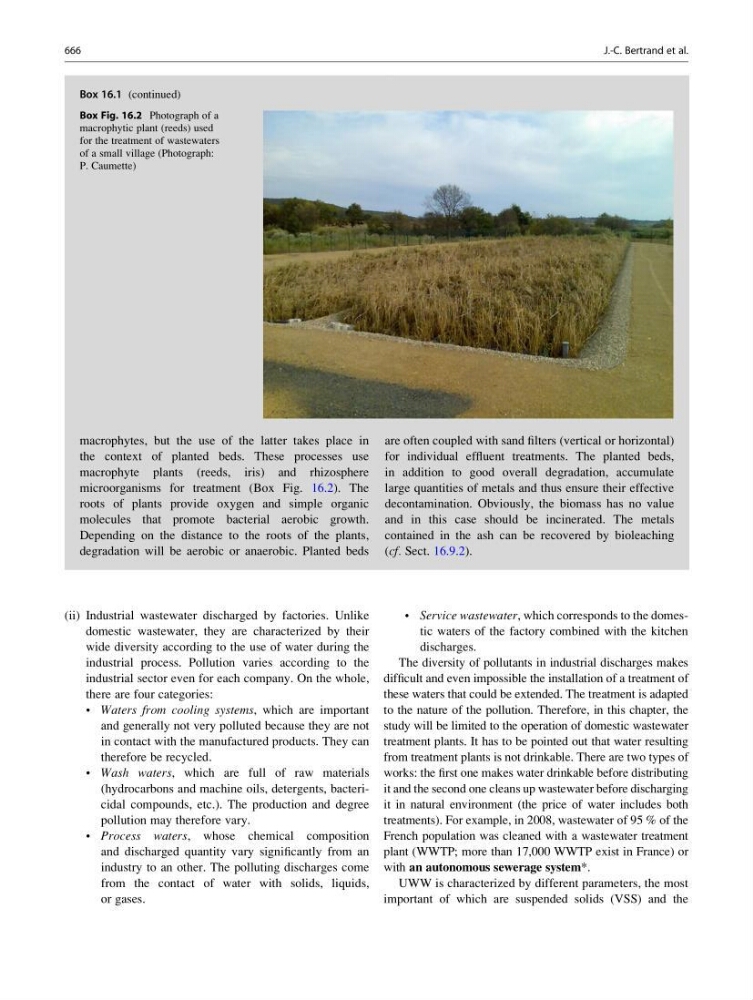
macrophytes, but the use of the latter takes place in
the context of planted beds. These processes use
macrophyte plants (reeds, iris) and rhizosphere
microorganisms for treatment (Box Fig. 16.2). The
roots of plants provide oxygen and simple organic
molecules that promote bacterial aerobic growth.
Depending on the distance to the roots of the plants,
degradation will be aerobic or anaerobic. Planted beds
(continued)
Box 16.1 (continued)
are often coupled with sand filters (vertical or horizontal)
for individual effluent treatments. The planted beds,
in addition to good overall degradation, accumulate
large quantities of metals and thus ensure their effective
decontamination. Obviously, the biomass has no value
and in this case should be incinerated. The metals
contained in the ash can be recovered by bioleaching
(cf. Sect. 16.9.2).
Box Fig. 16.2 Photograph of a
macrophytic plant (reeds) used
for the treatment of wastewaters
of a small village (Photograph:
P. Caumette)
666
J.-C. Bertrand et al.