

Box 16.1 (continued)
methanogenesis. If the lagoon treatment contains brackish water (coastal environments), sulfate reducting activity can cause problems related to the production of smelly
and toxic sulfide. These mineralization activities produce
large quantities of mineral salts (NH 4
+ , NO 2
À , PO 4
3À )
and gas (N 2 , CH 4 , CO 2 , H 2 S). The second, shallower
pond, allows primary production by microalgae that will
use the nutrients originating from organic matter degradation in the first pond. Due to the presence of oxygen
arising by oxygenic photosynthesis, degradation proceeds
through aerobic metabolism. The third pond allows the
development of primarily herbivorous zooplankton
(protozoans and metazoans), which will reduce the
microalgae load.
There are variations to this lagoon treatment
process:
(i) Aerated lagoons replace oxygen production by
microalgae by forced ventilation. Only two ponds
are then required (degradation and sedimentation),
thus reducing the surface. This system generates
costs due to forced aeration.
(continued)
Box 16.1 (continued)
(ii) Anaerobic lagoons require deeper ponds (more than 4
m) and high organic load for the establishment of
anoxic conditions. For proper operation, the temperature should be high (at least 25
C).
Epuration yields through lagoon treatment are
good, and most important, it allows excellent treatment of pathogenic microorganisms due to residence
times that are long enough to permit competition
between microorganisms (indigenous microorganisms
out-competing nonnative microorganisms). Pathogen
elimination is also due to the action of light radiation
(UV). This explains why lagoon treatment systems are
sometimes used as tertiary treatment after activated
sludge or extended aeration. This process has very
low operational costs and excellent integration into the
landscape. The investment depends on the size of the
basins, which, in turn depend on the volumes of effluent
to be treated. Thus, for big cities, the area required
(10–20 m
2 per capita equivalent) is often a limiting factor.
In lagoon treatment processes, primary production is
driven by microalgae. It can also be driven by
(continued)
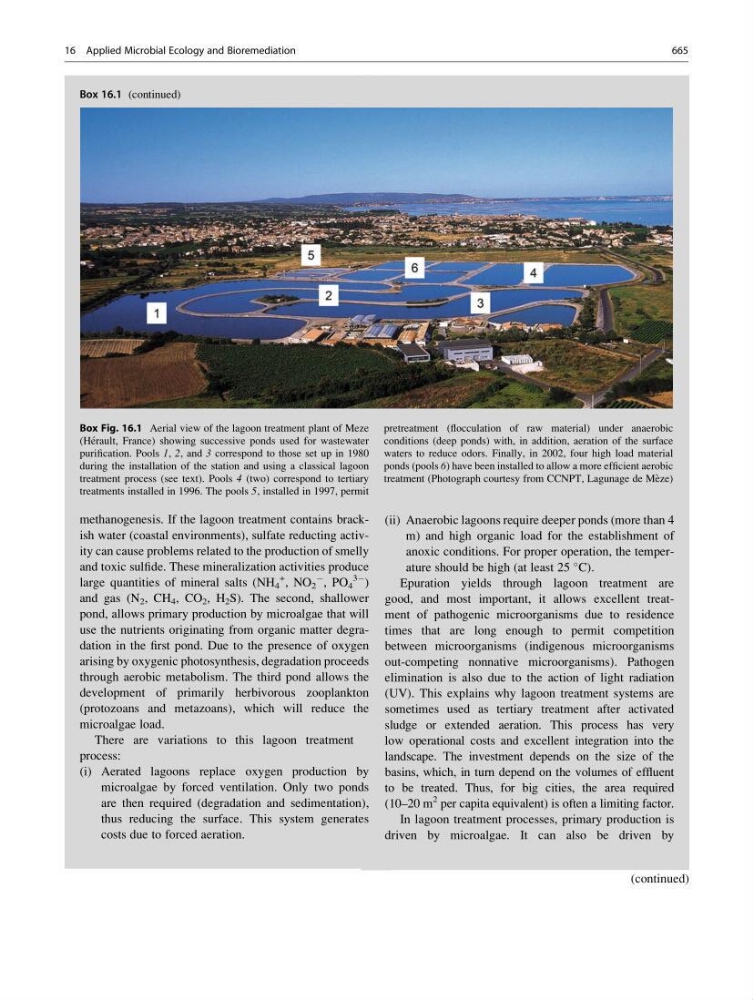
Box Fig. 16.1 Aerial view of the lagoon treatment plant of Meze
(He ´rault, France) showing successive ponds used for wastewater
purification. Pools 1, 2, and 3 correspond to those set up in 1980
during the installation of the station and using a classical lagoon
treatment process (see text). Pools 4 (two) correspond to tertiary
treatments installed in 1996. The pools 5, installed in 1997, permit
pretreatment (flocculation of raw material) under anaerobic
conditions (deep ponds) with, in addition, aeration of the surface
waters to reduce odors. Finally, in 2002, four high load material
ponds (pools 6) have been installed to allow a more efficient aerobic
treatment (Photograph courtesy from CCNPT, Lagunage de Me `ze)
16 Applied Microbial Ecology and Bioremediation
665