

Aerobic degradations are obtained by an adapted biomass
in constant and sufficient concentration in the aerated tank.
The biomass adsorbs and eliminates a more or less important
part of pollution according to the detention time in the tank
and to the organic load received by the treatment plant. The
dissolved pollution is partly transformed into sludge by bacterial assimilation. Another part of the biodegradable organic
matter is mineralized and releases as carbon dioxide, water,
sulfate ions, ammonium ions, etc. In the same tank, in presence of oxygen, ammonium ions resulting from degradation
of organic matter as well as those brought by the effluent
are oxidized to nitrate ions by two communities of aerobic,
chemolithotrophic, and autotrophic microorganisms. Ammonium oxidizing prokaryotes achieve the conversion from
NH 4
+ to NO 2
À and nitrite oxidizing prokaryotes achieve the
conversion from NO 2
À to NO 3
À . Most of the wastewater
treatment plants eliminate properly carbon compounds,
whereas nitrogen and phosphorus compounds are processed
only in the most performing plants.
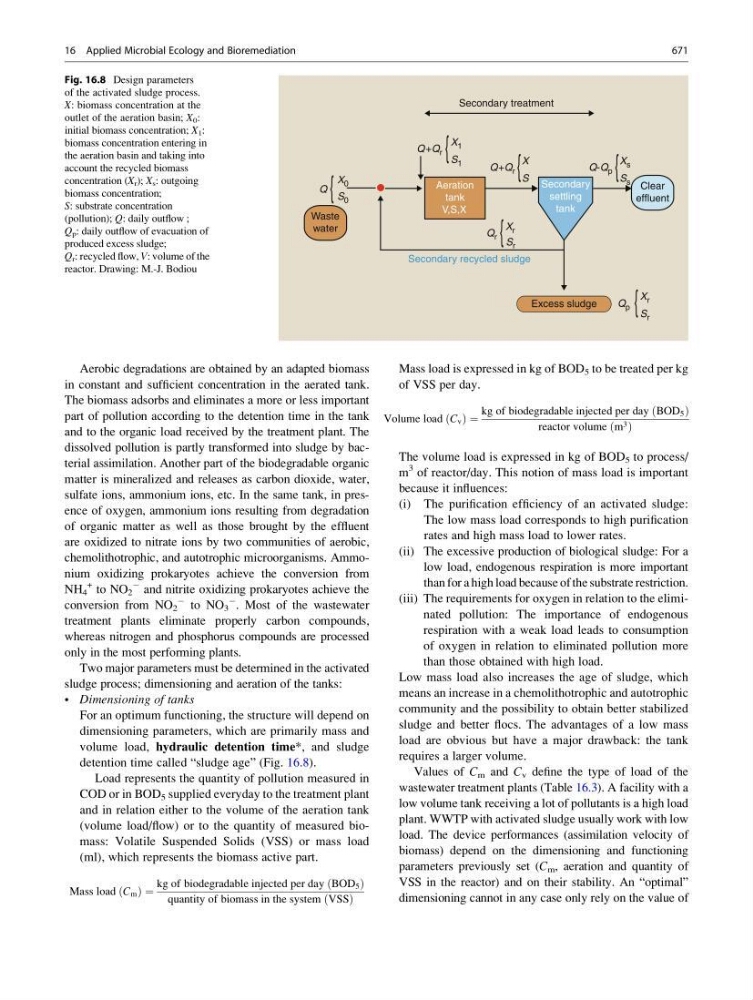
Two major parameters must be determined in the activated
sludge process; dimensioning and aeration of the tanks:
• Dimensioning of tanks
For an optimum functioning, the structure will depend on
dimensioning parameters, which are primarily mass and
volume load, hydraulic detention time*, and sludge
detention time called “sludge age” (Fig. 16.8).
Load represents the quantity of pollution measured in
COD or in BOD 5 supplied everyday to the treatment plant
and in relation either to the volume of the aeration tank
(volume load/flow) or to the quantity of measured biomass: Volatile Suspended Solids (VSS) or mass load
(ml), which represents the biomass active part.
Mass load C m
ð Þ ¼
kg of biodegradable injected per day BOD 5
ð
Þ
quantity of biomass in the system VSS
ð
Þ
Mass load is expressed in kg of BOD 5 to be treated per kg
of VSS per day.
Volume load C v
ð Þ ¼
kg of biodegradable injected per day BOD 5
ð
Þ
reactor volume m 3
ð Þ
The volume load is expressed in kg of BOD 5 to process/
m
3 of reactor/day. This notion of mass load is important
because it influences:
(i) The purification efficiency of an activated sludge:
The low mass load corresponds to high purification
rates and high mass load to lower rates.
(ii) The excessive production of biological sludge: For a
low load, endogenous respiration is more important
than for a high load because of the substrate restriction.
(iii) The requirements for oxygen in relation to the eliminated pollution: The importance of endogenous
respiration with a weak load leads to consumption
of oxygen in relation to eliminated pollution more
than those obtained with high load.
Low mass load also increases the age of sludge, which
means an increase in a chemolithotrophic and autotrophic
community and the possibility to obtain better stabilized
sludge and better flocs. The advantages of a low mass
load are obvious but have a major drawback: the tank
requires a larger volume.
Values of C m and C v define the type of load of the
wastewater treatment plants (Table 16.3). A facility with a
low volume tank receiving a lot of pollutants is a high load
plant. WWTP with activated sludge usually work with low
load. The device performances (assimilation velocity of
biomass) depend on the dimensioning and functioning
parameters previously set (C m , aeration and quantity of
VSS in the reactor) and on their stability. An “optimal”
dimensioning cannot in any case only rely on the value of
Aeration
tank
V,S,X
}
Q
X 0
S 0
}
X r
S r
Q r
}
X 1
S 1
Q +Q r
}
X
S
Q+Q r
}
X s
S s
Q-Q p
Secondary treatment
Waste
water
Excess sludge
}
X r
S r
Q p
Secondary
settling
tank
Clear
effluent
Secondary recycled sludge
Fig. 16.8 Design parameters
of the activated sludge process.
X: biomass concentration at the
outlet of the aeration basin; X 0 :
initial biomass concentration; X 1 :
biomass concentration entering in
the aeration basin and taking into
account the recycled biomass
concentration (X r ); X s : outgoing
biomass concentration;
S: substrate concentration
(pollution); Q: daily outflow ;
Q p : daily outflow of evacuation of
produced excess sludge;
Q r : recycled flow, V: volume of the
reactor. Drawing: M.-J. Bodiou
16 Applied Microbial Ecology and Bioremediation
671