

Box 15.6: The β-D-Glucuronidase Assay: A Tool for
Real-Time Management of E. coli Concentration
in Water
Philippe Lebaron
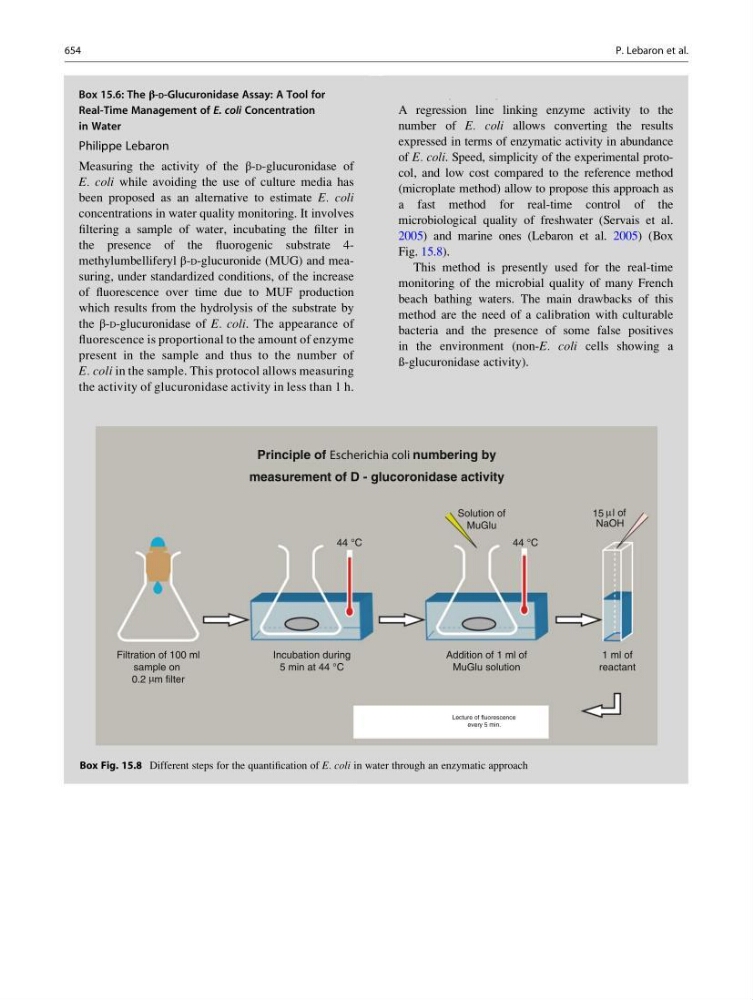
Measuring the activity of the β-D-glucuronidase of
E. coli while avoiding the use of culture media has
been proposed as an alternative to estimate E. coli
concentrations in water quality monitoring. It involves
filtering a sample of water, incubating the filter in
the presence of the fluorogenic substrate 4methylumbelliferyl β-D-glucuronide (MUG) and measuring, under standardized conditions, of the increase
of fluorescence over time due to MUF production
which results from the hydrolysis of the substrate by
the β-D-glucuronidase of E. coli. The appearance of
fluorescence is proportional to the amount of enzyme
present in the sample and thus to the number of
E. coli in the sample. This protocol allows measuring
the activity of glucuronidase activity in less than 1 h.
(continued)
Box 15.6 (continued)
A regression line linking enzyme activity to the
number of E. coli allows converting the results
expressed in terms of enzymatic activity in abundance
of E. coli. Speed, simplicity of the experimental protocol, and low cost compared to the reference method
(microplate method) allow to propose this approach as
a fast method for real-time control of the
microbiological quality of freshwater (Servais et al.
2005) and marine ones (Lebaron et al. 2005) (Box
Fig. 15.8).
This method is presently used for the real-time
monitoring of the microbial quality of many French
beach bathing waters. The main drawbacks of this
method are the need of a calibration with culturable
bacteria and the presence of some false positives
in the environment (non-E. coli cells showing a
ß-glucuronidase activity).
Principle of Escherichia coli numbering by
measurement of D - glucoronidase activity
44 °C
44 °C
Solution of
MuGlu
15 l of
NaOH
Filtration of 100 ml
sample on
0.2 m filter
Incubation during
5 min at 44 °C
Addition of 1 ml of
MuGlu solution
1 ml of
reactant
Lecture of fluorescence
every 5 min.
Box Fig. 15.8 Different steps for the quantification of E. coli in water through an enzymatic approach
654
P. Lebaron et al.