

15.9.2 Nucleic Acid-Based Methods
Nucleic acid-based methods have been developed to detect
bacterial fecal indicators as well as pathogens without growing the targeted microorganisms. These are based on the
identification of specific genes or specific nucleic acid
sequences. Environmental samples often do not contain
enough cells of the targeted pathogenic microorganisms to
produce a direct detection. This limit can be overcome by the
use of the polymerase chain reaction (PCR) to exponentially
amplify a specific target sequence and, as consequence,
increase its relative concentration, following extraction of
total DNA from the sample. This gene amplification significantly increases the probability of detecting the presence of a
relatively low number of target microorganisms and to confirm the presence or absence of specific pathogens in natural
samples.
Identification systems making use of nucleic acid-based
methods involve predominantly molecular hybridization
strategies targeting DNA sequences through nucleic acid
probings. The probes can be single-stranded (oligonucleotide probes) or denatured double-stranded DNA probes.
Hybridizations can occur between the DNA probe and its
targeted genomic DNA (DNA-DNA hybridization) or
between the DNA probe and rRNA or tRNA sequences
(DNA-RNA hybridization); these latter probings make possible assessment regarding both the physiological state
and classification of the detected microorganisms. Nucleic
acid-based methods are increasingly used in microbial ecology since they are much faster than culture-based ones and
are able to detect targeted microorganisms with a high
degree of sensitivity and specificity.
Even if one the major drawbacks of these methods, which
is the lack of quantification of cells initially present in the
Box 15.7: The MUG Microplate Method
Philippe Lebaron
Determination of Escherichia coli Most
Probable Number (MPN) by the Microplate
Method
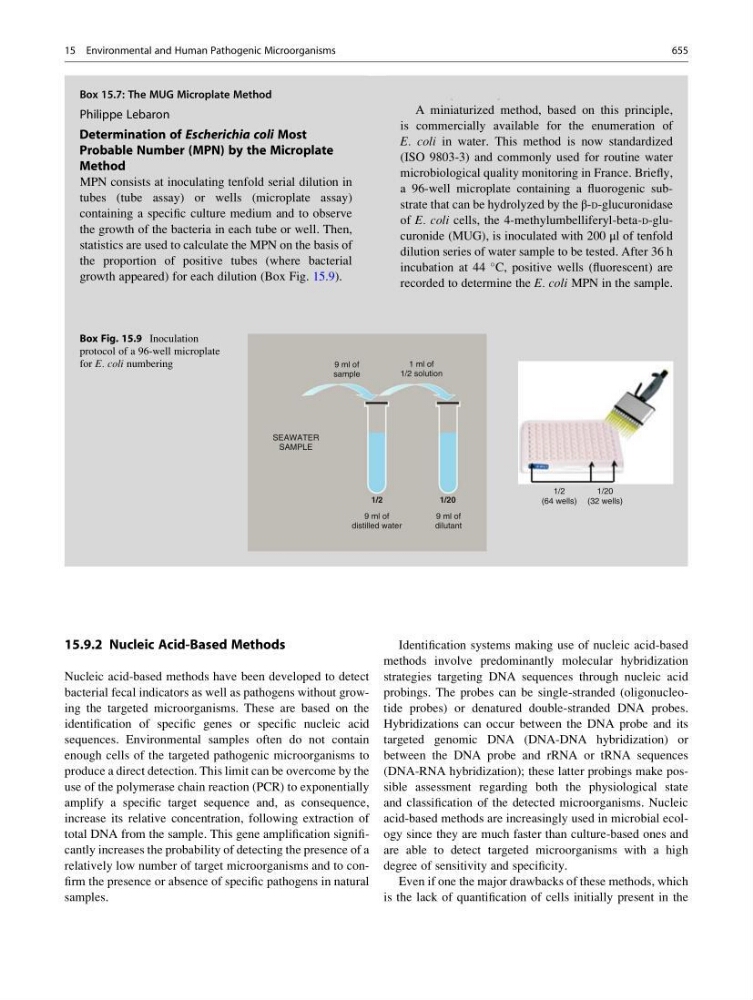
MPN consists at inoculating tenfold serial dilution in
tubes (tube assay) or wells (microplate assay)
containing a specific culture medium and to observe
the growth of the bacteria in each tube or well. Then,
statistics are used to calculate the MPN on the basis of
the proportion of positive tubes (where bacterial
growth appeared) for each dilution (Box Fig. 15.9).
(continued)
Box 15.7 (continued)
A miniaturized method, based on this principle,
is commercially available for the enumeration of
E. coli in water. This method is now standardized
(ISO 9803-3) and commonly used for routine water
microbiological quality monitoring in France. Briefly,
a 96-well microplate containing a fluorogenic substrate that can be hydrolyzed by the β-D-glucuronidase
of E. coli cells, the 4-methylumbelliferyl-beta-D-glucuronide (MUG), is inoculated with 200 μl of tenfold
dilution series of water sample to be tested. After 36 h
incubation at 44
C, positive wells (fluorescent) are
recorded to determine the E. coli MPN in the sample.
9 ml of
sample
9 ml of
distilled water
9 ml of
dilutant
1 ml of
1/2 solution
SEAWATER
SAMPLE
1/2
1/20
1/2
(64 wells)
1/20
(32 wells)
Box Fig. 15.9 Inoculation
protocol of a 96-well microplate
for E. coli numbering
15 Environmental and Human Pathogenic Microorganisms
655