

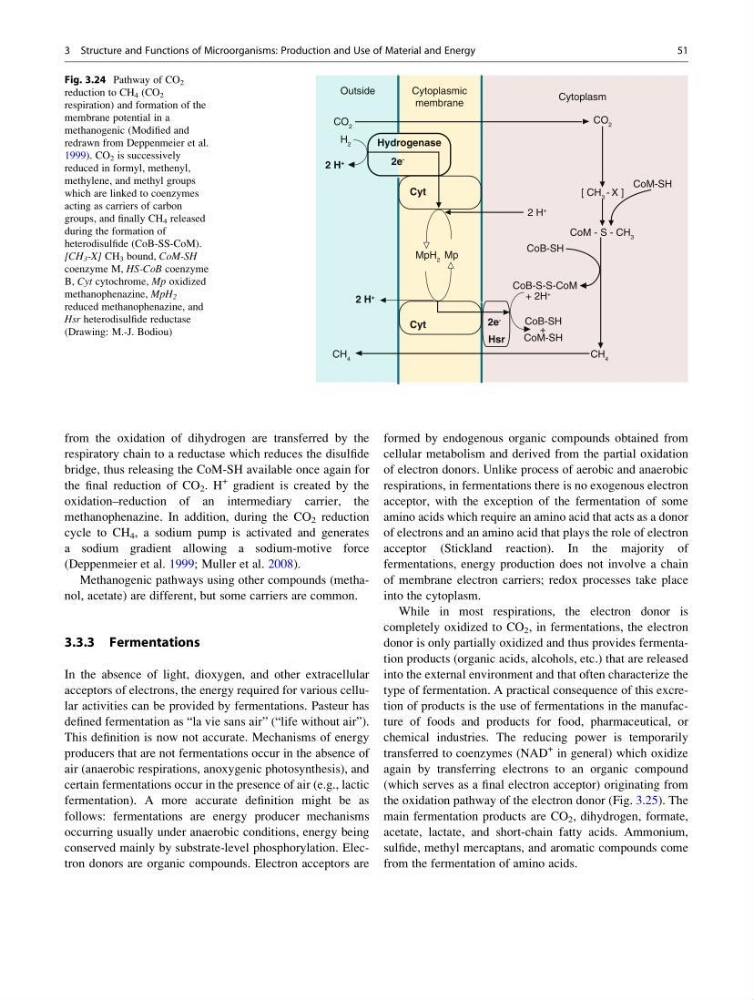
from the oxidation of dihydrogen are transferred by the
respiratory chain to a reductase which reduces the disulfide
bridge, thus releasing the CoM-SH available once again for
the final reduction of CO 2 . H
+ gradient is created by the
oxidation–reduction of an intermediary carrier, the
methanophenazine. In addition, during the CO 2 reduction
cycle to CH 4 , a sodium pump is activated and generates
a sodium gradient allowing a sodium-motive force
(Deppenmeier et al. 1999; Muller et al. 2008).
Methanogenic pathways using other compounds (methanol, acetate) are different, but some carriers are common.
3.3.3 Fermentations
In the absence of light, dioxygen, and other extracellular
acceptors of electrons, the energy required for various cellular activities can be provided by fermentations. Pasteur has
defined fermentation as “la vie sans air” (“life without air”).
This definition is now not accurate. Mechanisms of energy
producers that are not fermentations occur in the absence of
air (anaerobic respirations, anoxygenic photosynthesis), and
certain fermentations occur in the presence of air (e.g., lactic
fermentation). A more accurate definition might be as
follows: fermentations are energy producer mechanisms
occurring usually under anaerobic conditions, energy being
conserved mainly by substrate-level phosphorylation. Electron donors are organic compounds. Electron acceptors are
formed by endogenous organic compounds obtained from
cellular metabolism and derived from the partial oxidation
of electron donors. Unlike process of aerobic and anaerobic
respirations, in fermentations there is no exogenous electron
acceptor, with the exception of the fermentation of some
amino acids which require an amino acid that acts as a donor
of electrons and an amino acid that plays the role of electron
acceptor (Stickland reaction). In the majority of
fermentations, energy production does not involve a chain
of membrane electron carriers; redox processes take place
into the cytoplasm.
While in most respirations, the electron donor is
completely oxidized to CO 2 , in fermentations, the electron
donor is only partially oxidized and thus provides fermentation products (organic acids, alcohols, etc.) that are released
into the external environment and that often characterize the
type of fermentation. A practical consequence of this excretion of products is the use of fermentations in the manufacture of foods and products for food, pharmaceutical, or
chemical industries. The reducing power is temporarily
transferred to coenzymes (NAD
+ in general) which oxidize
again by transferring electrons to an organic compound
(which serves as a final electron acceptor) originating from
the oxidation pathway of the electron donor (Fig. 3.25). The
main fermentation products are CO 2 , dihydrogen, formate,
acetate, lactate, and short-chain fatty acids. Ammonium,
sulfide, methyl mercaptans, and aromatic compounds come
from the fermentation of amino acids.
Outside
Cytoplasm
Cytoplasmic
membrane
H 2
2 H
+
2 H
+
2 H
+
Hydrogenase
Cyt
Cyt
2e
-
2e
-
CoB-S-S-CoM
+ 2H
+
CoB-SH
CoB-SH
+
CoM-SH
CoM-SH
Hsr
MpH 2 Mp
CO 2
CO 2
[ CH 3 - X ]
CoM - S - CH 3
CH 4
CH 4
Fig. 3.24 Pathway of CO 2
reduction to CH 4 (CO 2
respiration) and formation of the
membrane potential in a
methanogenic (Modified and
redrawn from Deppenmeier et al.
1999). CO 2 is successively
reduced in formyl, methenyl,
methylene, and methyl groups
which are linked to coenzymes
acting as carriers of carbon
groups, and finally CH 4 released
during the formation of
heterodisulfide (CoB-SS-CoM).
[CH 3 -X] CH 3 bound, CoM-SH
coenzyme M, HS-CoB coenzyme
B, Cyt cytochrome, Mp oxidized
methanophenazine, MpH 2
reduced methanophenazine, and
Hsr heterodisulfide reductase
(Drawing: M.-J. Bodiou)
3 Structure and Functions of Microorganisms: Production and Use of Material and Energy
51
respiratory chain to a reductase which reduces the disulfide
bridge, thus releasing the CoM-SH available once again for
the final reduction of CO 2 . H
+ gradient is created by the
oxidation–reduction of an intermediary carrier, the
methanophenazine. In addition, during the CO 2 reduction
cycle to CH 4 , a sodium pump is activated and generates
a sodium gradient allowing a sodium-motive force
(Deppenmeier et al. 1999; Muller et al. 2008).
Methanogenic pathways using other compounds (methanol, acetate) are different, but some carriers are common.
3.3.3 Fermentations
In the absence of light, dioxygen, and other extracellular
acceptors of electrons, the energy required for various cellular activities can be provided by fermentations. Pasteur has
defined fermentation as “la vie sans air” (“life without air”).
This definition is now not accurate. Mechanisms of energy
producers that are not fermentations occur in the absence of
air (anaerobic respirations, anoxygenic photosynthesis), and
certain fermentations occur in the presence of air (e.g., lactic
fermentation). A more accurate definition might be as
follows: fermentations are energy producer mechanisms
occurring usually under anaerobic conditions, energy being
conserved mainly by substrate-level phosphorylation. Electron donors are organic compounds. Electron acceptors are
formed by endogenous organic compounds obtained from
cellular metabolism and derived from the partial oxidation
of electron donors. Unlike process of aerobic and anaerobic
respirations, in fermentations there is no exogenous electron
acceptor, with the exception of the fermentation of some
amino acids which require an amino acid that acts as a donor
of electrons and an amino acid that plays the role of electron
acceptor (Stickland reaction). In the majority of
fermentations, energy production does not involve a chain
of membrane electron carriers; redox processes take place
into the cytoplasm.
While in most respirations, the electron donor is
completely oxidized to CO 2 , in fermentations, the electron
donor is only partially oxidized and thus provides fermentation products (organic acids, alcohols, etc.) that are released
into the external environment and that often characterize the
type of fermentation. A practical consequence of this excretion of products is the use of fermentations in the manufacture of foods and products for food, pharmaceutical, or
chemical industries. The reducing power is temporarily
transferred to coenzymes (NAD
+ in general) which oxidize
again by transferring electrons to an organic compound
(which serves as a final electron acceptor) originating from
the oxidation pathway of the electron donor (Fig. 3.25). The
main fermentation products are CO 2 , dihydrogen, formate,
acetate, lactate, and short-chain fatty acids. Ammonium,
sulfide, methyl mercaptans, and aromatic compounds come
from the fermentation of amino acids.
Outside
Cytoplasm
Cytoplasmic
membrane
H 2
2 H
+
2 H
+
2 H
+
Hydrogenase
Cyt
Cyt
2e
-
2e
-
CoB-S-S-CoM
+ 2H
+
CoB-SH
CoB-SH
+
CoM-SH
CoM-SH
Hsr
MpH 2 Mp
CO 2
CO 2
[ CH 3 - X ]
CoM - S - CH 3
CH 4
CH 4
Fig. 3.24 Pathway of CO 2
reduction to CH 4 (CO 2
respiration) and formation of the
membrane potential in a
methanogenic (Modified and
redrawn from Deppenmeier et al.
1999). CO 2 is successively
reduced in formyl, methenyl,
methylene, and methyl groups
which are linked to coenzymes
acting as carriers of carbon
groups, and finally CH 4 released
during the formation of
heterodisulfide (CoB-SS-CoM).
[CH 3 -X] CH 3 bound, CoM-SH
coenzyme M, HS-CoB coenzyme
B, Cyt cytochrome, Mp oxidized
methanophenazine, MpH 2
reduced methanophenazine, and
Hsr heterodisulfide reductase
(Drawing: M.-J. Bodiou)
3 Structure and Functions of Microorganisms: Production and Use of Material and Energy
51