

Fumarate Respiration
Fumarate is not abundant in natural environments. However,
fumarate respiration is widespread among microorganisms,
probably due to the fact that fumarate is a common metabolite, formed from the catabolism of carbohydrates and
proteins. This type of respiration is known in Wolinella
succinogenes, Enterobacteriaceae, Clostridia, Paenibacillus
macerans, sulfate-reducing bacteria, and Propionibacteria.
The reducing power resulting from the oxidation electron
donors, mainly hydrogen, formate, or NADH, is transferred
by the respiratory chain to a fumarate reductase which
reduces the fumarate to succinate:
H 2 þ fumarate ! succinate
Formiate þ fumarate þ H
þ
! CO 2 þ succinate
With a redox potential of + 30 mV, the fumarate/succinate couple is not the source of important production of
energy. For example, the first reaction above produces only
À43 kJ.mol
À1 dihydrogen and therefore will require more
than one mole of dihydrogen to synthesize one mole of ATP.
In addition to the fumarate, other organic molecules can
play the role of electron acceptors during anaerobic
respirations such as glycine, dimethyl sulfoxide, and
trimethylamine oxide reduced, respectively, in acetate,
dimethyl sulfide, or trimethylamine.
CO 2 Respirations (Acetogenesis and Methanogenesis)
CO 2
from
metabolism
of
chemoorganotrophic
microorganisms is an abundant compound in natural
environments and serves as a terminal electron acceptor for
two groups of strict anaerobic microorganisms, acetogenic
bacteria and methanogenic archaea. In anoxic environments,
these microorganisms have at their disposal electron donors
from the decomposition of organic matter, in particular
dihydrogen. Thus, some of them are chemolithotrophic
autotrophs. CO 2 reduction leads to the formation of acetate
in acetogens and methane in methanogens. Redox
couples are very electronegative (CO 2 /CH 4 , À0.24 V and
CO 2 /acetate, À0.29 V); consequently, the two respirations
are low in energy:
4 H 2 þ CO 2 ! CH 4 þ 2 H 2 O
ΔG
0 ¼ À131 kJ
4 H 2 þ 2 CO 2 ! CH 3 COOH þ 2 H 2 O ΔG
0 ¼ À95 kJ
– Acetogenesis
Acetogenic bacteria form a very heterogeneous group of
Gram-positive bacteria essentially (Acetobacterium,
Butyribacterium, Clostridium, Eubacterium, Moorella,
Sporomusa). They use CO 2 , CO, or formate as electron
acceptors and produce acetate as an end product of their
respiration. The electron donor is mostly dihydrogen. However, molecules such as sugars, alcohols, organic acids, or
aromatic compounds can serve as electron donors and carbon sources. In all cases, the reduction of CO 2 passes
through acetyl-CoA (Wood–Ljungdahl pathway) (cf.
Sect. 3.4.1).
With dihydrogen as electron donor, the reduction of one
molecule of CO 2 as a methyl group and the reduction of a
second molecule of CO 2 in the form of carbonyl function
lead to the formation of acetyl-CoA in the presence of
coenzyme A; acetyl-CoA is subsequently phosphorylated
to acetyl phosphate which releases a molecule acetate and
an ATP molecule (substrate-level phosphorylation).
During this process, energy can also be produced by the
formation of a Na
+ gradient, instead of H
+ gradient, at the
origin of a sodium-motive force (Muller 2003; Detkova and
Pusheva 2006).
– Methanogenesis
All
organisms
are
methanogenic
archaea.
Methanogenesis with dihydrogen as substrate and CO 2 as
electron acceptor and carbon source is very widespread
among the methanogenic microorganisms. However, other
compounds involving other pathways could be used by some
methanogens. Methanogenic reactions can be divided into
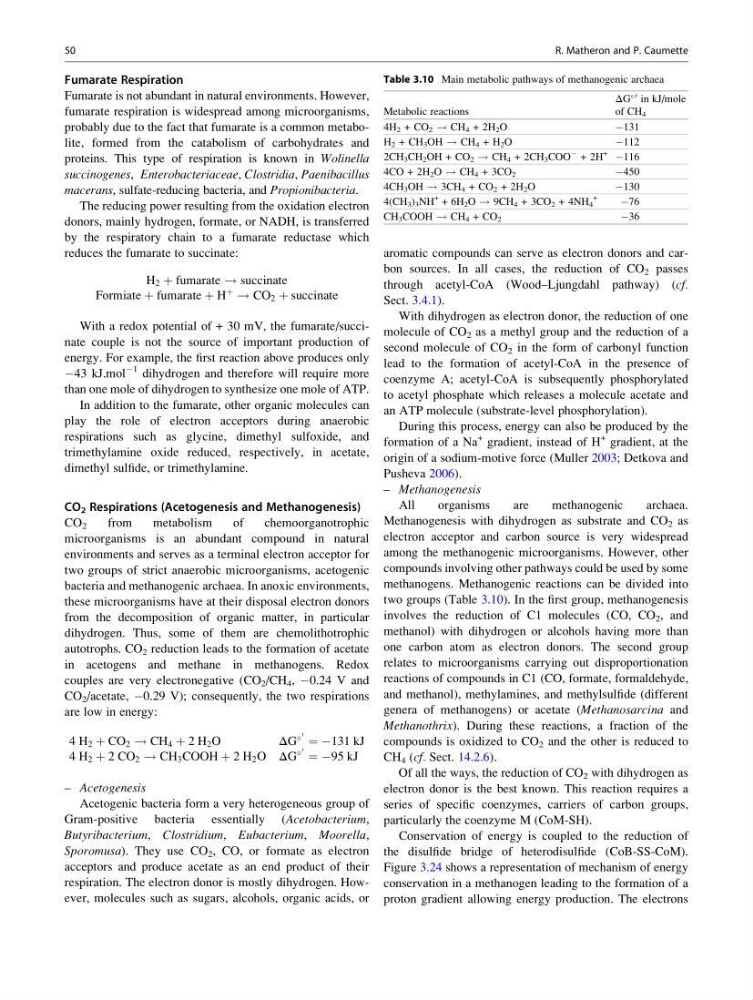
two groups (Table 3.10). In the first group, methanogenesis
involves the reduction of C1 molecules (CO, CO 2 , and
methanol) with dihydrogen or alcohols having more than
one carbon atom as electron donors. The second group
relates to microorganisms carrying out disproportionation
reactions of compounds in C1 (CO, formate, formaldehyde,
and methanol), methylamines, and methylsulfide (different
genera of methanogens) or acetate (Methanosarcina and
Methanothrix). During these reactions, a fraction of the
compounds is oxidized to CO 2 and the other is reduced to
CH 4 (cf. Sect. 14.2.6).
Of all the ways, the reduction of CO 2 with dihydrogen as
electron donor is the best known. This reaction requires a
series of specific coenzymes, carriers of carbon groups,
particularly the coenzyme M (CoM-SH).
Conservation of energy is coupled to the reduction of
the disulfide bridge of heterodisulfide (CoB-SS-CoM).
Figure 3.24 shows a representation of mechanism of energy
conservation in a methanogen leading to the formation of a
proton gradient allowing energy production. The electrons
Table 3.10 Main metabolic pathways of methanogenic archaea
Metabolic reactions
ΔG
0 in kJ/mole
of CH 4
4H 2 + CO 2 ! CH 4 + 2H 2 O
À131
H 2 + CH 3 OH ! CH 4 + H 2 O
À112
2CH 3 CH 2 OH + CO 2 ! CH 4 + 2CH 3 COO
À + 2H
+ À116
4CO + 2H 2 O ! CH 4 + 3CO 2
À450
4CH 3 OH ! 3CH 4 + CO 2 + 2H 2 O
À130
4(CH 3 ) 3 NH
+ + 6H 2 O ! 9CH 4 + 3CO 2 + 4NH 4
+
À76
CH 3 COOH ! CH 4 + CO 2
À36
50
R. Matheron and P. Caumette
Fumarate is not abundant in natural environments. However,
fumarate respiration is widespread among microorganisms,
probably due to the fact that fumarate is a common metabolite, formed from the catabolism of carbohydrates and
proteins. This type of respiration is known in Wolinella
succinogenes, Enterobacteriaceae, Clostridia, Paenibacillus
macerans, sulfate-reducing bacteria, and Propionibacteria.
The reducing power resulting from the oxidation electron
donors, mainly hydrogen, formate, or NADH, is transferred
by the respiratory chain to a fumarate reductase which
reduces the fumarate to succinate:
H 2 þ fumarate ! succinate
Formiate þ fumarate þ H
þ
! CO 2 þ succinate
With a redox potential of + 30 mV, the fumarate/succinate couple is not the source of important production of
energy. For example, the first reaction above produces only
À43 kJ.mol
À1 dihydrogen and therefore will require more
than one mole of dihydrogen to synthesize one mole of ATP.
In addition to the fumarate, other organic molecules can
play the role of electron acceptors during anaerobic
respirations such as glycine, dimethyl sulfoxide, and
trimethylamine oxide reduced, respectively, in acetate,
dimethyl sulfide, or trimethylamine.
CO 2 Respirations (Acetogenesis and Methanogenesis)
CO 2
from
metabolism
of
chemoorganotrophic
microorganisms is an abundant compound in natural
environments and serves as a terminal electron acceptor for
two groups of strict anaerobic microorganisms, acetogenic
bacteria and methanogenic archaea. In anoxic environments,
these microorganisms have at their disposal electron donors
from the decomposition of organic matter, in particular
dihydrogen. Thus, some of them are chemolithotrophic
autotrophs. CO 2 reduction leads to the formation of acetate
in acetogens and methane in methanogens. Redox
couples are very electronegative (CO 2 /CH 4 , À0.24 V and
CO 2 /acetate, À0.29 V); consequently, the two respirations
are low in energy:
4 H 2 þ CO 2 ! CH 4 þ 2 H 2 O
ΔG
0 ¼ À131 kJ
4 H 2 þ 2 CO 2 ! CH 3 COOH þ 2 H 2 O ΔG
0 ¼ À95 kJ
– Acetogenesis
Acetogenic bacteria form a very heterogeneous group of
Gram-positive bacteria essentially (Acetobacterium,
Butyribacterium, Clostridium, Eubacterium, Moorella,
Sporomusa). They use CO 2 , CO, or formate as electron
acceptors and produce acetate as an end product of their
respiration. The electron donor is mostly dihydrogen. However, molecules such as sugars, alcohols, organic acids, or
aromatic compounds can serve as electron donors and carbon sources. In all cases, the reduction of CO 2 passes
through acetyl-CoA (Wood–Ljungdahl pathway) (cf.
Sect. 3.4.1).
With dihydrogen as electron donor, the reduction of one
molecule of CO 2 as a methyl group and the reduction of a
second molecule of CO 2 in the form of carbonyl function
lead to the formation of acetyl-CoA in the presence of
coenzyme A; acetyl-CoA is subsequently phosphorylated
to acetyl phosphate which releases a molecule acetate and
an ATP molecule (substrate-level phosphorylation).
During this process, energy can also be produced by the
formation of a Na
+ gradient, instead of H
+ gradient, at the
origin of a sodium-motive force (Muller 2003; Detkova and
Pusheva 2006).
– Methanogenesis
All
organisms
are
methanogenic
archaea.
Methanogenesis with dihydrogen as substrate and CO 2 as
electron acceptor and carbon source is very widespread
among the methanogenic microorganisms. However, other
compounds involving other pathways could be used by some
methanogens. Methanogenic reactions can be divided into
two groups (Table 3.10). In the first group, methanogenesis
involves the reduction of C1 molecules (CO, CO 2 , and
methanol) with dihydrogen or alcohols having more than
one carbon atom as electron donors. The second group
relates to microorganisms carrying out disproportionation
reactions of compounds in C1 (CO, formate, formaldehyde,
and methanol), methylamines, and methylsulfide (different
genera of methanogens) or acetate (Methanosarcina and
Methanothrix). During these reactions, a fraction of the
compounds is oxidized to CO 2 and the other is reduced to
CH 4 (cf. Sect. 14.2.6).
Of all the ways, the reduction of CO 2 with dihydrogen as
electron donor is the best known. This reaction requires a
series of specific coenzymes, carriers of carbon groups,
particularly the coenzyme M (CoM-SH).
Conservation of energy is coupled to the reduction of
the disulfide bridge of heterodisulfide (CoB-SS-CoM).
Figure 3.24 shows a representation of mechanism of energy
conservation in a methanogen leading to the formation of a
proton gradient allowing energy production. The electrons
Table 3.10 Main metabolic pathways of methanogenic archaea
Metabolic reactions
ΔG
0 in kJ/mole
of CH 4
4H 2 + CO 2 ! CH 4 + 2H 2 O
À131
H 2 + CH 3 OH ! CH 4 + H 2 O
À112
2CH 3 CH 2 OH + CO 2 ! CH 4 + 2CH 3 COO
À + 2H
+ À116
4CO + 2H 2 O ! CH 4 + 3CO 2
À450
4CH 3 OH ! 3CH 4 + CO 2 + 2H 2 O
À130
4(CH 3 ) 3 NH
+ + 6H 2 O ! 9CH 4 + 3CO 2 + 4NH 4
+
À76
CH 3 COOH ! CH 4 + CO 2
À36
50
R. Matheron and P. Caumette