

oxidation of methane by anaerobic methanotrophic archaea
(reverse methanogenesis). Milucka et al. (2012) revealed the
presence of methanotrophic archaea capable of coupling the
anaerobic oxidation of methane to sulfate reduction; sulfatereducing bacteria associated with methanotrophs get their
energy from the disproportionation* of reduced sulfur
compound (disulfide) released by methanotrophs.
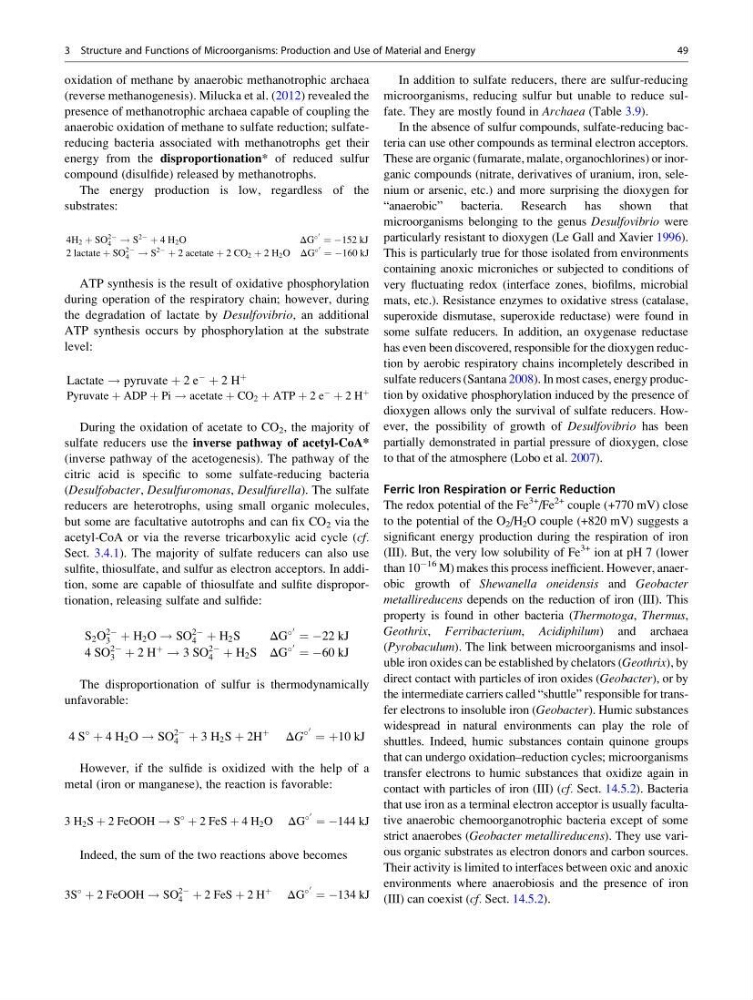
The energy production is low, regardless of the
substrates:
4H 2 þ SO
2À
4 ! S
2À þ 4 H 2 O
ΔG
0 ¼ À152 kJ
2 lactate þ SO
2À
4 ! S
2À þ 2 acetate þ 2 CO 2 þ 2 H 2 O ΔG
0 ¼ À160 kJ
ATP synthesis is the result of oxidative phosphorylation
during operation of the respiratory chain; however, during
the degradation of lactate by Desulfovibrio, an additional
ATP synthesis occurs by phosphorylation at the substrate
level:
Lactate ! pyruvate þ 2 e
À
þ 2 H
þ
Pyruvate þ ADP þ Pi ! acetate þ CO 2 þ ATP þ 2 e
À
þ 2 H
þ
During the oxidation of acetate to CO 2 , the majority of
sulfate reducers use the inverse pathway of acetyl-CoA*
(inverse pathway of the acetogenesis). The pathway of the
citric acid is specific to some sulfate-reducing bacteria
(Desulfobacter, Desulfuromonas, Desulfurella). The sulfate
reducers are heterotrophs, using small organic molecules,
but some are facultative autotrophs and can fix CO 2 via the
acetyl-CoA or via the reverse tricarboxylic acid cycle (cf.
Sect. 3.4.1). The majority of sulfate reducers can also use
sulfite, thiosulfate, and sulfur as electron acceptors. In addition, some are capable of thiosulfate and sulfite disproportionation, releasing sulfate and sulfide:
S 2 O
2À
3 þ H 2 O ! SO
2À
4 þ H 2 S
ΔG
0 ¼ À22 kJ
4 SO
2À
3 þ 2 H
þ
! 3 SO
2À
4 þ H 2 S ΔG
0 ¼ À60 kJ
The disproportionation of sulfur is thermodynamically
unfavorable:
4 S
þ 4 H 2 O ! SO
2À
4 þ 3 H 2 S þ 2H
þ
ΔG
0 ¼ þ10 kJ
However, if the sulfide is oxidized with the help of a
metal (iron or manganese), the reaction is favorable:
3 H 2 S þ 2 FeOOH ! S
þ 2 FeS þ 4 H 2 O ΔG
0 ¼ À144 kJ
Indeed, the sum of the two reactions above becomes
3S
þ 2 FeOOH ! SO
2À
4 þ 2 FeS þ 2 H
þ
ΔG
0 ¼ À134 kJ
In addition to sulfate reducers, there are sulfur-reducing
microorganisms, reducing sulfur but unable to reduce sulfate. They are mostly found in Archaea (Table 3.9).
In the absence of sulfur compounds, sulfate-reducing bacteria can use other compounds as terminal electron acceptors.
These are organic (fumarate, malate, organochlorines) or inorganic compounds (nitrate, derivatives of uranium, iron, selenium or arsenic, etc.) and more surprising the dioxygen for
“anaerobic” bacteria. Research has shown that
microorganisms belonging to the genus Desulfovibrio were
particularly resistant to dioxygen (Le Gall and Xavier 1996).
This is particularly true for those isolated from environments
containing anoxic microniches or subjected to conditions of
very fluctuating redox (interface zones, biofilms, microbial
mats, etc.). Resistance enzymes to oxidative stress (catalase,
superoxide dismutase, superoxide reductase) were found in
some sulfate reducers. In addition, an oxygenase reductase
has even been discovered, responsible for the dioxygen reduction by aerobic respiratory chains incompletely described in
sulfate reducers (Santana 2008). In most cases, energy production by oxidative phosphorylation induced by the presence of
dioxygen allows only the survival of sulfate reducers. However, the possibility of growth of Desulfovibrio has been
partially demonstrated in partial pressure of dioxygen, close
to that of the atmosphere (Lobo et al. 2007).
Ferric Iron Respiration or Ferric Reduction
The redox potential of the Fe
3+
/Fe
2+ couple (+770 mV) close
to the potential of the O 2 /H 2 O couple (+820 mV) suggests a
significant energy production during the respiration of iron
(III). But, the very low solubility of Fe
3+ ion at pH 7 (lower
than 10
À16 M) makes this process inefficient. However, anaerobic growth of Shewanella oneidensis and Geobacter
metallireducens depends on the reduction of iron (III). This
property is found in other bacteria (Thermotoga, Thermus,
Geothrix, Ferribacterium, Acidiphilum) and archaea
(Pyrobaculum). The link between microorganisms and insoluble iron oxides can be established by chelators (Geothrix), by
direct contact with particles of iron oxides (Geobacter), or by
the intermediate carriers called “shuttle” responsible for transfer electrons to insoluble iron (Geobacter). Humic substances
widespread in natural environments can play the role of
shuttles. Indeed, humic substances contain quinone groups
that can undergo oxidation–reduction cycles; microorganisms
transfer electrons to humic substances that oxidize again in
contact with particles of iron (III) (cf. Sect. 14.5.2). Bacteria
that use iron as a terminal electron acceptor is usually facultative anaerobic chemoorganotrophic bacteria except of some
strict anaerobes (Geobacter metallireducens). They use various organic substrates as electron donors and carbon sources.
Their activity is limited to interfaces between oxic and anoxic
environments where anaerobiosis and the presence of iron
(III) can coexist (cf. Sect. 14.5.2).
3 Structure and Functions of Microorganisms: Production and Use of Material and Energy
49
(reverse methanogenesis). Milucka et al. (2012) revealed the
presence of methanotrophic archaea capable of coupling the
anaerobic oxidation of methane to sulfate reduction; sulfatereducing bacteria associated with methanotrophs get their
energy from the disproportionation* of reduced sulfur
compound (disulfide) released by methanotrophs.
The energy production is low, regardless of the
substrates:
4H 2 þ SO
2À
4 ! S
2À þ 4 H 2 O
ΔG
0 ¼ À152 kJ
2 lactate þ SO
2À
4 ! S
2À þ 2 acetate þ 2 CO 2 þ 2 H 2 O ΔG
0 ¼ À160 kJ
ATP synthesis is the result of oxidative phosphorylation
during operation of the respiratory chain; however, during
the degradation of lactate by Desulfovibrio, an additional
ATP synthesis occurs by phosphorylation at the substrate
level:
Lactate ! pyruvate þ 2 e
À
þ 2 H
þ
Pyruvate þ ADP þ Pi ! acetate þ CO 2 þ ATP þ 2 e
À
þ 2 H
þ
During the oxidation of acetate to CO 2 , the majority of
sulfate reducers use the inverse pathway of acetyl-CoA*
(inverse pathway of the acetogenesis). The pathway of the
citric acid is specific to some sulfate-reducing bacteria
(Desulfobacter, Desulfuromonas, Desulfurella). The sulfate
reducers are heterotrophs, using small organic molecules,
but some are facultative autotrophs and can fix CO 2 via the
acetyl-CoA or via the reverse tricarboxylic acid cycle (cf.
Sect. 3.4.1). The majority of sulfate reducers can also use
sulfite, thiosulfate, and sulfur as electron acceptors. In addition, some are capable of thiosulfate and sulfite disproportionation, releasing sulfate and sulfide:
S 2 O
2À
3 þ H 2 O ! SO
2À
4 þ H 2 S
ΔG
0 ¼ À22 kJ
4 SO
2À
3 þ 2 H
þ
! 3 SO
2À
4 þ H 2 S ΔG
0 ¼ À60 kJ
The disproportionation of sulfur is thermodynamically
unfavorable:
4 S
þ 4 H 2 O ! SO
2À
4 þ 3 H 2 S þ 2H
þ
ΔG
0 ¼ þ10 kJ
However, if the sulfide is oxidized with the help of a
metal (iron or manganese), the reaction is favorable:
3 H 2 S þ 2 FeOOH ! S
þ 2 FeS þ 4 H 2 O ΔG
0 ¼ À144 kJ
Indeed, the sum of the two reactions above becomes
3S
þ 2 FeOOH ! SO
2À
4 þ 2 FeS þ 2 H
þ
ΔG
0 ¼ À134 kJ
In addition to sulfate reducers, there are sulfur-reducing
microorganisms, reducing sulfur but unable to reduce sulfate. They are mostly found in Archaea (Table 3.9).
In the absence of sulfur compounds, sulfate-reducing bacteria can use other compounds as terminal electron acceptors.
These are organic (fumarate, malate, organochlorines) or inorganic compounds (nitrate, derivatives of uranium, iron, selenium or arsenic, etc.) and more surprising the dioxygen for
“anaerobic” bacteria. Research has shown that
microorganisms belonging to the genus Desulfovibrio were
particularly resistant to dioxygen (Le Gall and Xavier 1996).
This is particularly true for those isolated from environments
containing anoxic microniches or subjected to conditions of
very fluctuating redox (interface zones, biofilms, microbial
mats, etc.). Resistance enzymes to oxidative stress (catalase,
superoxide dismutase, superoxide reductase) were found in
some sulfate reducers. In addition, an oxygenase reductase
has even been discovered, responsible for the dioxygen reduction by aerobic respiratory chains incompletely described in
sulfate reducers (Santana 2008). In most cases, energy production by oxidative phosphorylation induced by the presence of
dioxygen allows only the survival of sulfate reducers. However, the possibility of growth of Desulfovibrio has been
partially demonstrated in partial pressure of dioxygen, close
to that of the atmosphere (Lobo et al. 2007).
Ferric Iron Respiration or Ferric Reduction
The redox potential of the Fe
3+
/Fe
2+ couple (+770 mV) close
to the potential of the O 2 /H 2 O couple (+820 mV) suggests a
significant energy production during the respiration of iron
(III). But, the very low solubility of Fe
3+ ion at pH 7 (lower
than 10
À16 M) makes this process inefficient. However, anaerobic growth of Shewanella oneidensis and Geobacter
metallireducens depends on the reduction of iron (III). This
property is found in other bacteria (Thermotoga, Thermus,
Geothrix, Ferribacterium, Acidiphilum) and archaea
(Pyrobaculum). The link between microorganisms and insoluble iron oxides can be established by chelators (Geothrix), by
direct contact with particles of iron oxides (Geobacter), or by
the intermediate carriers called “shuttle” responsible for transfer electrons to insoluble iron (Geobacter). Humic substances
widespread in natural environments can play the role of
shuttles. Indeed, humic substances contain quinone groups
that can undergo oxidation–reduction cycles; microorganisms
transfer electrons to humic substances that oxidize again in
contact with particles of iron (III) (cf. Sect. 14.5.2). Bacteria
that use iron as a terminal electron acceptor is usually facultative anaerobic chemoorganotrophic bacteria except of some
strict anaerobes (Geobacter metallireducens). They use various organic substrates as electron donors and carbon sources.
Their activity is limited to interfaces between oxic and anoxic
environments where anaerobiosis and the presence of iron
(III) can coexist (cf. Sect. 14.5.2).
3 Structure and Functions of Microorganisms: Production and Use of Material and Energy
49