

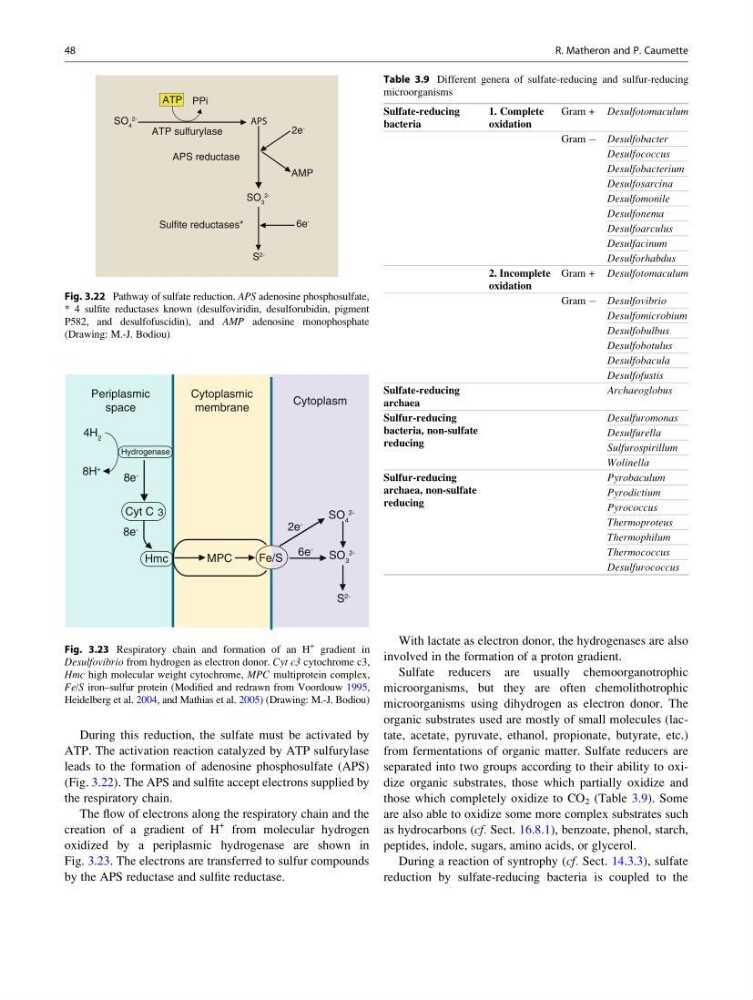
During this reduction, the sulfate must be activated by
ATP. The activation reaction catalyzed by ATP sulfurylase
leads to the formation of adenosine phosphosulfate (APS)
(Fig. 3.22). The APS and sulfite accept electrons supplied by
the respiratory chain.
The flow of electrons along the respiratory chain and the
creation of a gradient of H
+ from molecular hydrogen
oxidized by a periplasmic hydrogenase are shown in
Fig. 3.23. The electrons are transferred to sulfur compounds
by the APS reductase and sulfite reductase.
With lactate as electron donor, the hydrogenases are also
involved in the formation of a proton gradient.
Sulfate reducers are usually chemoorganotrophic
microorganisms, but they are often chemolithotrophic
microorganisms using dihydrogen as electron donor. The
organic substrates used are mostly of small molecules (lactate, acetate, pyruvate, ethanol, propionate, butyrate, etc.)
from fermentations of organic matter. Sulfate reducers are
separated into two groups according to their ability to oxidize organic substrates, those which partially oxidize and
those which completely oxidize to CO 2 (Table 3.9). Some
are also able to oxidize some more complex substrates such
as hydrocarbons (cf. Sect. 16.8.1), benzoate, phenol, starch,
peptides, indole, sugars, amino acids, or glycerol.
During a reaction of syntrophy (cf. Sect. 14.3.3), sulfate
reduction by sulfate-reducing bacteria is coupled to the
ATP sulfurylase
Sulfite reductases*
APS reductase
ATP PPi
APS
AMP
2e
-
6e
-
SO 3
2SO 4
2S
2Fig. 3.22 Pathway of sulfate reduction. APS adenosine phosphosulfate,
* 4 sulfite reductases known (desulfoviridin, desulforubidin, pigment
P582, and desulfofuscidin), and AMP adenosine monophosphate
(Drawing: M.-J. Bodiou)
S
2Periplasmic
space
Cytoplasm
Cytoplasmic
membrane
Hmc
Cyt C 3
4H 2
8H
+
Hydrogenase
MPC
Fe/S
2e
-
6e
-
8e
-
8e
-
SO 3
2SO 4
2Fig. 3.23 Respiratory chain and formation of an H
+ gradient in
Desulfovibrio from hydrogen as electron donor. Cyt c3 cytochrome c3,
Hmc high molecular weight cytochrome, MPC multiprotein complex,
Fe/S iron–sulfur protein (Modified and redrawn from Voordouw 1995,
Heidelberg et al. 2004, and Mathias et al. 2005) (Drawing: M.-J. Bodiou)
Table 3.9 Different genera of sulfate-reducing and sulfur-reducing
microorganisms
Sulfate-reducing
bacteria
1. Complete
oxidation
Gram + Desulfotomaculum
Gram À Desulfobacter
Desulfococcus
Desulfobacterium
Desulfosarcina
Desulfomonile
Desulfonema
Desulfoarculus
Desulfacinum
Desulforhabdus
2. Incomplete
oxidation
Gram + Desulfotomaculum
Gram À Desulfovibrio
Desulfomicrobium
Desulfobulbus
Desulfobotulus
Desulfobacula
Desulfofustis
Sulfate-reducing
archaea
Archaeoglobus
Sulfur-reducing
bacteria, non-sulfate
reducing
Desulfuromonas
Desulfurella
Sulfurospirillum
Wolinella
Sulfur-reducing
archaea, non-sulfate
reducing
Pyrobaculum
Pyrodictium
Pyrococcus
Thermoproteus
Thermophilum
Thermococcus
Desulfurococcus
48
R. Matheron and P. Caumette
ATP. The activation reaction catalyzed by ATP sulfurylase
leads to the formation of adenosine phosphosulfate (APS)
(Fig. 3.22). The APS and sulfite accept electrons supplied by
the respiratory chain.
The flow of electrons along the respiratory chain and the
creation of a gradient of H
+ from molecular hydrogen
oxidized by a periplasmic hydrogenase are shown in
Fig. 3.23. The electrons are transferred to sulfur compounds
by the APS reductase and sulfite reductase.
With lactate as electron donor, the hydrogenases are also
involved in the formation of a proton gradient.
Sulfate reducers are usually chemoorganotrophic
microorganisms, but they are often chemolithotrophic
microorganisms using dihydrogen as electron donor. The
organic substrates used are mostly of small molecules (lactate, acetate, pyruvate, ethanol, propionate, butyrate, etc.)
from fermentations of organic matter. Sulfate reducers are
separated into two groups according to their ability to oxidize organic substrates, those which partially oxidize and
those which completely oxidize to CO 2 (Table 3.9). Some
are also able to oxidize some more complex substrates such
as hydrocarbons (cf. Sect. 16.8.1), benzoate, phenol, starch,
peptides, indole, sugars, amino acids, or glycerol.
During a reaction of syntrophy (cf. Sect. 14.3.3), sulfate
reduction by sulfate-reducing bacteria is coupled to the
ATP sulfurylase
Sulfite reductases*
APS reductase
ATP PPi
APS
AMP
2e
-
6e
-
SO 3
2SO 4
2S
2Fig. 3.22 Pathway of sulfate reduction. APS adenosine phosphosulfate,
* 4 sulfite reductases known (desulfoviridin, desulforubidin, pigment
P582, and desulfofuscidin), and AMP adenosine monophosphate
(Drawing: M.-J. Bodiou)
S
2Periplasmic
space
Cytoplasm
Cytoplasmic
membrane
Hmc
Cyt C 3
4H 2
8H
+
Hydrogenase
MPC
Fe/S
2e
-
6e
-
8e
-
8e
-
SO 3
2SO 4
2Fig. 3.23 Respiratory chain and formation of an H
+ gradient in
Desulfovibrio from hydrogen as electron donor. Cyt c3 cytochrome c3,
Hmc high molecular weight cytochrome, MPC multiprotein complex,
Fe/S iron–sulfur protein (Modified and redrawn from Voordouw 1995,
Heidelberg et al. 2004, and Mathias et al. 2005) (Drawing: M.-J. Bodiou)
Table 3.9 Different genera of sulfate-reducing and sulfur-reducing
microorganisms
Sulfate-reducing
bacteria
1. Complete
oxidation
Gram + Desulfotomaculum
Gram À Desulfobacter
Desulfococcus
Desulfobacterium
Desulfosarcina
Desulfomonile
Desulfonema
Desulfoarculus
Desulfacinum
Desulforhabdus
2. Incomplete
oxidation
Gram + Desulfotomaculum
Gram À Desulfovibrio
Desulfomicrobium
Desulfobulbus
Desulfobotulus
Desulfobacula
Desulfofustis
Sulfate-reducing
archaea
Archaeoglobus
Sulfur-reducing
bacteria, non-sulfate
reducing
Desulfuromonas
Desulfurella
Sulfurospirillum
Wolinella
Sulfur-reducing
archaea, non-sulfate
reducing
Pyrobaculum
Pyrodictium
Pyrococcus
Thermoproteus
Thermophilum
Thermococcus
Desulfurococcus
48
R. Matheron and P. Caumette