

close to that obtained by aerobic respiration. For example,
with glucose as substrate,
C 6 H 12 O 6 þ 6 O 2 ! 6 H 2 O þ 6 CO 2
ΔG
0 ¼ À2, 868 kJ
C 6 H 12 O 6 þ 12 NO
À
3 ! 12 NO
À
2 þ 6 CO 2 þ 6 H 2 O ΔG
0 ¼ À1, 764 kJ
C 6 H 12 O 6 þ 4 NO 3
À ! 2 N 2 þ 6 CO 2 þ 6 H 2 O
ΔG
0 ¼ À2, 425 kJ
Prokaryotes that perform nitrate respiration are facultative anaerobic microorganisms, able to use the dioxygen in
oxic conditions and nitrate under anoxic conditions.
Enzymes that reduce nitrogen compounds are sensitive to
dioxygen, and thus nitrate respiration will begin only when
dioxygen is in very low concentration in the cell environment. Denitrifying enzymes have a sensitivity to dioxygen
that is increasing from nitrate reductase which is tolerant to
dioxygen, to nitrous oxide reductase, which is the most
sensitive; so, when dioxygen is in low concentration, nitrate
reduction can start but not the reduction of nitrous oxide
whose reductase is inhibited at low-concentration dioxygen,
thereby releasing nitrous oxide in the atmosphere (cf. Sect.
14.3.5, Fig. 14.31). In most bacteria that reduce nitrate, these
different enzymes are inducible under anaerobic conditions
and in the presence of nitrogen compounds, with the exception of some bacteria where they are constitutive
(Thiomicrospira denitrificans). Like other carriers of the
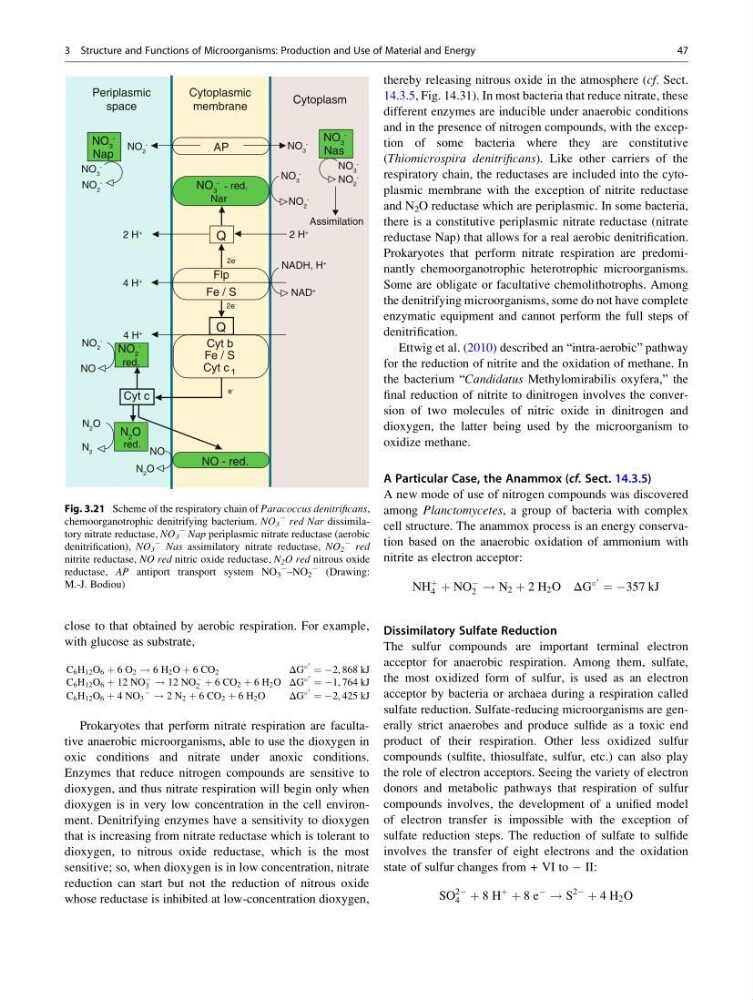
respiratory chain, the reductases are included into the cytoplasmic membrane with the exception of nitrite reductase
and N 2 O reductase which are periplasmic. In some bacteria,
there is a constitutive periplasmic nitrate reductase (nitrate
reductase Nap) that allows for a real aerobic denitrification.
Prokaryotes that perform nitrate respiration are predominantly chemoorganotrophic heterotrophic microorganisms.
Some are obligate or facultative chemolithotrophs. Among
the denitrifying microorganisms, some do not have complete
enzymatic equipment and cannot perform the full steps of
denitrification.
Ettwig et al. (2010) described an “intra-aerobic” pathway
for the reduction of nitrite and the oxidation of methane. In
the bacterium “Candidatus Methylomirabilis oxyfera,” the
final reduction of nitrite to dinitrogen involves the conversion of two molecules of nitric oxide in dinitrogen and
dioxygen, the latter being used by the microorganism to
oxidize methane.
A Particular Case, the Anammox (cf. Sect. 14.3.5)
A new mode of use of nitrogen compounds was discovered
among Planctomycetes, a group of bacteria with complex
cell structure. The anammox process is an energy conservation based on the anaerobic oxidation of ammonium with
nitrite as electron acceptor:
NH
þ
4 þ NO
À
2 ! N 2 þ 2 H 2 O ΔG
0 ¼ À357 kJ
Dissimilatory Sulfate Reduction
The sulfur compounds are important terminal electron
acceptor for anaerobic respiration. Among them, sulfate,
the most oxidized form of sulfur, is used as an electron
acceptor by bacteria or archaea during a respiration called
sulfate reduction. Sulfate-reducing microorganisms are generally strict anaerobes and produce sulfide as a toxic end
product of their respiration. Other less oxidized sulfur
compounds (sulfite, thiosulfate, sulfur, etc.) can also play
the role of electron acceptors. Seeing the variety of electron
donors and metabolic pathways that respiration of sulfur
compounds involves, the development of a unified model
of electron transfer is impossible with the exception of
sulfate reduction steps. The reduction of sulfate to sulfide
involves the transfer of eight electrons and the oxidation
state of sulfur changes from + VI to À II:
SO
2À
4 þ 8 H
þ
þ 8 e
À
! S
2À
þ 4 H 2 O
Periplasmic
space
Cytoplasmic
membrane
NO 3
- - red.
Nar
AP
Q
Q
Cytoplasm
Flp
Fe / S
Fe / S
Cyt b
Cyt c 1
NO - red.
NO 3
-
NO 3
-
NO
NO 2
-
NO
Nap
Nas
NO 2
-
NO 3
-
NO 2
-
NO 2
-
NO 2
-
NO 2
-
red.
red.
N 2 O
N 2 O
N 2
N 2 O
Cyt c
NO 3
-
NO 3
-
NO 3
-
NADH, H
+
NAD
+
4 H
+
4 H
+
2 H
+
2 H
+
2e -
e -
2e -
Assimilation
Fig. 3.21 Scheme of the respiratory chain of Paracoccus denitrificans,
chemoorganotrophic denitrifying bacterium. NO 3
À red Nar dissimilatory nitrate reductase, NO 3
À Nap periplasmic nitrate reductase (aerobic
denitrification), NO 3
À Nas assimilatory nitrate reductase, NO 2
À red
nitrite reductase, NO red nitric oxide reductase, N 2 O red nitrous oxide
reductase, AP antiport transport system NO 3
À
–NO 2
À (Drawing:
M.-J. Bodiou)
3 Structure and Functions of Microorganisms: Production and Use of Material and Energy
47
with glucose as substrate,
C 6 H 12 O 6 þ 6 O 2 ! 6 H 2 O þ 6 CO 2
ΔG
0 ¼ À2, 868 kJ
C 6 H 12 O 6 þ 12 NO
À
3 ! 12 NO
À
2 þ 6 CO 2 þ 6 H 2 O ΔG
0 ¼ À1, 764 kJ
C 6 H 12 O 6 þ 4 NO 3
À ! 2 N 2 þ 6 CO 2 þ 6 H 2 O
ΔG
0 ¼ À2, 425 kJ
Prokaryotes that perform nitrate respiration are facultative anaerobic microorganisms, able to use the dioxygen in
oxic conditions and nitrate under anoxic conditions.
Enzymes that reduce nitrogen compounds are sensitive to
dioxygen, and thus nitrate respiration will begin only when
dioxygen is in very low concentration in the cell environment. Denitrifying enzymes have a sensitivity to dioxygen
that is increasing from nitrate reductase which is tolerant to
dioxygen, to nitrous oxide reductase, which is the most
sensitive; so, when dioxygen is in low concentration, nitrate
reduction can start but not the reduction of nitrous oxide
whose reductase is inhibited at low-concentration dioxygen,
thereby releasing nitrous oxide in the atmosphere (cf. Sect.
14.3.5, Fig. 14.31). In most bacteria that reduce nitrate, these
different enzymes are inducible under anaerobic conditions
and in the presence of nitrogen compounds, with the exception of some bacteria where they are constitutive
(Thiomicrospira denitrificans). Like other carriers of the
respiratory chain, the reductases are included into the cytoplasmic membrane with the exception of nitrite reductase
and N 2 O reductase which are periplasmic. In some bacteria,
there is a constitutive periplasmic nitrate reductase (nitrate
reductase Nap) that allows for a real aerobic denitrification.
Prokaryotes that perform nitrate respiration are predominantly chemoorganotrophic heterotrophic microorganisms.
Some are obligate or facultative chemolithotrophs. Among
the denitrifying microorganisms, some do not have complete
enzymatic equipment and cannot perform the full steps of
denitrification.
Ettwig et al. (2010) described an “intra-aerobic” pathway
for the reduction of nitrite and the oxidation of methane. In
the bacterium “Candidatus Methylomirabilis oxyfera,” the
final reduction of nitrite to dinitrogen involves the conversion of two molecules of nitric oxide in dinitrogen and
dioxygen, the latter being used by the microorganism to
oxidize methane.
A Particular Case, the Anammox (cf. Sect. 14.3.5)
A new mode of use of nitrogen compounds was discovered
among Planctomycetes, a group of bacteria with complex
cell structure. The anammox process is an energy conservation based on the anaerobic oxidation of ammonium with
nitrite as electron acceptor:
NH
þ
4 þ NO
À
2 ! N 2 þ 2 H 2 O ΔG
0 ¼ À357 kJ
Dissimilatory Sulfate Reduction
The sulfur compounds are important terminal electron
acceptor for anaerobic respiration. Among them, sulfate,
the most oxidized form of sulfur, is used as an electron
acceptor by bacteria or archaea during a respiration called
sulfate reduction. Sulfate-reducing microorganisms are generally strict anaerobes and produce sulfide as a toxic end
product of their respiration. Other less oxidized sulfur
compounds (sulfite, thiosulfate, sulfur, etc.) can also play
the role of electron acceptors. Seeing the variety of electron
donors and metabolic pathways that respiration of sulfur
compounds involves, the development of a unified model
of electron transfer is impossible with the exception of
sulfate reduction steps. The reduction of sulfate to sulfide
involves the transfer of eight electrons and the oxidation
state of sulfur changes from + VI to À II:
SO
2À
4 þ 8 H
þ
þ 8 e
À
! S
2À
þ 4 H 2 O
Periplasmic
space
Cytoplasmic
membrane
NO 3
- - red.
Nar
AP
Q
Q
Cytoplasm
Flp
Fe / S
Fe / S
Cyt b
Cyt c 1
NO - red.
NO 3
-
NO 3
-
NO
NO 2
-
NO
Nap
Nas
NO 2
-
NO 3
-
NO 2
-
NO 2
-
NO 2
-
NO 2
-
red.
red.
N 2 O
N 2 O
N 2
N 2 O
Cyt c
NO 3
-
NO 3
-
NO 3
-
NADH, H
+
NAD
+
4 H
+
4 H
+
2 H
+
2 H
+
2e -
e -
2e -
Assimilation
Fig. 3.21 Scheme of the respiratory chain of Paracoccus denitrificans,
chemoorganotrophic denitrifying bacterium. NO 3
À red Nar dissimilatory nitrate reductase, NO 3
À Nap periplasmic nitrate reductase (aerobic
denitrification), NO 3
À Nas assimilatory nitrate reductase, NO 2
À red
nitrite reductase, NO red nitric oxide reductase, N 2 O red nitrous oxide
reductase, AP antiport transport system NO 3
À
–NO 2
À (Drawing:
M.-J. Bodiou)
3 Structure and Functions of Microorganisms: Production and Use of Material and Energy
47