

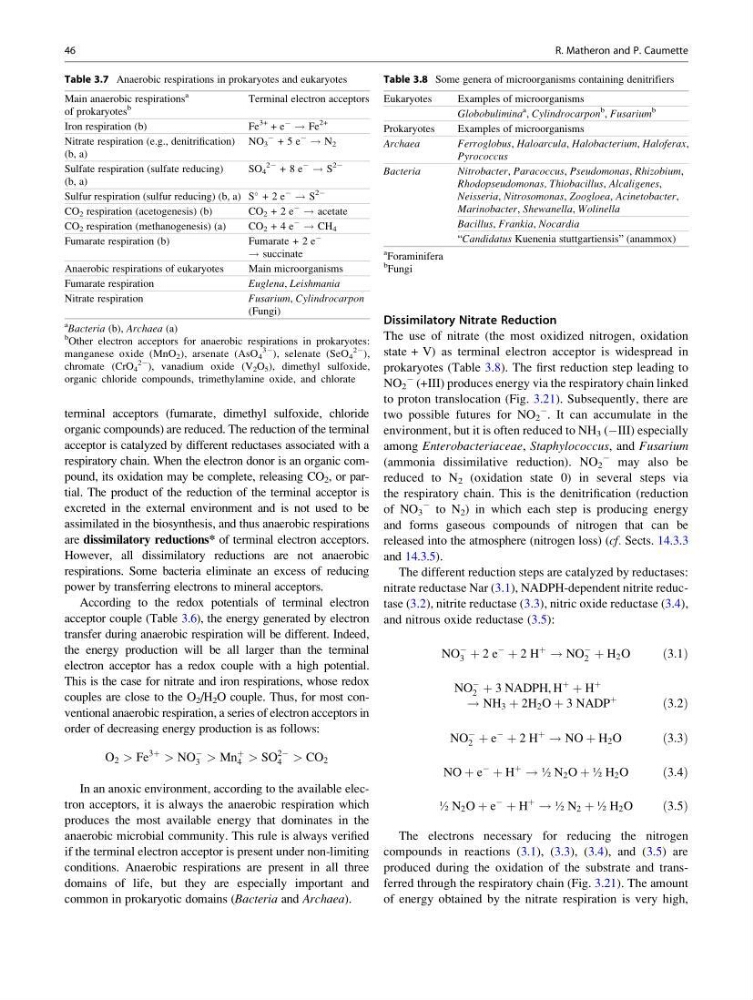
terminal acceptors (fumarate, dimethyl sulfoxide, chloride
organic compounds) are reduced. The reduction of the terminal
acceptor is catalyzed by different reductases associated with a
respiratory chain. When the electron donor is an organic compound, its oxidation may be complete, releasing CO 2 , or partial. The product of the reduction of the terminal acceptor is
excreted in the external environment and is not used to be
assimilated in the biosynthesis, and thus anaerobic respirations
are dissimilatory reductions* of terminal electron acceptors.
However, all dissimilatory reductions are not anaerobic
respirations. Some bacteria eliminate an excess of reducing
power by transferring electrons to mineral acceptors.
According to the redox potentials of terminal electron
acceptor couple (Table 3.6), the energy generated by electron
transfer during anaerobic respiration will be different. Indeed,
the energy production will be all larger than the terminal
electron acceptor has a redox couple with a high potential.
This is the case for nitrate and iron respirations, whose redox
couples are close to the O 2 /H 2 O couple. Thus, for most conventional anaerobic respiration, a series of electron acceptors in
order of decreasing energy production is as follows:
O 2 > Fe
3þ
> NO
À
3 > Mn
þ
4 > SO
2À
4 > CO 2
In an anoxic environment, according to the available electron acceptors, it is always the anaerobic respiration which
produces the most available energy that dominates in the
anaerobic microbial community. This rule is always verified
if the terminal electron acceptor is present under non-limiting
conditions. Anaerobic respirations are present in all three
domains of life, but they are especially important and
common in prokaryotic domains (Bacteria and Archaea).
Dissimilatory Nitrate Reduction
The use of nitrate (the most oxidized nitrogen, oxidation
state + V) as terminal electron acceptor is widespread in
prokaryotes (Table 3.8). The first reduction step leading to
NO 2
À (+III) produces energy via the respiratory chain linked
to proton translocation (Fig. 3.21). Subsequently, there are
two possible futures for NO 2
À
. It can accumulate in the
environment, but it is often reduced to NH 3 (ÀIII) especially
among Enterobacteriaceae, Staphylococcus, and Fusarium
(ammonia dissimilative reduction). NO 2
À may also be
reduced to N 2 (oxidation state 0) in several steps via
the respiratory chain. This is the denitrification (reduction
of NO 3
À to N 2 ) in which each step is producing energy
and forms gaseous compounds of nitrogen that can be
released into the atmosphere (nitrogen loss) (cf. Sects. 14.3.3
and 14.3.5).
The different reduction steps are catalyzed by reductases:
nitrate reductase Nar (3.1), NADPH-dependent nitrite reductase (3.2), nitrite reductase (3.3), nitric oxide reductase (3.4),
and nitrous oxide reductase (3.5):
NO
À
3 þ 2 e
À
þ 2 H
þ
! NO
À
2 þ H 2 O
ð3:1Þ
NO
À
2 þ 3 NADPH, H
þ
þ H
þ
! NH 3 þ 2H 2 O þ 3 NADP
þ
ð3:2Þ
NO
À
2 þ e
À
þ 2 H
þ
! NO þ H 2 O
ð3:3Þ
NO þ e
À
þ H
þ
! ½ N 2 O þ ½ H 2 O
ð3:4Þ
½ N 2 O þ e
À
þ H
þ
! ½ N 2 þ ½ H 2 O
ð3:5Þ
The electrons necessary for reducing the nitrogen
compounds in reactions (3.1), (3.3), (3.4), and (3.5) are
produced during the oxidation of the substrate and transferred through the respiratory chain (Fig. 3.21). The amount
of energy obtained by the nitrate respiration is very high,
Table 3.7 Anaerobic respirations in prokaryotes and eukaryotes
Main anaerobic respirations
a
of prokaryotes
b
Terminal electron acceptors
Iron respiration (b)
Fe
3+ + e
À ! Fe
2+
Nitrate respiration (e.g., denitrification)
(b, a)
NO 3
À + 5 e
À ! N 2
Sulfate respiration (sulfate reducing)
(b, a)
SO 4
2À + 8 e
À ! S
2À
Sulfur respiration (sulfur reducing) (b, a) S
+ 2 e
À ! S
2À
CO 2 respiration (acetogenesis) (b)
CO 2 + 2 e
À ! acetate
CO 2 respiration (methanogenesis) (a)
CO 2 + 4 e
À ! CH 4
Fumarate respiration (b)
Fumarate + 2 e
À
! succinate
Anaerobic respirations of eukaryotes
Main microorganisms
Fumarate respiration
Euglena, Leishmania
Nitrate respiration
Fusarium, Cylindrocarpon
(Fungi)
a
Bacteria (b), Archaea (a)
b
Other electron acceptors for anaerobic respirations in prokaryotes:
manganese oxide (MnO 2 ), arsenate (AsO 4
3À
), selenate (SeO 4
2À ),
chromate (CrO 4
2À
), vanadium oxide (V 2 O 5 ), dimethyl sulfoxide,
organic chloride compounds, trimethylamine oxide, and chlorate
Table 3.8 Some genera of microorganisms containing denitrifiers
Eukaryotes
Examples of microorganisms
Globobulimina
a
, Cylindrocarpon
b
, Fusarium
b
Prokaryotes
Examples of microorganisms
Archaea
Ferroglobus, Haloarcula, Halobacterium, Haloferax,
Pyrococcus
Bacteria
Nitrobacter, Paracoccus, Pseudomonas, Rhizobium,
Rhodopseudomonas, Thiobacillus, Alcaligenes,
Neisseria, Nitrosomonas, Zoogloea, Acinetobacter,
Marinobacter, Shewanella, Wolinella
Bacillus, Frankia, Nocardia
“Candidatus Kuenenia stuttgartiensis” (anammox)
a
Foraminifera
b
Fungi
46
R. Matheron and P. Caumette
organic compounds) are reduced. The reduction of the terminal
acceptor is catalyzed by different reductases associated with a
respiratory chain. When the electron donor is an organic compound, its oxidation may be complete, releasing CO 2 , or partial. The product of the reduction of the terminal acceptor is
excreted in the external environment and is not used to be
assimilated in the biosynthesis, and thus anaerobic respirations
are dissimilatory reductions* of terminal electron acceptors.
However, all dissimilatory reductions are not anaerobic
respirations. Some bacteria eliminate an excess of reducing
power by transferring electrons to mineral acceptors.
According to the redox potentials of terminal electron
acceptor couple (Table 3.6), the energy generated by electron
transfer during anaerobic respiration will be different. Indeed,
the energy production will be all larger than the terminal
electron acceptor has a redox couple with a high potential.
This is the case for nitrate and iron respirations, whose redox
couples are close to the O 2 /H 2 O couple. Thus, for most conventional anaerobic respiration, a series of electron acceptors in
order of decreasing energy production is as follows:
O 2 > Fe
3þ
> NO
À
3 > Mn
þ
4 > SO
2À
4 > CO 2
In an anoxic environment, according to the available electron acceptors, it is always the anaerobic respiration which
produces the most available energy that dominates in the
anaerobic microbial community. This rule is always verified
if the terminal electron acceptor is present under non-limiting
conditions. Anaerobic respirations are present in all three
domains of life, but they are especially important and
common in prokaryotic domains (Bacteria and Archaea).
Dissimilatory Nitrate Reduction
The use of nitrate (the most oxidized nitrogen, oxidation
state + V) as terminal electron acceptor is widespread in
prokaryotes (Table 3.8). The first reduction step leading to
NO 2
À (+III) produces energy via the respiratory chain linked
to proton translocation (Fig. 3.21). Subsequently, there are
two possible futures for NO 2
À
. It can accumulate in the
environment, but it is often reduced to NH 3 (ÀIII) especially
among Enterobacteriaceae, Staphylococcus, and Fusarium
(ammonia dissimilative reduction). NO 2
À may also be
reduced to N 2 (oxidation state 0) in several steps via
the respiratory chain. This is the denitrification (reduction
of NO 3
À to N 2 ) in which each step is producing energy
and forms gaseous compounds of nitrogen that can be
released into the atmosphere (nitrogen loss) (cf. Sects. 14.3.3
and 14.3.5).
The different reduction steps are catalyzed by reductases:
nitrate reductase Nar (3.1), NADPH-dependent nitrite reductase (3.2), nitrite reductase (3.3), nitric oxide reductase (3.4),
and nitrous oxide reductase (3.5):
NO
À
3 þ 2 e
À
þ 2 H
þ
! NO
À
2 þ H 2 O
ð3:1Þ
NO
À
2 þ 3 NADPH, H
þ
þ H
þ
! NH 3 þ 2H 2 O þ 3 NADP
þ
ð3:2Þ
NO
À
2 þ e
À
þ 2 H
þ
! NO þ H 2 O
ð3:3Þ
NO þ e
À
þ H
þ
! ½ N 2 O þ ½ H 2 O
ð3:4Þ
½ N 2 O þ e
À
þ H
þ
! ½ N 2 þ ½ H 2 O
ð3:5Þ
The electrons necessary for reducing the nitrogen
compounds in reactions (3.1), (3.3), (3.4), and (3.5) are
produced during the oxidation of the substrate and transferred through the respiratory chain (Fig. 3.21). The amount
of energy obtained by the nitrate respiration is very high,
Table 3.7 Anaerobic respirations in prokaryotes and eukaryotes
Main anaerobic respirations
a
of prokaryotes
b
Terminal electron acceptors
Iron respiration (b)
Fe
3+ + e
À ! Fe
2+
Nitrate respiration (e.g., denitrification)
(b, a)
NO 3
À + 5 e
À ! N 2
Sulfate respiration (sulfate reducing)
(b, a)
SO 4
2À + 8 e
À ! S
2À
Sulfur respiration (sulfur reducing) (b, a) S
+ 2 e
À ! S
2À
CO 2 respiration (acetogenesis) (b)
CO 2 + 2 e
À ! acetate
CO 2 respiration (methanogenesis) (a)
CO 2 + 4 e
À ! CH 4
Fumarate respiration (b)
Fumarate + 2 e
À
! succinate
Anaerobic respirations of eukaryotes
Main microorganisms
Fumarate respiration
Euglena, Leishmania
Nitrate respiration
Fusarium, Cylindrocarpon
(Fungi)
a
Bacteria (b), Archaea (a)
b
Other electron acceptors for anaerobic respirations in prokaryotes:
manganese oxide (MnO 2 ), arsenate (AsO 4
3À
), selenate (SeO 4
2À ),
chromate (CrO 4
2À
), vanadium oxide (V 2 O 5 ), dimethyl sulfoxide,
organic chloride compounds, trimethylamine oxide, and chlorate
Table 3.8 Some genera of microorganisms containing denitrifiers
Eukaryotes
Examples of microorganisms
Globobulimina
a
, Cylindrocarpon
b
, Fusarium
b
Prokaryotes
Examples of microorganisms
Archaea
Ferroglobus, Haloarcula, Halobacterium, Haloferax,
Pyrococcus
Bacteria
Nitrobacter, Paracoccus, Pseudomonas, Rhizobium,
Rhodopseudomonas, Thiobacillus, Alcaligenes,
Neisseria, Nitrosomonas, Zoogloea, Acinetobacter,
Marinobacter, Shewanella, Wolinella
Bacillus, Frankia, Nocardia
“Candidatus Kuenenia stuttgartiensis” (anammox)
a
Foraminifera
b
Fungi
46
R. Matheron and P. Caumette