

in its terminal part (cytochromes, Fig. 3.18a–d). Thus, the
potential difference between the donor couple (reduced mineral
compound) and acceptor couple (O 2 /H 2 O) (Table 3.6) is relatively low, so the amount of energy will always be low except
for paths using dihydrogen or CO as electron donors. As a
result, the chemolithotrophic bacteria oxidize a large amount
of reduced compounds (electron donors) for a relatively low
energy and therefore biomass. In the case of sulfur-oxidizing
bacteria and nitrifying bacteria, this great oxidation activity can
lead a significant production of acid compounds (H 2 SO 4 ,
HNO 3 ) which, in environments poorly buffered, are responsible
for the phenomena of corrosion.
The translocation of protons resulting from activity of the
respiratory chain leads to a proton-motive force that can be
used as energy or allow the synthesis of ATP by oxidative
phosphorylation. In most chemolithotrophic bacteria, ATP
production is exclusively obtained by oxidative phosphorylation, with the exception of sulfur-oxidizing bacteria in
which a small amount of ATP is produced by substratelevel phosphorylation in the oxidation of sulfite to sulfate.
In chemolithotrophic autotrophic microorganisms, the
reduction of CO 2 into organic compounds used for biosynthesis requires reducing power in the form of large amounts
of reduced coenzymes (NADH, H
+ or NADPH, H
+
). The
electrons required for reduction of these coenzymes are
derived from the oxidation of electron donor (reduced inorganic compound). However, apart from the case of
dihydrogen and CO, the redox potentials of redox couples
of electron donors (energy sources) are higher than that of
redox couple of NAD
+ /NADH, H
+ , so electrons cannot be
transferred spontaneously to NAD
+ . The result is a transfer
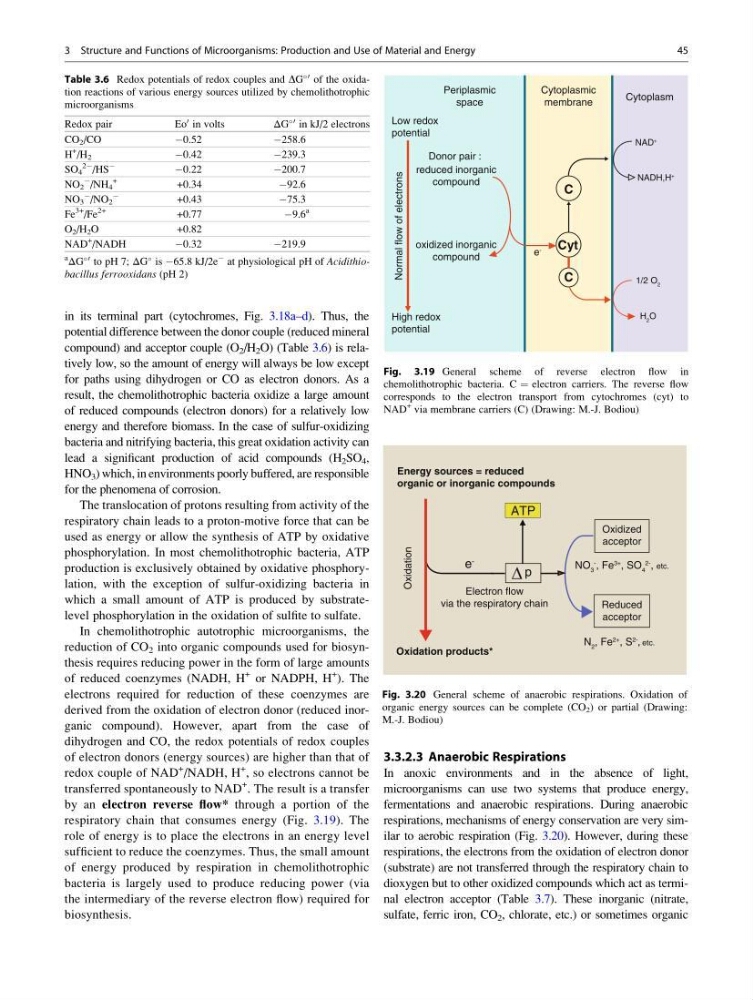
by an electron reverse flow* through a portion of the
respiratory chain that consumes energy (Fig. 3.19). The
role of energy is to place the electrons in an energy level
sufficient to reduce the coenzymes. Thus, the small amount
of energy produced by respiration in chemolithotrophic
bacteria is largely used to produce reducing power (via
the intermediary of the reverse electron flow) required for
biosynthesis.
3.3.2.3 Anaerobic Respirations
In anoxic environments and in the absence of light,
microorganisms can use two systems that produce energy,
fermentations and anaerobic respirations. During anaerobic
respirations, mechanisms of energy conservation are very similar to aerobic respiration (Fig. 3.20). However, during these
respirations, the electrons from the oxidation of electron donor
(substrate) are not transferred through the respiratory chain to
dioxygen but to other oxidized compounds which act as terminal electron acceptor (Table 3.7). These inorganic (nitrate,
sulfate, ferric iron, CO 2 , chlorate, etc.) or sometimes organic
Table 3.6 Redox potentials of redox couples and DG
0 of the oxidation reactions of various energy sources utilized by chemolithotrophic
microorganisms
Redox pair
Eo
0 in volts
ΔG
0 in kJ/2 electrons
CO 2 /CO
À0.52
À258.6
H
+ /H 2
À0.42
À239.3
SO 4
2À
/HS
À
À0.22
À200.7
NO 2
À
/NH 4
+
+0.34
À92.6
NO 3
À
/NO 2
À
+0.43
À75.3
Fe
3+ /Fe
2+
+0.77
À9.6
a
O 2 /H 2 O
+0.82
NAD
+ /NADH
À0.32
À219.9
a
ΔG
0 to pH 7; ΔG
is À65.8 kJ/2e
À at physiological pH of Acidithiobacillus ferrooxidans (pH 2)
Donor pair :
reduced inorganic
compound
oxidized inorganic
compound
Periplasmic
space
Cytoplasm
Cytoplasmic
membrane
C
C
Cyt
NADH,H
+
NAD
+
Normal flow of electrons
Low redox
potential
High redox
potential
1/2 O 2
H 2 O
e
-
Fig. 3.19 General scheme of reverse electron flow in
chemolithotrophic bacteria. C ¼ electron carriers. The reverse flow
corresponds to the electron transport from cytochromes (cyt) to
NAD
+ via membrane carriers (C) (Drawing: M.-J. Bodiou)
e
-
ATP
Oxidation
Oxidation products*
Energy sources = reduced
organic or inorganic compounds
Electron flow
via the respiratory chain
Reduced
acceptor
Oxidized
acceptor
NO 3
- , Fe
3+ , SO 4
2, etc.
N 2 , Fe
2+ , S
2, etc.
p
Fig. 3.20 General scheme of anaerobic respirations. Oxidation of
organic energy sources can be complete (CO 2 ) or partial (Drawing:
M.-J. Bodiou)
3 Structure and Functions of Microorganisms: Production and Use of Material and Energy
45
potential difference between the donor couple (reduced mineral
compound) and acceptor couple (O 2 /H 2 O) (Table 3.6) is relatively low, so the amount of energy will always be low except
for paths using dihydrogen or CO as electron donors. As a
result, the chemolithotrophic bacteria oxidize a large amount
of reduced compounds (electron donors) for a relatively low
energy and therefore biomass. In the case of sulfur-oxidizing
bacteria and nitrifying bacteria, this great oxidation activity can
lead a significant production of acid compounds (H 2 SO 4 ,
HNO 3 ) which, in environments poorly buffered, are responsible
for the phenomena of corrosion.
The translocation of protons resulting from activity of the
respiratory chain leads to a proton-motive force that can be
used as energy or allow the synthesis of ATP by oxidative
phosphorylation. In most chemolithotrophic bacteria, ATP
production is exclusively obtained by oxidative phosphorylation, with the exception of sulfur-oxidizing bacteria in
which a small amount of ATP is produced by substratelevel phosphorylation in the oxidation of sulfite to sulfate.
In chemolithotrophic autotrophic microorganisms, the
reduction of CO 2 into organic compounds used for biosynthesis requires reducing power in the form of large amounts
of reduced coenzymes (NADH, H
+ or NADPH, H
+
). The
electrons required for reduction of these coenzymes are
derived from the oxidation of electron donor (reduced inorganic compound). However, apart from the case of
dihydrogen and CO, the redox potentials of redox couples
of electron donors (energy sources) are higher than that of
redox couple of NAD
+ /NADH, H
+ , so electrons cannot be
transferred spontaneously to NAD
+ . The result is a transfer
by an electron reverse flow* through a portion of the
respiratory chain that consumes energy (Fig. 3.19). The
role of energy is to place the electrons in an energy level
sufficient to reduce the coenzymes. Thus, the small amount
of energy produced by respiration in chemolithotrophic
bacteria is largely used to produce reducing power (via
the intermediary of the reverse electron flow) required for
biosynthesis.
3.3.2.3 Anaerobic Respirations
In anoxic environments and in the absence of light,
microorganisms can use two systems that produce energy,
fermentations and anaerobic respirations. During anaerobic
respirations, mechanisms of energy conservation are very similar to aerobic respiration (Fig. 3.20). However, during these
respirations, the electrons from the oxidation of electron donor
(substrate) are not transferred through the respiratory chain to
dioxygen but to other oxidized compounds which act as terminal electron acceptor (Table 3.7). These inorganic (nitrate,
sulfate, ferric iron, CO 2 , chlorate, etc.) or sometimes organic
Table 3.6 Redox potentials of redox couples and DG
0 of the oxidation reactions of various energy sources utilized by chemolithotrophic
microorganisms
Redox pair
Eo
0 in volts
ΔG
0 in kJ/2 electrons
CO 2 /CO
À0.52
À258.6
H
+ /H 2
À0.42
À239.3
SO 4
2À
/HS
À
À0.22
À200.7
NO 2
À
/NH 4
+
+0.34
À92.6
NO 3
À
/NO 2
À
+0.43
À75.3
Fe
3+ /Fe
2+
+0.77
À9.6
a
O 2 /H 2 O
+0.82
NAD
+ /NADH
À0.32
À219.9
a
ΔG
0 to pH 7; ΔG
is À65.8 kJ/2e
À at physiological pH of Acidithiobacillus ferrooxidans (pH 2)
Donor pair :
reduced inorganic
compound
oxidized inorganic
compound
Periplasmic
space
Cytoplasm
Cytoplasmic
membrane
C
C
Cyt
NADH,H
+
NAD
+
Normal flow of electrons
Low redox
potential
High redox
potential
1/2 O 2
H 2 O
e
-
Fig. 3.19 General scheme of reverse electron flow in
chemolithotrophic bacteria. C ¼ electron carriers. The reverse flow
corresponds to the electron transport from cytochromes (cyt) to
NAD
+ via membrane carriers (C) (Drawing: M.-J. Bodiou)
e
-
ATP
Oxidation
Oxidation products*
Energy sources = reduced
organic or inorganic compounds
Electron flow
via the respiratory chain
Reduced
acceptor
Oxidized
acceptor
NO 3
- , Fe
3+ , SO 4
2, etc.
N 2 , Fe
2+ , S
2, etc.
p
Fig. 3.20 General scheme of anaerobic respirations. Oxidation of
organic energy sources can be complete (CO 2 ) or partial (Drawing:
M.-J. Bodiou)
3 Structure and Functions of Microorganisms: Production and Use of Material and Energy
45