

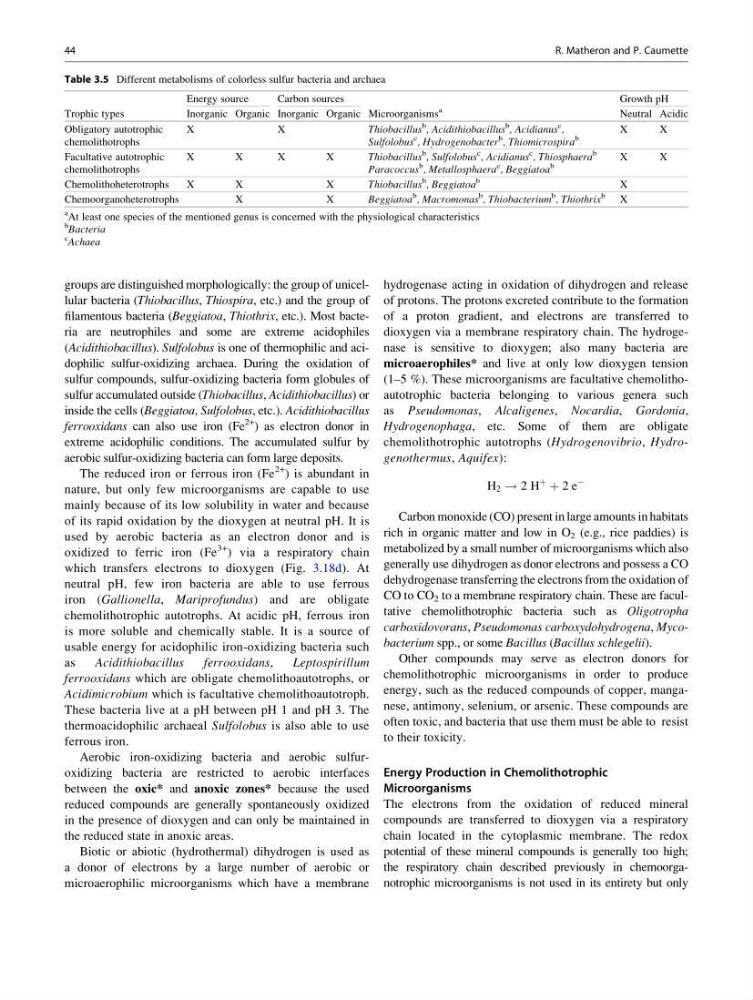
groups are distinguished morphologically: the group of unicellular bacteria (Thiobacillus, Thiospira, etc.) and the group of
filamentous bacteria (Beggiatoa, Thiothrix, etc.). Most bacteria are neutrophiles and some are extreme acidophiles
(Acidithiobacillus). Sulfolobus is one of thermophilic and acidophilic sulfur-oxidizing archaea. During the oxidation of
sulfur compounds, sulfur-oxidizing bacteria form globules of
sulfur accumulated outside (Thiobacillus, Acidithiobacillus) or
inside the cells (Beggiatoa, Sulfolobus, etc.). Acidithiobacillus
ferrooxidans can also use iron (Fe
2+
) as electron donor in
extreme acidophilic conditions. The accumulated sulfur by
aerobic sulfur-oxidizing bacteria can form large deposits.
The reduced iron or ferrous iron (Fe
2+ ) is abundant in
nature, but only few microorganisms are capable to use
mainly because of its low solubility in water and because
of its rapid oxidation by the dioxygen at neutral pH. It is
used by aerobic bacteria as an electron donor and is
oxidized to ferric iron (Fe
3+ ) via a respiratory chain
which transfers electrons to dioxygen (Fig. 3.18d). At
neutral pH, few iron bacteria are able to use ferrous
iron (Gallionella, Mariprofundus) and are obligate
chemolithotrophic autotrophs. At acidic pH, ferrous iron
is more soluble and chemically stable. It is a source of
usable energy for acidophilic iron-oxidizing bacteria such
as
Acidithiobacillus
ferrooxidans,
Leptospirillum
ferrooxidans which are obligate chemolithoautotrophs, or
Acidimicrobium which is facultative chemolithoautotroph.
These bacteria live at a pH between pH 1 and pH 3. The
thermoacidophilic archaeal Sulfolobus is also able to use
ferrous iron.
Aerobic iron-oxidizing bacteria and aerobic sulfuroxidizing bacteria are restricted to aerobic interfaces
between the oxic* and anoxic zones* because the used
reduced compounds are generally spontaneously oxidized
in the presence of dioxygen and can only be maintained in
the reduced state in anoxic areas.
Biotic or abiotic (hydrothermal) dihydrogen is used as
a donor of electrons by a large number of aerobic or
microaerophilic microorganisms which have a membrane
hydrogenase acting in oxidation of dihydrogen and release
of protons. The protons excreted contribute to the formation
of a proton gradient, and electrons are transferred to
dioxygen via a membrane respiratory chain. The hydrogenase is sensitive to dioxygen; also many bacteria are
microaerophiles* and live at only low dioxygen tension
(1–5 %). These microorganisms are facultative chemolithoautotrophic bacteria belonging to various genera such
as Pseudomonas, Alcaligenes, Nocardia, Gordonia,
Hydrogenophaga, etc. Some of them are obligate
chemolithotrophic autotrophs (Hydrogenovibrio, Hydrogenothermus, Aquifex):
H 2 ! 2 H
þ
þ 2 e
À
Carbon monoxide (CO) present in large amounts in habitats
rich in organic matter and low in O 2 (e.g., rice paddies) is
metabolized by a small number of microorganisms which also
generally use dihydrogen as donor electrons and possess a CO
dehydrogenase transferring the electrons from the oxidation of
CO to CO 2 to a membrane respiratory chain. These are facultative chemolithotrophic bacteria such as Oligotropha
carboxidovorans, Pseudomonas carboxydohydrogena, Mycobacterium spp., or some Bacillus (Bacillus schlegelii).
Other compounds may serve as electron donors for
chemolithotrophic microorganisms in order to produce
energy, such as the reduced compounds of copper, manganese, antimony, selenium, or arsenic. These compounds are
often toxic, and bacteria that use them must be able to resist
to their toxicity.
Energy Production in Chemolithotrophic
Microorganisms
The electrons from the oxidation of reduced mineral
compounds are transferred to dioxygen via a respiratory
chain located in the cytoplasmic membrane. The redox
potential of these mineral compounds is generally too high;
the respiratory chain described previously in chemoorganotrophic microorganisms is not used in its entirety but only
Table 3.5 Different metabolisms of colorless sulfur bacteria and archaea
Trophic types
Energy source
Carbon sources
Microorganisms
a
Growth pH
Inorganic Organic Inorganic Organic
Neutral Acidic
Obligatory autotrophic
chemolithotrophs
X
X
Thiobacillus
b
, Acidithiobacillus
b
, Acidianus
c
,
Sulfolobus
c
, Hydrogenobacter
b
, Thiomicrospira
b
X
X
Facultative autotrophic
chemolithotrophs
X
X
X
X
Thiobacillus
b
, Sulfolobus
c
, Acidianus
c
, Thiosphaera
b
Paracoccus
b
, Metallosphaera
c
, Beggiatoa
b
X
X
Chemolithoheterotrophs
X
X
X
Thiobacillus
b
, Beggiatoa
b
X
Chemoorganoheterotrophs
X
X
Beggiatoa
b
, Macromonas
b
, Thiobacterium
b
, Thiothrix
b
X
a
At least one species of the mentioned genus is concerned with the physiological characteristics
b
Bacteria
c
Achaea
44
R. Matheron and P. Caumette
filamentous bacteria (Beggiatoa, Thiothrix, etc.). Most bacteria are neutrophiles and some are extreme acidophiles
(Acidithiobacillus). Sulfolobus is one of thermophilic and acidophilic sulfur-oxidizing archaea. During the oxidation of
sulfur compounds, sulfur-oxidizing bacteria form globules of
sulfur accumulated outside (Thiobacillus, Acidithiobacillus) or
inside the cells (Beggiatoa, Sulfolobus, etc.). Acidithiobacillus
ferrooxidans can also use iron (Fe
2+
) as electron donor in
extreme acidophilic conditions. The accumulated sulfur by
aerobic sulfur-oxidizing bacteria can form large deposits.
The reduced iron or ferrous iron (Fe
2+ ) is abundant in
nature, but only few microorganisms are capable to use
mainly because of its low solubility in water and because
of its rapid oxidation by the dioxygen at neutral pH. It is
used by aerobic bacteria as an electron donor and is
oxidized to ferric iron (Fe
3+ ) via a respiratory chain
which transfers electrons to dioxygen (Fig. 3.18d). At
neutral pH, few iron bacteria are able to use ferrous
iron (Gallionella, Mariprofundus) and are obligate
chemolithotrophic autotrophs. At acidic pH, ferrous iron
is more soluble and chemically stable. It is a source of
usable energy for acidophilic iron-oxidizing bacteria such
as
Acidithiobacillus
ferrooxidans,
Leptospirillum
ferrooxidans which are obligate chemolithoautotrophs, or
Acidimicrobium which is facultative chemolithoautotroph.
These bacteria live at a pH between pH 1 and pH 3. The
thermoacidophilic archaeal Sulfolobus is also able to use
ferrous iron.
Aerobic iron-oxidizing bacteria and aerobic sulfuroxidizing bacteria are restricted to aerobic interfaces
between the oxic* and anoxic zones* because the used
reduced compounds are generally spontaneously oxidized
in the presence of dioxygen and can only be maintained in
the reduced state in anoxic areas.
Biotic or abiotic (hydrothermal) dihydrogen is used as
a donor of electrons by a large number of aerobic or
microaerophilic microorganisms which have a membrane
hydrogenase acting in oxidation of dihydrogen and release
of protons. The protons excreted contribute to the formation
of a proton gradient, and electrons are transferred to
dioxygen via a membrane respiratory chain. The hydrogenase is sensitive to dioxygen; also many bacteria are
microaerophiles* and live at only low dioxygen tension
(1–5 %). These microorganisms are facultative chemolithoautotrophic bacteria belonging to various genera such
as Pseudomonas, Alcaligenes, Nocardia, Gordonia,
Hydrogenophaga, etc. Some of them are obligate
chemolithotrophic autotrophs (Hydrogenovibrio, Hydrogenothermus, Aquifex):
H 2 ! 2 H
þ
þ 2 e
À
Carbon monoxide (CO) present in large amounts in habitats
rich in organic matter and low in O 2 (e.g., rice paddies) is
metabolized by a small number of microorganisms which also
generally use dihydrogen as donor electrons and possess a CO
dehydrogenase transferring the electrons from the oxidation of
CO to CO 2 to a membrane respiratory chain. These are facultative chemolithotrophic bacteria such as Oligotropha
carboxidovorans, Pseudomonas carboxydohydrogena, Mycobacterium spp., or some Bacillus (Bacillus schlegelii).
Other compounds may serve as electron donors for
chemolithotrophic microorganisms in order to produce
energy, such as the reduced compounds of copper, manganese, antimony, selenium, or arsenic. These compounds are
often toxic, and bacteria that use them must be able to resist
to their toxicity.
Energy Production in Chemolithotrophic
Microorganisms
The electrons from the oxidation of reduced mineral
compounds are transferred to dioxygen via a respiratory
chain located in the cytoplasmic membrane. The redox
potential of these mineral compounds is generally too high;
the respiratory chain described previously in chemoorganotrophic microorganisms is not used in its entirety but only
Table 3.5 Different metabolisms of colorless sulfur bacteria and archaea
Trophic types
Energy source
Carbon sources
Microorganisms
a
Growth pH
Inorganic Organic Inorganic Organic
Neutral Acidic
Obligatory autotrophic
chemolithotrophs
X
X
Thiobacillus
b
, Acidithiobacillus
b
, Acidianus
c
,
Sulfolobus
c
, Hydrogenobacter
b
, Thiomicrospira
b
X
X
Facultative autotrophic
chemolithotrophs
X
X
X
X
Thiobacillus
b
, Sulfolobus
c
, Acidianus
c
, Thiosphaera
b
Paracoccus
b
, Metallosphaera
c
, Beggiatoa
b
X
X
Chemolithoheterotrophs
X
X
X
Thiobacillus
b
, Beggiatoa
b
X
Chemoorganoheterotrophs
X
X
Beggiatoa
b
, Macromonas
b
, Thiobacterium
b
, Thiothrix
b
X
a
At least one species of the mentioned genus is concerned with the physiological characteristics
b
Bacteria
c
Achaea
44
R. Matheron and P. Caumette