

14.5.2.3 Iron Oxidation
The oxidation of Fe(II) to Fe(III) iron by chemical or
microbial processes depends on pH and oxygen concentration. In oxic conditions, the oxidation pathways of iron will be
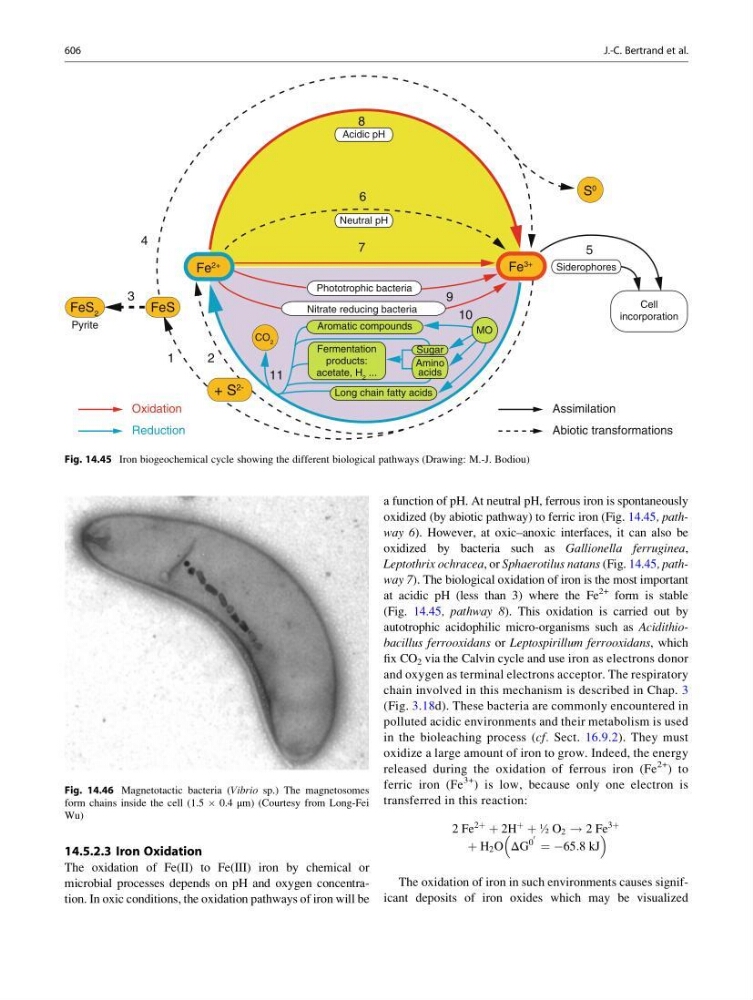
a function of pH. At neutral pH, ferrous iron is spontaneously
oxidized (by abiotic pathway) to ferric iron (Fig. 14.45, pathway 6). However, at oxic–anoxic interfaces, it can also be
oxidized by bacteria such as Gallionella ferruginea,
Leptothrix ochracea, or Sphaerotilus natans (Fig. 14.45, pathway 7). The biological oxidation of iron is the most important
at acidic pH (less than 3) where the Fe
2+ form is stable
(Fig. 14.45, pathway 8). This oxidation is carried out by
autotrophic acidophilic micro-organisms such as Acidithiobacillus ferrooxidans or Leptospirillum ferrooxidans, which
fix CO 2 via the Calvin cycle and use iron as electrons donor
and oxygen as terminal electrons acceptor. The respiratory
chain involved in this mechanism is described in Chap. 3
(Fig. 3.18d). These bacteria are commonly encountered in
polluted acidic environments and their metabolism is used
in the bioleaching process (cf. Sect. 16.9.2). They must
oxidize a large amount of iron to grow. Indeed, the energy
released during the oxidation of ferrous iron (Fe
2+ ) to
ferric iron (Fe
3+ ) is low, because only one electron is
transferred in this reaction:
2 Fe
2þ
þ 2H
þ
þ ½ O 2 ! 2 Fe
3þ
þ H 2 O ΔG
0
0 ¼ À65:8 kJ
The oxidation of iron in such environments causes significant deposits of iron oxides which may be visualized
FeS 2
1
2
3
4
5
6
7
8
9
10
11
Siderophores
Cell
incorporation
Pyrite
Aromatic compounds
Sugar
Amino
acids
Acidic pH
Phototrophic bacteria
Nitrate reducing bacteria
Neutral pH
FeS
CO 2
+ S
2Fe
2+
Fe
3+
S
0
Fermentation
products:
acetate, H 2 ...
MO
Long chain fatty acids
Assimilation
Oxidation
Reduction
Abiotic transformations
Fig. 14.45 Iron biogeochemical cycle showing the different biological pathways (Drawing: M.-J. Bodiou)
Fig. 14.46 Magnetotactic bacteria (Vibrio sp.) The magnetosomes
form chains inside the cell (1.5 Â 0.4 μm) (Courtesy from Long-Fei
Wu)
606
J.-C. Bertrand et al.