

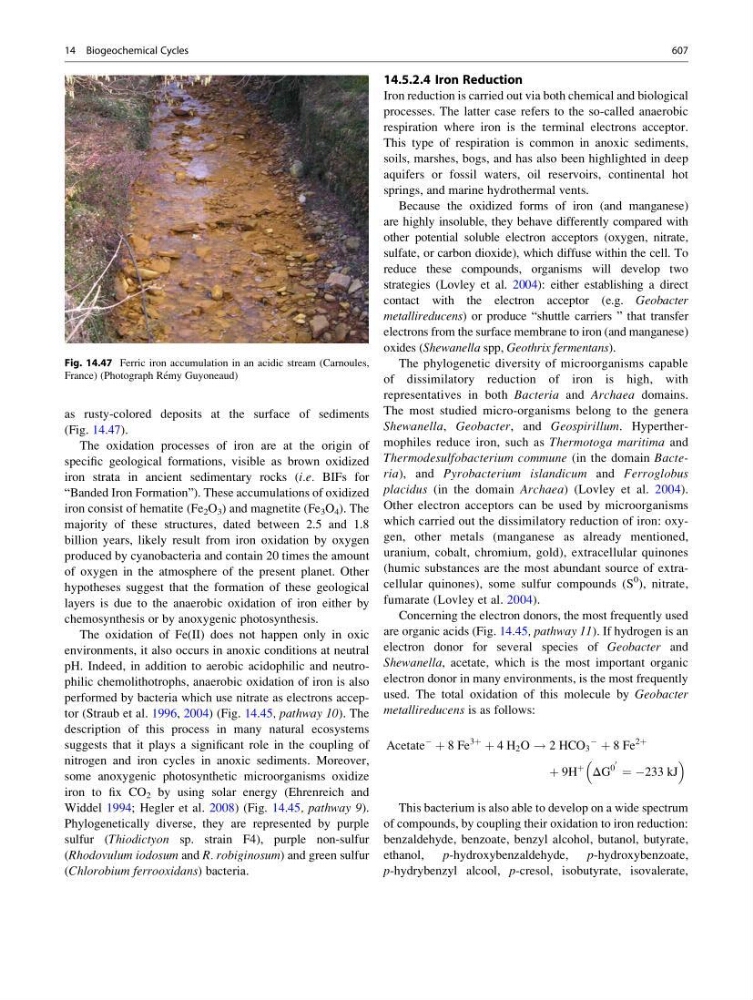
as rusty-colored deposits at the surface of sediments
(Fig. 14.47).
The oxidation processes of iron are at the origin of
specific geological formations, visible as brown oxidized
iron strata in ancient sedimentary rocks (i.e. BIFs for
“Banded Iron Formation”). These accumulations of oxidized
iron consist of hematite (Fe 2 O 3 ) and magnetite (Fe 3 O 4 ). The
majority of these structures, dated between 2.5 and 1.8
billion years, likely result from iron oxidation by oxygen
produced by cyanobacteria and contain 20 times the amount
of oxygen in the atmosphere of the present planet. Other
hypotheses suggest that the formation of these geological
layers is due to the anaerobic oxidation of iron either by
chemosynthesis or by anoxygenic photosynthesis.
The oxidation of Fe(II) does not happen only in oxic
environments, it also occurs in anoxic conditions at neutral
pH. Indeed, in addition to aerobic acidophilic and neutrophilic chemolithotrophs, anaerobic oxidation of iron is also
performed by bacteria which use nitrate as electrons acceptor (Straub et al. 1996, 2004) (Fig. 14.45, pathway 10). The
description of this process in many natural ecosystems
suggests that it plays a significant role in the coupling of
nitrogen and iron cycles in anoxic sediments. Moreover,
some anoxygenic photosynthetic microorganisms oxidize
iron to fix CO 2 by using solar energy (Ehrenreich and
Widdel 1994; Hegler et al. 2008) (Fig. 14.45, pathway 9).
Phylogenetically diverse, they are represented by purple
sulfur (Thiodictyon sp. strain F4), purple non-sulfur
(Rhodovulum iodosum and R. robiginosum) and green sulfur
(Chlorobium ferrooxidans) bacteria.
14.5.2.4 Iron Reduction
Iron reduction is carried out via both chemical and biological
processes. The latter case refers to the so-called anaerobic
respiration where iron is the terminal electrons acceptor.
This type of respiration is common in anoxic sediments,
soils, marshes, bogs, and has also been highlighted in deep
aquifers or fossil waters, oil reservoirs, continental hot
springs, and marine hydrothermal vents.
Because the oxidized forms of iron (and manganese)
are highly insoluble, they behave differently compared with
other potential soluble electron acceptors (oxygen, nitrate,
sulfate, or carbon dioxide), which diffuse within the cell. To
reduce these compounds, organisms will develop two
strategies (Lovley et al. 2004): either establishing a direct
contact with the electron acceptor (e.g. Geobacter
metallireducens) or produce “shuttle carriers ” that transfer
electrons from the surface membrane to iron (and manganese)
oxides (Shewanella spp, Geothrix fermentans).
The phylogenetic diversity of microorganisms capable
of dissimilatory reduction of iron is high, with
representatives in both Bacteria and Archaea domains.
The most studied micro-organisms belong to the genera
Shewanella, Geobacter, and Geospirillum. Hyperthermophiles reduce iron, such as Thermotoga maritima and
Thermodesulfobacterium commune (in the domain Bacteria), and Pyrobacterium islandicum and Ferroglobus
placidus (in the domain Archaea) (Lovley et al. 2004).
Other electron acceptors can be used by microorganisms
which carried out the dissimilatory reduction of iron: oxygen, other metals (manganese as already mentioned,
uranium, cobalt, chromium, gold), extracellular quinones
(humic substances are the most abundant source of extracellular quinones), some sulfur compounds (S
0 ), nitrate,
fumarate (Lovley et al. 2004).
Concerning the electron donors, the most frequently used
are organic acids (Fig. 14.45, pathway 11). If hydrogen is an
electron donor for several species of Geobacter and
Shewanella, acetate, which is the most important organic
electron donor in many environments, is the most frequently
used. The total oxidation of this molecule by Geobacter
metallireducens is as follows:
Acetate
À
þ 8 Fe
3þ
þ 4 H 2 O ! 2 HCO 3
À
þ 8 Fe
2þ
þ 9H
þ
ΔG
0
0 ¼ À233 kJ
This bacterium is also able to develop on a wide spectrum
of compounds, by coupling their oxidation to iron reduction:
benzaldehyde, benzoate, benzyl alcohol, butanol, butyrate,
ethanol,
p-hydroxybenzaldehyde,
p-hydroxybenzoate,
p-hydrybenzyl alcool, p-cresol, isobutyrate, isovalerate,
Fig. 14.47 Ferric iron accumulation in an acidic stream (Carnoules,
France) (Photograph Re ´my Guyoneaud)
14 Biogeochemical Cycles
607