

Box 14.15 (continued)
demethylation is called reductive demethylation.
An oxidative demethylation, producing CO 2 and
inorganic mercury, called oxidative demethylation,
has been demonstrated under anoxic conditions (sulfate reducting or methanogenic conditions).
In ecosystems numerous abiotic processes (photochemical or chemical) and biotic processes are
involved in methylmercury or dimethylmercury
production. The methylmercury accumulates much
more easily in food webs, due to its lipophilic
characteristics. Its half life in biota is much longer
than the one of inorganic mercury and it accumulates
in the central nervous system. Thus, activities that
contribute to methylmercury production are of interest
for human health. Indeed, methylmercury production
(due to acethaldehyde production) and its accumulation in food webs was implicated in the Minameta
disease in Japan (1950–1960). Methylmercury, may
also be produced through biological activities. Some
are indirect mechanisms (non-enzymatic) due to biogenic molecules such as iodomethane, methylated
metals, and other metabolites. Mercury methylation
through enzymatic processes mainly occur under
anoxic conditions and it has been demonstrated that
sulfate-reducing bacteria are among the main mercury
(continued)
Box 14.15 (continued)
methylators (Compeau and Bartha 1985) even if methylmercury production capacities may vary a lot in
between strains/populations (Ranchou-Peyruse et al.
2009). Some other microorganisms such as some
iron reducers (Geobacter spp.) may also
producemethylmercury (Fleming et al. 2006). Finally,
the genetic determinisms of methylmercury production
has been elucidated (Parks et al. 2013) and these genes
have been found to be distributed in many other
organisms such as methanogens.
Mercury biomethylation increases mercury
bioaccumulation in organisms and mercury bioamplification through food webs to higher trophic levels
(carnivorous fishes, humans) where its concentration
may be 10
7 times the concentration in the water. Since
mercury anthropic emissions have increased three to
four times since the industrial era (fossil energy burning, mining activities, other industrial activities), the
global biogeochemical mercury cycle has been
modified in terms of fluxes. In addition, in some
ecosystems such as the Amazonian region, goldmining
activities has implications for mercury contamination
and methylmercury bioamplification in food webs.
Methylmercury contamination and poisoning is of
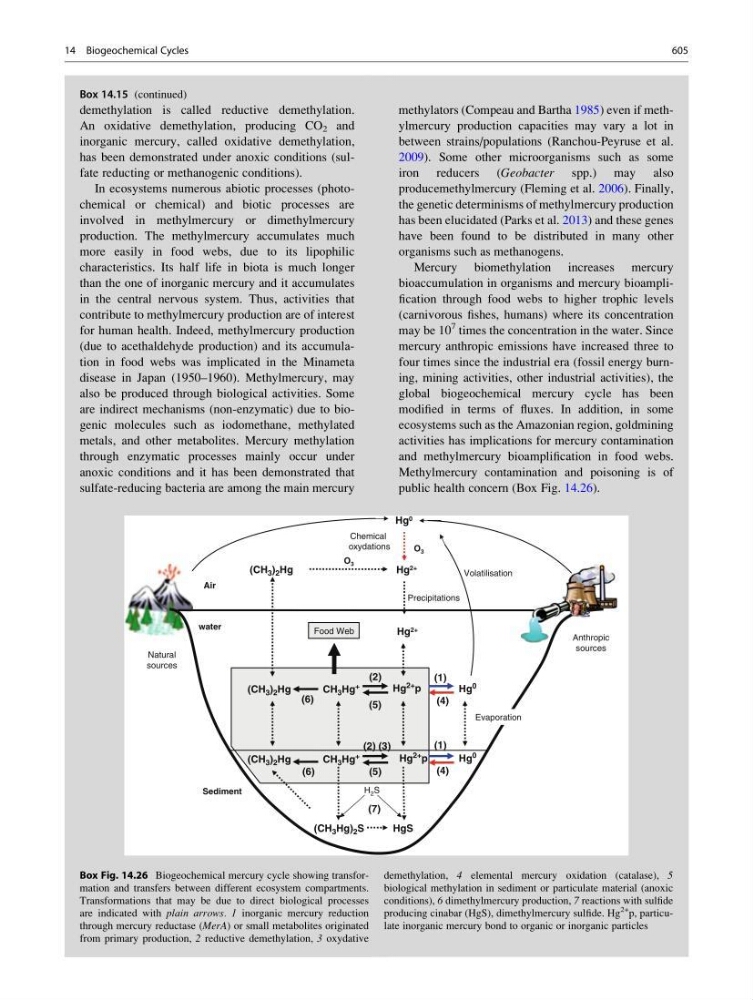
public health concern (Box Fig. 14.26).
Hg 2+
Hg 0
O 3
Precipitations
Hg 2+
Natural
sources
Hg 2+ p
Hg 2+ p
Hg 0
Hg 0
water
Air
Sediment
HgS
Volatilisation
(CH 3 ) 2 Hg
(CH 3 ) 2 Hg
(CH 3 Hg) 2 S
CH 3 Hg +
CH 3 Hg +
(CH 3 ) 2 Hg
O 3
Chemical
oxydations
(1)
(1)
(2)
(2) (3)
(4)
(4)
(5)
(5)
(6)
(6)
Food Web
H 2 S
(7)
Evaporation
Anthropic
sources
Box Fig. 14.26 Biogeochemical mercury cycle showing transformation and transfers between different ecosystem compartments.
Transformations that may be due to direct biological processes
are indicated with plain arrows. 1 inorganic mercury reduction
through mercury reductase (MerA) or small metabolites originated
from primary production, 2 reductive demethylation, 3 oxydative
demethylation, 4 elemental mercury oxidation (catalase), 5
biological methylation in sediment or particulate material (anoxic
conditions), 6 dimethylmercury production, 7 reactions with sulfide
producing cinabar (HgS), dimethylmercury sulfide. Hg
2+ p, particulate inorganic mercury bond to organic or inorganic particles
14 Biogeochemical Cycles
605