

the analysis of the gene encoding rRNA 16S are possible for
Chromatiaceae and green sulfur bacteria.
Phototrophic Purple Bacteria
Phototrophic purple (or red) bacteria are distributed among
Proteobacteria: three families of sulfur bacteria within the
Gammaproteobacteria (Chromatiaceae, Ectothiorhodospiraceae, Halorhodospiraceae), and a set of physiologically
close species (phototrophic purple nonsulfur bacteria) within
the alpha- (Rhodospirillum, Rhodobacter, etc.) and beta(Rhodoferax, Rubrivivax, etc.) proteobacteria. In these
phototrophic microorganisms, reaction centers are located
in cytoplasmic invaginations forming cellular vesicles,
plates, or tubules (cf. Sect. 3.3.4) that contain photosynthetic
pigments: carotenoids and bacteriochlorophylls a or b
(Overmann and Garcia-Pichel 2006).
The family Chromatiaceae (Table 14.9) comprises
photolithotrophic microorganisms that use reduced sulfur
compounds as electron donors under anoxic conditions.
They accumulate elemental sulfur as intracellular globules
(Fig. 14.40). In these microorganisms, CO 2 fixation is
achieved through the reductive cycle of pentoses-phosphates
(Calvin-Benson Cycle). Two major physiological groups
can be differentiated among Chromatiaceae. The first
group comprises strict anaerobic microorganisms and obligatory photoautotrophs (Chromatium okenii, Thiospirillum
jenense, and Thiococcus pfennigii). These bacteria photooxidize sulfide or sulfur and can only photo-assimilate few
simple organic compounds (acetate, pyruvate) in the presence of CO 2 and sulfide. They are unable to grow on thiosulfate and dihydrogen; they also do not grow under
photoheterotrophic or chemotrophic conditions as well.
The second group includes species which are more versatile,
capable to photo-assimilate many organic compounds in the
presence (mixotrophy) or in the absence of reduced sulfur
compounds. These microorganisms are less sensitive to
dioxygen can be grown in chemolithotrophic or in chemoorganotrophic conditions, in the presence of low dioxygen
tensions. The genera Thiocapsa, Amoebobacter, and
Allochromatium are the main representatives of this group.
The families Ectothiorhodospiraceae and Halorhodospiraceae (Table 14.9) include anaerobic photolithoautotrophic microorganisms, and form extracellular sulfur
globules during the oxidation of reduced sulfur compounds
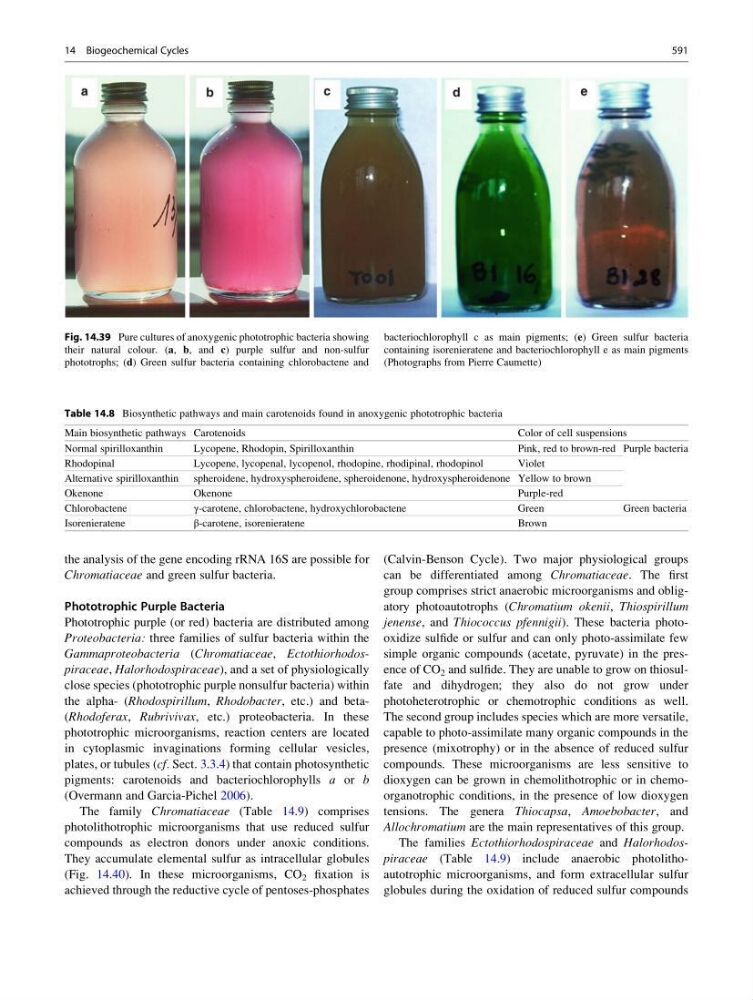
Fig. 14.39 Pure cultures of anoxygenic phototrophic bacteria showing
their natural colour. (a, b, and c) purple sulfur and non-sulfur
phototrophs; (d) Green sulfur bacteria containing chlorobactene and
bacteriochlorophyll c as main pigments; (e) Green sulfur bacteria
containing isorenieratene and bacteriochlorophyll e as main pigments
(Photographs from Pierre Caumette)
Table 14.8 Biosynthetic pathways and main carotenoids found in anoxygenic phototrophic bacteria
Main biosynthetic pathways Carotenoids
Color of cell suspensions
Normal spirilloxanthin
Lycopene, Rhodopin, Spirilloxanthin
Pink, red to brown-red Purple bacteria
Rhodopinal
Lycopene, lycopenal, lycopenol, rhodopine, rhodipinal, rhodopinol
Violet
Alternative spirilloxanthin spheroidene, hydroxyspheroidene, spheroidenone, hydroxyspheroidenone Yellow to brown
Okenone
Okenone
Purple-red
Chlorobactene
γ-carotene, chlorobactene, hydroxychlorobactene
Green
Green bacteria
Isorenieratene
β-carotene, isorenieratene
Brown
14 Biogeochemical Cycles
591