

environments rich in sulfur such as marine water or salt
marshes (Jørgensen and Fenchel 1974). One of the main
groups of microorganisms involved in this process is
represented by sulfate-reducing bacteria (SRB), but in addition few Archaea are also involved in this activity. The
general term of sulfate-reducers will be used hereafter in
this chapter.
Fermentation and anaerobic respiration processes (denitrification, sulfate-reduction and methanogenesis), which are
essential in the mineralization of organic matter, produce
large amounts of CO 2 as well as reduced inorganic
compounds which can be either trapped in anoxic zones
(FeS, FeS 2 ), recycled (H 2 , CH 4 ), or released in surface
waters and atmosphere (CH 4 , N 2 , H 2 S). Among these
metabolisms, the dissimilatory sulfate reduction is largely
favored in sulfate-rich marine environments where some
authors consider that 50 % of the organic matter is
mineralized this way (Jørgensen 1977). In some eutrophic
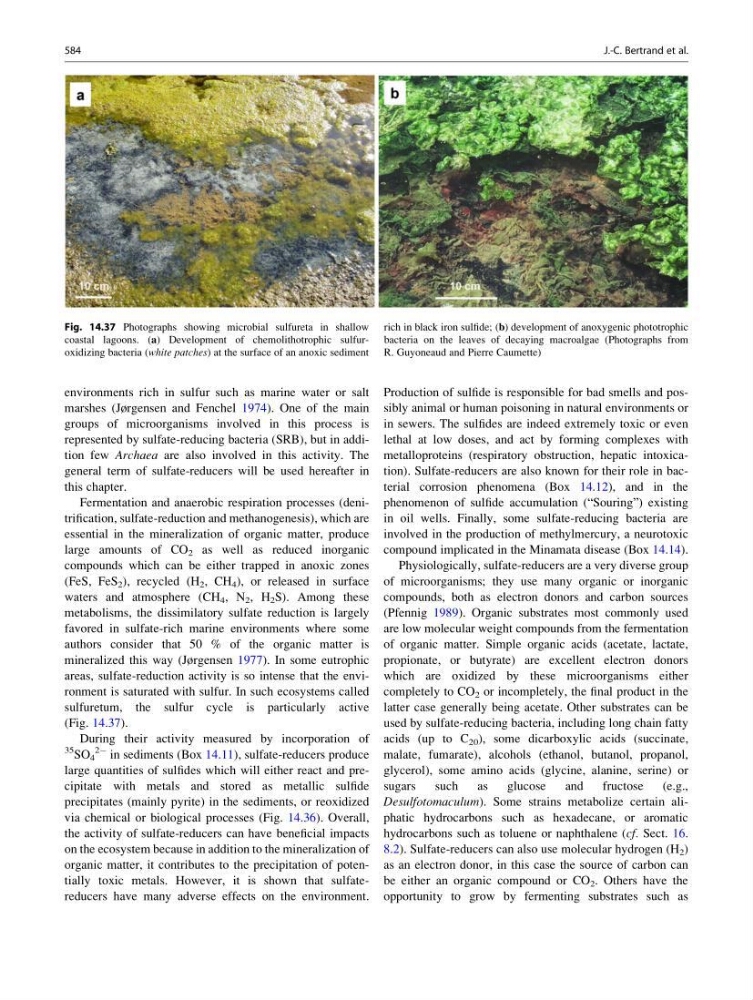
areas, sulfate-reduction activity is so intense that the environment is saturated with sulfur. In such ecosystems called
sulfuretum, the sulfur cycle is particularly active
(Fig. 14.37).
During their activity measured by incorporation of
35 SO 4
2À in sediments (Box 14.11), sulfate-reducers produce
large quantities of sulfides which will either react and precipitate with metals and stored as metallic sulfide
precipitates (mainly pyrite) in the sediments, or reoxidized
via chemical or biological processes (Fig. 14.36). Overall,
the activity of sulfate-reducers can have beneficial impacts
on the ecosystem because in addition to the mineralization of
organic matter, it contributes to the precipitation of potentially toxic metals. However, it is shown that sulfatereducers have many adverse effects on the environment.
Production of sulfide is responsible for bad smells and possibly animal or human poisoning in natural environments or
in sewers. The sulfides are indeed extremely toxic or even
lethal at low doses, and act by forming complexes with
metalloproteins (respiratory obstruction, hepatic intoxication). Sulfate-reducers are also known for their role in bacterial corrosion phenomena (Box 14.12), and in the
phenomenon of sulfide accumulation (“Souring”) existing
in oil wells. Finally, some sulfate-reducing bacteria are
involved in the production of methylmercury, a neurotoxic
compound implicated in the Minamata disease (Box 14.14).
Physiologically, sulfate-reducers are a very diverse group
of microorganisms; they use many organic or inorganic
compounds, both as electron donors and carbon sources
(Pfennig 1989). Organic substrates most commonly used
are low molecular weight compounds from the fermentation
of organic matter. Simple organic acids (acetate, lactate,
propionate, or butyrate) are excellent electron donors
which are oxidized by these microorganisms either
completely to CO 2 or incompletely, the final product in the
latter case generally being acetate. Other substrates can be
used by sulfate-reducing bacteria, including long chain fatty
acids (up to C 20 ), some dicarboxylic acids (succinate,
malate, fumarate), alcohols (ethanol, butanol, propanol,
glycerol), some amino acids (glycine, alanine, serine) or
sugars
such
as
glucose
and
fructose
(e.g.,
Desulfotomaculum). Some strains metabolize certain aliphatic hydrocarbons such as hexadecane, or aromatic
hydrocarbons such as toluene or naphthalene (cf. Sect. 16.
8.2). Sulfate-reducers can also use molecular hydrogen (H 2 )
as an electron donor, in this case the source of carbon can
be either an organic compound or CO 2 . Others have the
opportunity to grow by fermenting substrates such as
Fig. 14.37 Photographs showing microbial sulfureta in shallow
coastal lagoons. (a) Development of chemolithotrophic sulfuroxidizing bacteria (white patches) at the surface of an anoxic sediment
rich in black iron sulfide; (b) development of anoxygenic phototrophic
bacteria on the leaves of decaying macroalgae (Photographs from
R. Guyoneaud and Pierre Caumette)
584
J.-C. Bertrand et al.