

compounds (dimethyl sulfide or DMS, carbon oxysulfide or
COS) found in the atmosphere (Lomans et al. 2002).
Sulfides and polysulfides (S X
2À ) may react with
methylated groups or long-chain aliphatic or aromatic organic
compounds, to produce organic sulfur compounds during
biotic and abiotic reactions. Biodegradation of amino acids
and dimethylsulfoniopropionate (DMSP) contributes to the
formation of other organic sulfur compounds such as
methanethiol (MSH: CH 3 SH), dimethyl sulfide (DMS:
[CH 3 ] 2 S), dimethyl disulfide (DMDS: [CH 3 ] 2 S 2 ), or 3mercaptopropionate (3-MPA: HSCH 2 CH 2 COOH). These
volatile organic sulfur compounds exhibit small molecular
weight and can be used as electron donors in anaerobic
conditions. Some anoxygenic phototrophic bacteria can use
the DMS as electron donor when fixing CO 2 , and the produced dimethyl sulfoxide (DMSO) can be used in respiratory
processes, as electron acceptor, by phototrophic bacteria (also
called photosynthetic bacteria) in the absence of light energy
and by facultative aerobic microorganisms. Methanogens are
also able to consume DMS and MSH. Under aerobic
conditions, sulfur-oxidizing chemolithotrophic bacteria and
the micro-organisms of the genus Hyphomicrobium are also
able to achieve this degradation (Lomans et al. 2002).
Sulfur is thus subjected to many changes between its
organic and mineral forms. Degradation of sulfur organic
compounds releases simple organic compounds (formaldehyde, formate, acetate, propionate) and sulfide. Production
of sulfides through this step of the sulfur cycle represents a
small fraction (1–5 %) of sulfides produced in marine
ecosystems where dissimilatory reduction of sulfate is predominant (Jørgensen 1977), but represents the largest source
of reduced sulfur compounds in sulfate poor freshwater
environments.
14.4.2.2 Dissimilatory Sulfate Reduction
One of the main mechanisms for the production of reduced
mineral sulfur compounds is often grouped under the general
term of dissimilatory sulfate-reduction or dissimilatory
reduction of sulfates, a specific metabolism of bacteria and
Archaea. This term, widely used, is not appropriate because
it includes organisms that use sulfate but also other oxidized
sulfur compounds (thiosulfate, sulfite, elemental sulfur) as
terminal electron acceptors. This anaerobic respiration
metabolism, commonly called “sulfate respiration” (cf.
Sect. 3.3.2, Figs. 3.22, 3.23; Table 3.9), largely contributes
to the degradation of organic compounds in salted anoxic
Fe
2+
FeS
FeS 2
PHOTOSYNTHESIS
A S S I M
I L A T I O N
ASSIMILATIO N
DEGR ADATION
D
E G
R A D A T I O N
ASS IMIL AT IO N
A
S S I M
I L A T IO N
S
0
S
0
S
0
SO 4
2organic
S
S 2 O 3
2SH 2
H 2 S
H 2 S
S 2 O 3
2SO 3
2SO 4
2SO 3
2DIFFUSION
(S) n
2SULFATE
REDUCTION
OXIC
ANOXIC
1
1
1
2
3
4
4
4 4
4
Degradation
Oxidation
Reduction
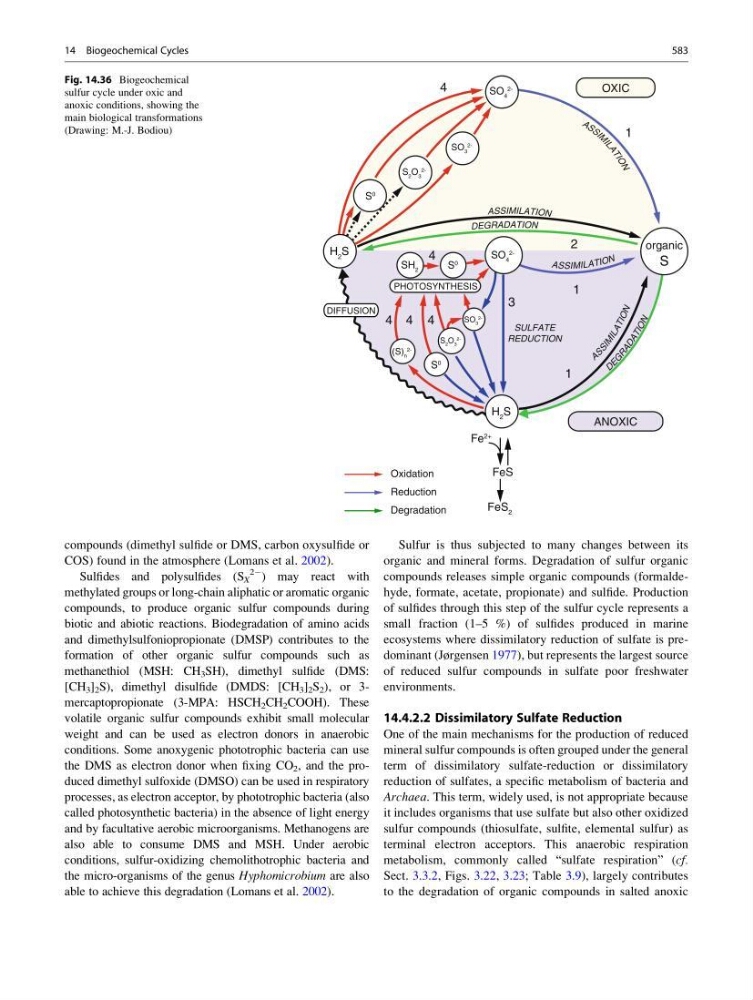
Fig. 14.36 Biogeochemical
sulfur cycle under oxic and
anoxic conditions, showing the
main biological transformations
(Drawing: M.-J. Bodiou)
14 Biogeochemical Cycles
583