

organisms results in the release of inorganic sulfur, mainly in
the form of sulfide, a phenomenon called sulfhydrization
(Fig. 14.36, pathway 2). Another process contributing to
the production of reduced sulfur is grouped under the terms
of dissimilatory sulfate-reduction or sulfate respiration
(Fig. 14.36, pathway 3). During this process, all the oxidized
forms of sulfur such as sulfate (SO 4
2À
), thiosulfate (S 2 O 3
2À
),
sulfite (SO 3
2À
), or elemental sulfur (S
0 ) may be used as
electron acceptors by prokaryotes (bacteria and Archaea)
and reduced to sulfide (S
2À
). This activity most often occurs
in reduced and anoxic environments. The sulfur oxidation
processes (Fig. 14.36, pathway 4) will use reduced or partially oxidized sulfur compounds as electron donors. Sulfur
oxidation
involves
photolithotrophic
anoxygenic
metabolisms in anoxic conditions, and chemolithotrophic
metabolisms in oxic and anoxic conditions.
Although sulfate, sulfur, and sulfide are the three major
reservoirs of sulfur, intermediate compounds such as thiosulfate (S 2 O 3
2À
), have a very important role in the functioning of the biogeochemical cycle of sulfur. The thiosufate
used as electron donor or acceptor generates, in the sulfur
cycle, a phenomenon called the “thiosulfate shunt”
(Jørgensen 1990). This compound can actually either be
oxidized to sulfate (SO 4
2À
), dismutated to sulfate (SO 4
2À
)
and sulfide (HS
À ) (disproportionation of thiosulfate), or be
reduced to sulfide.
14.4.2 The Production of Sulfide
14.4.2.1 Organic Sulfur: Biosynthesis
and Degradation
The organic matter is a reservoir of sulfur and thus a form of
immobilization of this element. Organic forms of sulfur can
originate either from the assimilatory reduction by plants or
micro-organisms, or from the direct assimilation of sulfide
leading to the incorporation of sulfur in cellular material
(amino acid biosynthesis, osmoregulators, coenzymes).
Under the action of animal decomposers and of aerobic or
anaerobic microorganisms, organic sulfur in death
organisms is mineralized and released into the environment
as inorganic sulfur, mainly in the form of sulfide. Sulfur can
also be transformed in many ways in oxic or anoxic
conditions, resulting in the production of volatile organic
STRATOSPHERE
TROPOSPHERE
Altitude of
10 to 15 Km
Solar radiation
reflexion
Acid
rains
Alteration
erosion
Acid
rains
COS
COS
SO 2
SO 2
SO 2
DMS
DMS
SO 4
2SO 4
2SO 4
2SO 4
2H 2 SO 4
Dissolved
organic
sulfur
Plankton
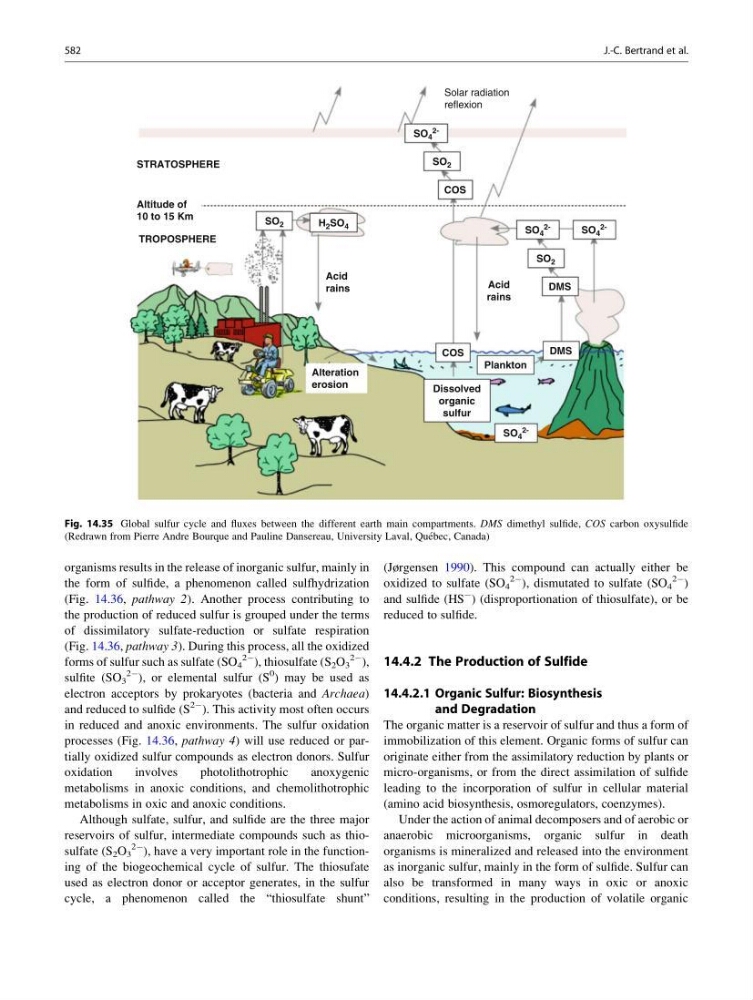
Fig. 14.35 Global sulfur cycle and fluxes between the different earth main compartments. DMS dimethyl sulfide, COS carbon oxysulfide
(Redrawn from Pierre Andre Bourque and Pauline Dansereau, University Laval, Que ´bec, Canada)
582
J.-C. Bertrand et al.