

sediment surface may also cause a decrease in denitrification
when the concentrations of oxygen released are too
important.
Sediment bioturbation processes generated by benthic
macrofauna (Box 14.3) also affects the nitrogen cycling in
marine sediments. Irrigation generated by the activity of
burrowing macroorganisms enables the transport of nitrate
and oxygen from the water column to the depths of the
sediment. This input causes two direct and antagonistic
effects on denitrification: a positive effect due to an increase
of the amount of nitrate and/or a negative effect due to
oxygen inhibition (Gilbert et al. 1995). However, the presence of dissolved oxygen and the release of ammonium
through excretions of these animals promote nitrification in
areas near burrows, and thus indirectly stimulate denitrification in sediments. Another aspect concerns the production of
fecal pellets by suspension and deposit feeders. These fecal
pellets are sites of intense microbial activity whose high
oxygen demand causes the formation of anoxic microniches.
These latter facilitates contact and exchanges between
aerobic
(nitrifying) and anaerobic (denitrifying)
microorganisms.
14.4 Sulfur Cycle
14.4.1 Introduction
Similar to carbon, nitrogen, oxygen, phosphorus and selenium, sulfur, atomic number 16, is classified among the
“non-metallic” elements. Sulfur is present in its natural
state as four stable isotopes (
32 S,
33 S,
34 S and
36 S).
32
S
(95 % of total) and
34 S (4 %) are the most abundant while
35 S is a synthetic radioactive isotope. Sulfur exists in many
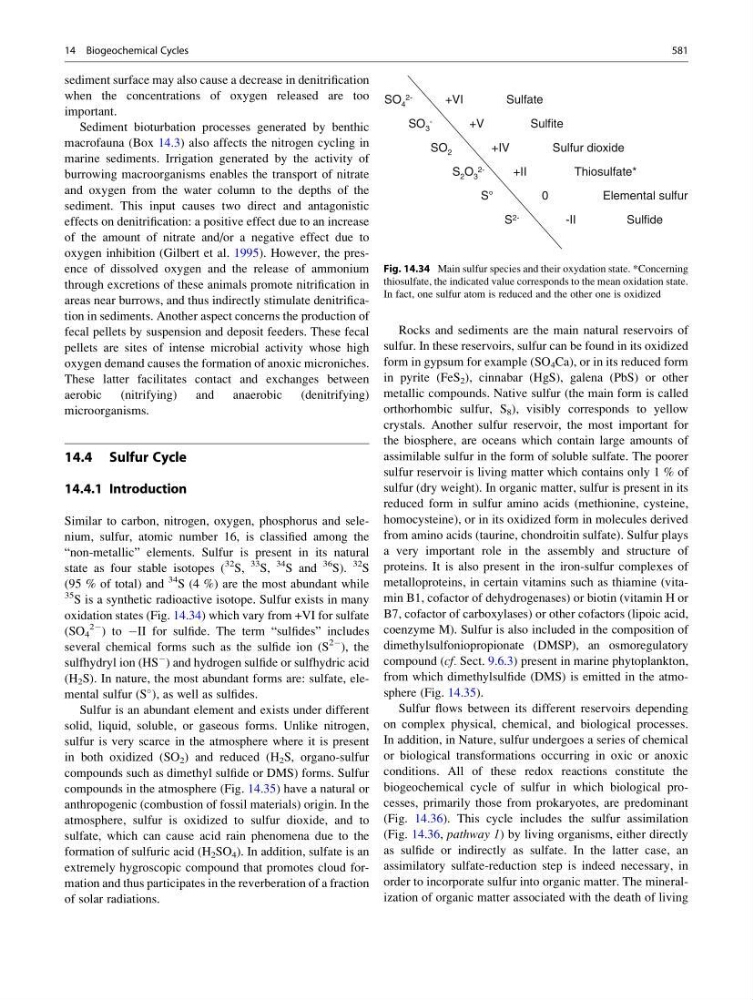
oxidation states (Fig. 14.34) which vary from +VI for sulfate
(SO 4
2À ) to ÀII for sulfide. The term “sulfides” includes
several chemical forms such as the sulfide ion (S
2À ), the
sulfhydryl ion (HS
À ) and hydrogen sulfide or sulfhydric acid
(H 2 S). In nature, the most abundant forms are: sulfate, elemental sulfur (S
), as well as sulfides.
Sulfur is an abundant element and exists under different
solid, liquid, soluble, or gaseous forms. Unlike nitrogen,
sulfur is very scarce in the atmosphere where it is present
in both oxidized (SO 2 ) and reduced (H 2 S, organo-sulfur
compounds such as dimethyl sulfide or DMS) forms. Sulfur
compounds in the atmosphere (Fig. 14.35) have a natural or
anthropogenic (combustion of fossil materials) origin. In the
atmosphere, sulfur is oxidized to sulfur dioxide, and to
sulfate, which can cause acid rain phenomena due to the
formation of sulfuric acid (H 2 SO 4 ). In addition, sulfate is an
extremely hygroscopic compound that promotes cloud formation and thus participates in the reverberation of a fraction
of solar radiations.
Rocks and sediments are the main natural reservoirs of
sulfur. In these reservoirs, sulfur can be found in its oxidized
form in gypsum for example (SO 4 Ca), or in its reduced form
in pyrite (FeS 2 ), cinnabar (HgS), galena (PbS) or other
metallic compounds. Native sulfur (the main form is called
orthorhombic sulfur, S 8 ), visibly corresponds to yellow
crystals. Another sulfur reservoir, the most important for
the biosphere, are oceans which contain large amounts of
assimilable sulfur in the form of soluble sulfate. The poorer
sulfur reservoir is living matter which contains only 1 % of
sulfur (dry weight). In organic matter, sulfur is present in its
reduced form in sulfur amino acids (methionine, cysteine,
homocysteine), or in its oxidized form in molecules derived
from amino acids (taurine, chondroitin sulfate). Sulfur plays
a very important role in the assembly and structure of
proteins. It is also present in the iron-sulfur complexes of
metalloproteins, in certain vitamins such as thiamine (vitamin B1, cofactor of dehydrogenases) or biotin (vitamin H or
B7, cofactor of carboxylases) or other cofactors (lipoic acid,
coenzyme M). Sulfur is also included in the composition of
dimethylsulfoniopropionate (DMSP), an osmoregulatory
compound (cf. Sect. 9.6.3) present in marine phytoplankton,
from which dimethylsulfide (DMS) is emitted in the atmosphere (Fig. 14.35).
Sulfur flows between its different reservoirs depending
on complex physical, chemical, and biological processes.
In addition, in Nature, sulfur undergoes a series of chemical
or biological transformations occurring in oxic or anoxic
conditions. All of these redox reactions constitute the
biogeochemical cycle of sulfur in which biological processes, primarily those from prokaryotes, are predominant
(Fig. 14.36). This cycle includes the sulfur assimilation
(Fig. 14.36, pathway 1) by living organisms, either directly
as sulfide or indirectly as sulfate. In the latter case, an
assimilatory sulfate-reduction step is indeed necessary, in
order to incorporate sulfur into organic matter. The mineralization of organic matter associated with the death of living
SO 4
2+VI
Sulfate
SO 3
-
+V
Sulfite
SO 2
+IV
Sulfur dioxide
S 2 O 3
2+II
Thiosulfate*
S°
0
Elemental sulfur
S 2-II
Sulfide
Fig. 14.34 Main sulfur species and their oxydation state. *Concerning
thiosulfate, the indicated value corresponds to the mean oxidation state.
In fact, one sulfur atom is reduced and the other one is oxidized
14 Biogeochemical Cycles
581